Vertical Integration & The Trust Gap: Why Generic AI Can’t Protect Your Business

August 7, 2026 | EqualDocs Industry Analysis
As artificial intelligence matures, the legal technology sector is experiencing two simultaneous, seemingly contradictory shifts: frontier AI labs are moving rapidly to build specialized legal capabilities, while practicing attorneys and corporate legal departments are raising alarms over the lack of verification, accuracy, and accountability in off-the-shelf AI models.
For small and medium-sized enterprises (SMEs) trying to navigate this landscape, the signal is clear: AI is essential for speed, but generic public LLMs are a massive liability when it comes to business-critical agreements.
1. Anthropic Appoints Robert Mahari as ‘Head of Claude for Legal’
In a major signal that frontier AI labs are aggressively verticalizing their offerings, Anthropic has appointed Robert Mahari—a fellow at Stanford’s CodeX and MIT doctoral graduate—as its first official Head of Claude for Legal.
Mahari’s mandate is to help Anthropic scale legal-specific AI applications, reflecting the industry’s realization that general-purpose chatbots cannot safely navigate the nuances of complex business law without domain-specific customization.
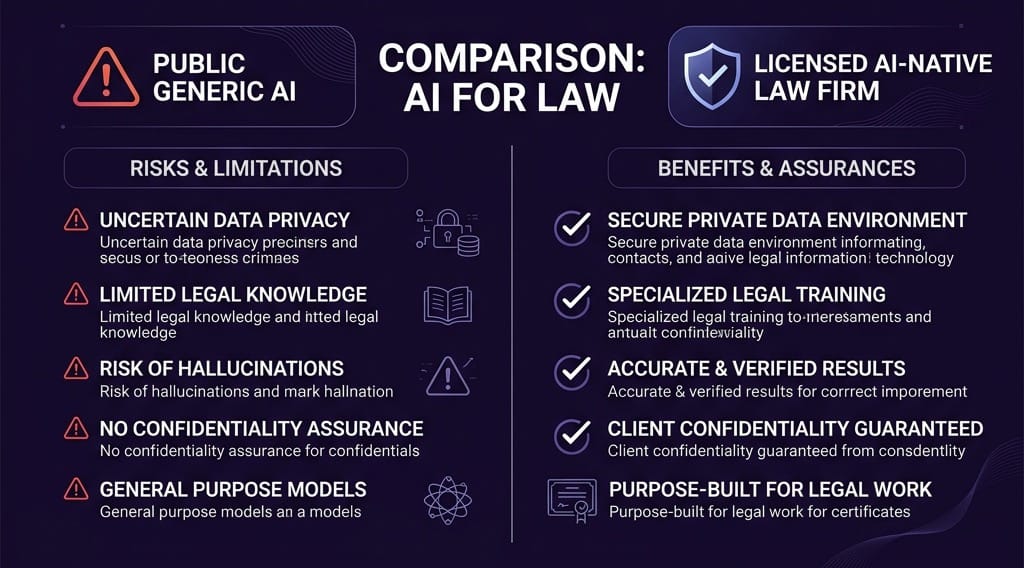
The EqualDocs Take: While we celebrate frontier labs prioritizing legal verticalization—our own tools leverage Claude’s advanced reasoning capabilities—an AI model alone cannot assume professional liability. Generic terms of service for public models always include a disclaimer: “This tool does not provide legal advice.” If an AI hallucination introduces a loophole in your contract, you bear 100% of the cost. EqualDocs bridges this gap: we are a licensed law firm operating with professional liability insurance. We use AI to accelerate drafting, but a human lawyer signs off on every review.
2. UK Ministry of Justice Launches “Legal Services AI Growth Lab”
In regulatory news, the UK government’s Ministry of Justice has officially invited legal and tech firms to apply for its new Legal Services AI Growth Lab. This initiative acts as a regulatory sandbox, allowing legal AI innovators to test new tools in a controlled environment to ensure security, compliance, and consumer protection.
The launch of government-backed sandboxes globally highlights a growing consensus: legal AI requires guardrails.
The EqualDocs Take: As regulators step in to establish safety frameworks, SMEs must audit their own AI usage. Sending confidential corporate agreements into unshielded public AI interfaces risks exposing your intellectual property. EqualDocs provides a secure, private sandbox environment for every client, ensuring your data is isolated and never leaked to public training sets.
3. The Legal AI Trust Gap: Why 99% of Lawyers Demand Human Verification
Recent market research from BARBRI and a survey by Supio have exposed a widening “trust gap” in legal AI. While over 78% of law firms have experimented with AI tools to save time, 99% of attorneys refuse to use unverified AI-generated content in their work.
Firms are deploying AI tools rapidly to draft summaries, but the lack of an audit trail and the risk of hallucinations prevent them from relying on raw AI output.
The EqualDocs Take: Lawyers refuse to trust raw AI because their licenses are on the line. Small business owners should operate under the same standard. Relying on a generic chatbot for contract review without a verification layer is a high-risk gamble. EqualDocs solves the trust gap by combining our proprietary legal AI with supervised review by licensed attorneys, offering a secure audit trail and flat-rate, predictable pricing:
- Starter (Free, 200 EC): Rapid AI intake to assess if you need a lawyer.
- Pro ($19.99/mo, 1,000 EC): High-speed document checks in a private sandbox.
- Growth ($79/mo, 3,500 EC): Scaled wind-risk protection for growing startups.
- Enterprise ($299/mo, 12,000 EC): Flat-rate, dedicated lawyer supervision.
Stop risking your company’s compliance on disclaimer-heavy public models. Get speed, security, and real accountability with EqualDocs.
EqualDocs — Your Digital General Counsel | equaldocs.com