Legal AI Is Moving Upstream: The New Battle Is Who Controls the First Request

Week 42, week-to-date (October 12–18, 2026) | EqualDocs Weekly Intelligence
This week’s legal-technology launches did not focus on writing a memo. They targeted the moments before work begins: when a business sends a request, when a consumer tries to understand whether a problem is legal, and when an in-house team decides what outside counsel should cost.
AI is moving from an assistant inside the workflow to the control layer around it.
The Executive Scan
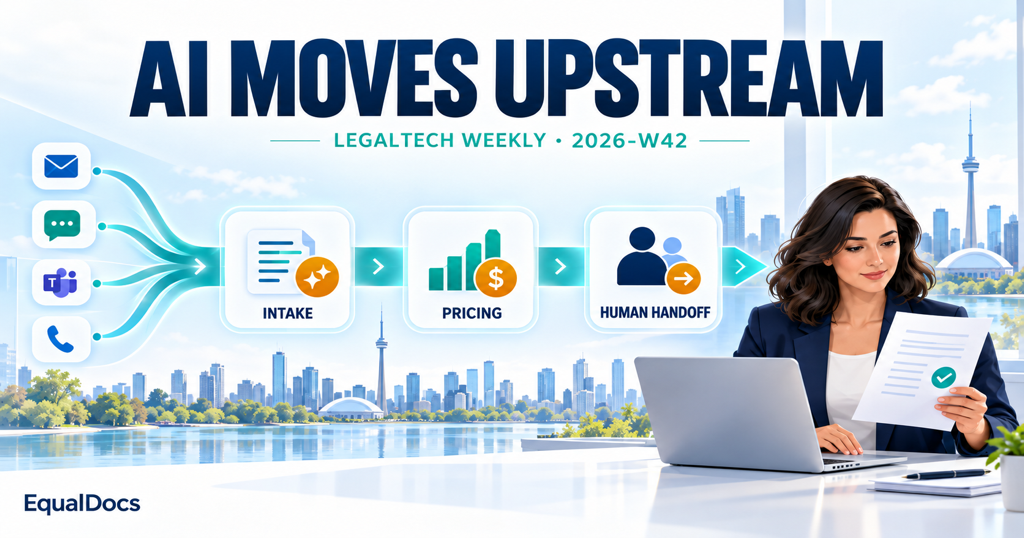
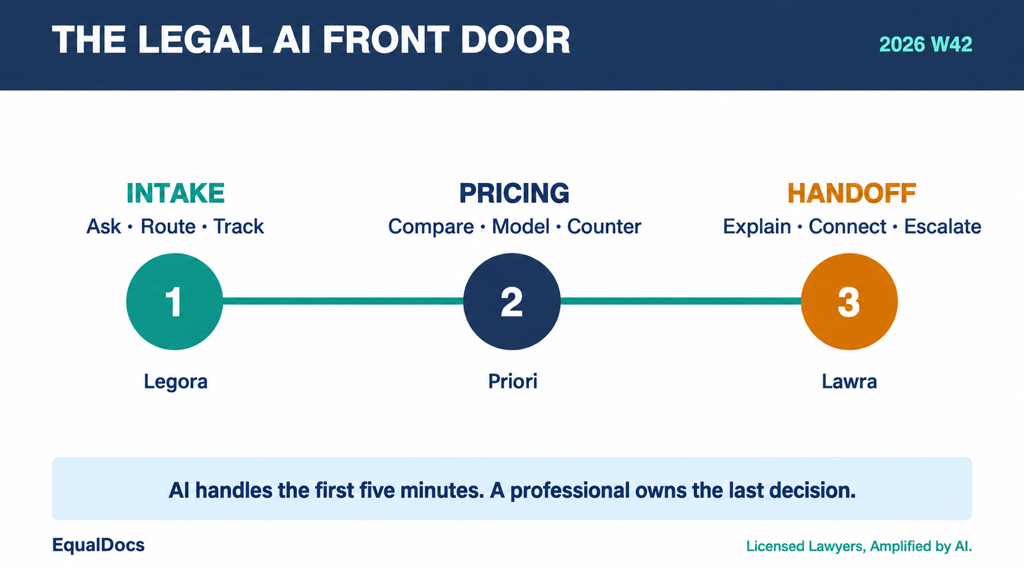
- Legora launched Intake, an “agentic legal front door.” Requests can arrive through email, Teams, Slack or MCP, after which an agent asks follow-up questions, routes the work, applies approved playbooks and returns the result after lawyer review.
- Priori launched AI-native Rate Review. In-house teams can compare proposed outside-counsel increases across practice area, seniority and jurisdiction, model financial impact, and generate counterproposals at scale.
- Slater and Gordon launched Lawra, a free AI gateway to legal help. Its pilot drew more than 40,000 visitors; the firm says the system is supervised by lawyers, stores data onshore and does not train on user queries.
1. Intake Becomes the Operating System
Legora’s new Intake product is designed to capture requests where employees already work. A question can arrive through email, Teams, Slack or an MCP connection. The system reads it, asks follow-up questions, applies custom routing rules and converts it into tracked work rather than another message buried in an inbox.
The agent can complete routine requests using approved playbooks and skills. Complex work is escalated, and a lawyer reviews and approves what goes back to the requester. Legora describes this as an “agentic legal front door.”
For years, legal AI competed at the document layer: summarize this, compare these clauses, draft that. Intake competes one level higher by shaping the relationship between the business and the legal team.
For SMEs, the first five minutes of a legal problem determine much of the cost that follows. Collecting the right facts, identifying urgency and showing what is missing lets a professional focus on the decision that requires judgment.
The risk is equally clear. When intake becomes automated, a weak routing rule can hide a serious issue as efficiently as a strong rule can accelerate it. The workflow needs visible escalation points and a named professional who remains accountable.
2. AI Turns Outside-Counsel Pricing Into Data
Priori’s Rate Review targets a familiar ritual: law firms submit new rates, legal departments receive spreadsheets and emails, and each request is negotiated largely in isolation.
The new tool analyzes proposed percentage increases and their financial effect using recent billing data. It compares rates across a panel by practice area, seniority and jurisdiction, applies internal pricing policies, and can generate counterproposals across a large volume of requests. Priori says the system also preserves a defensible record of the analysis and negotiation.
This is the BigLaw efficiency paradox moving into the open. Firms increasingly use AI to perform preliminary work faster, yet the commercial model often remains an hourly rate multiplied by time. Now clients are gaining AI tools of their own—not just to review the work, but to challenge the price.
For smaller businesses, the useful principle is simpler: the price of a legal outcome should be understandable before the meter starts. If automation reduces the cost of intake, research or first drafts, the benefit should reach the client through a flat quote or a clearly defined scope—not disappear into an opaque hourly bill.
3. Free AI Triage Becomes a Law-Firm Front Door
Australian firm Slater and Gordon launched Lawra as a free, plain-language first stop for people who are unsure whether they have a legal problem or where to get help.
The launch was paired with a survey of 1,085 Australians. Forty-two per cent said they did not know where to turn for legal support, 60% said cost concerns could deter them from speaking to a lawyer, and 68% said they would use a free AI tool that explains whether they may have a legal problem and what to do next. The firm says more than 40,000 people visited during the pilot.
Slater and Gordon says Lawra was developed and supervised by its lawyers, keeps judgment with people, stores data in Australia and does not train on user queries. It can connect a user to the firm or another appropriate pathway.
That is a different model from a generic chatbot with a blanket disclaimer. The software does not pretend to be the final professional. It lowers the anxiety and information cost of taking the first step, then creates a deliberate handoff.
The EqualDocs Advantage
These three launches point toward the same market: intake, pricing and triage are becoming AI-native, but trust still depends on who owns the result.
EqualDocs is built around that combination:
- Multilingual AI intake: clients can explain a problem in any language and receive structured next steps.
- Licensed lawyer review: matters requiring legal judgment are reviewed through EqualDocs Avocats inc., registered with the Barreau du Québec and operating across Canada.
- Professional accountability: the professional-service layer carries malpractice responsibility rather than pushing every risk back to the user through a software disclaimer.
- Transparent pricing: Starter is 19.99 for 1,000 EC; Growth is 299 for 12,000 EC. Custom matters receive a flat quote before work begins.
The next legal-tech contest will not be won by the system that writes the longest answer. It will be won by the system that gets the request to the right professional, at a price the client understands, with a final result someone is prepared to stand behind.
Licensed Lawyers, Amplified by AI.