Legal AI Has Left the Pilot: Now the Question Is Who Controls the Work

Week 41, week-to-date (October 5-11, 2026) | EqualDocs Weekly Intelligence
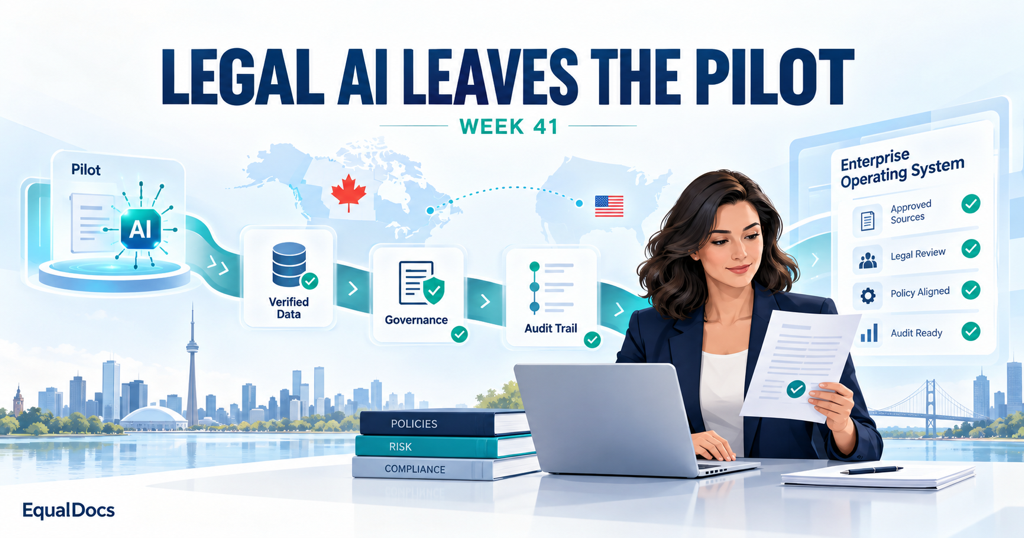
Legal AI crossed an important line this week. It is no longer being treated only as a drafting experiment. A major Canadian legal department made AI the expected first pass, investors backed the data layer beneath legal systems, and California enacted statutory duties that keep professional judgment and responsibility with people.
The Executive Scan
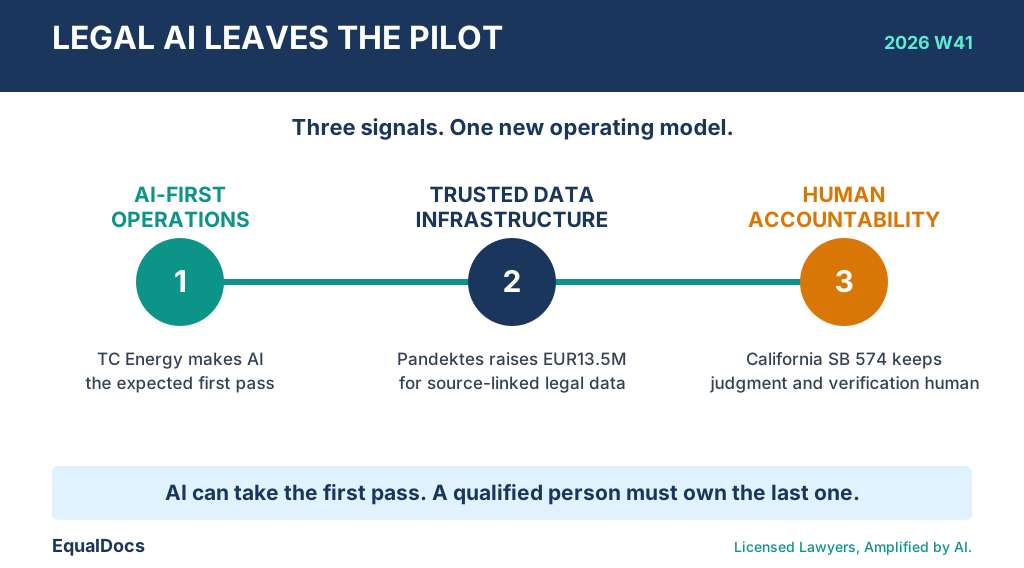
- Enterprise adoption is becoming operational policy. TC Energy deployed Harvey across its legal team after a pilot built around a “Harvey-First” directive.
- Trustworthy legal data is becoming infrastructure. Pandektes raised EUR13.5 million to expand a continuously updated, source-linked legal information layer for AI products and workflows.
- Human accountability is becoming law. California’s SB 574 will require lawyers to protect confidential information, verify AI output and citations, disclose covered AI use to courts, and retain control of legal judgment from January 1, 2027.
1. “AI-First” Moves From Experiment to Operating Model
On October 5, Harvey announced that TC Energy had deployed its platform across the company’s legal team in Canada, the United States, and Mexico. During the pilot, the department used a “Harvey-First” directive: lawyers were encouraged to make the system their first pass before moving deeper into litigation, regulatory work, transactions, commercial agreements, and compliance.
The important signal is not the vendor name. It is the change in default behavior. When an in-house department makes AI the starting point, adoption stops being a collection of optional experiments and becomes part of how work enters the team.
That shift will put pressure on outside firms. If a client can summarize, research, compare, and prepare a first draft internally, it will be less willing to pay premium hourly rates for the same preliminary work. The old efficiency paradox becomes harder to defend: using AI to reduce drafting time while charging the client as though nothing changed.
For smaller businesses, the same principle should produce a better outcome, not simply a cheaper chatbot. AI can remove repetitive work, but the savings should reach the client through transparent pricing and faster delivery. The remaining legal judgment should be clearly identified and professionally reviewed.
2. The Next Legal-AI Battle Is Under the Interface
Also on October 5, Copenhagen-based Pandektes announced a EUR13.5 million Series A led by Alstin Capital, with participation from PROfounders, Scale Capital, and existing investors. The company says more than 500 law firms, businesses, and public institutions use its platform, and roughly two-thirds of organizations that test it become customers.
Pandektes is not pitching another writing assistant. Its ambition is to build a common legal-information layer: millions of public documents collected across jurisdictions, kept current, connected to original sources, structured for machines, and opened to other products through an API.
That matters because a fluent answer is not necessarily a reliable answer. If the underlying legislation is outdated, a decision is missing, or the source cannot be traced, a better model does not repair the foundation. As more tools begin to take actions instead of merely producing text, provenance becomes even more valuable.
This also exposes the software disclaimer trap. A vendor may provide impressive research while its terms place verification, confidentiality, and downstream responsibility on the customer. Businesses should ask four practical questions: What sources were used? When were they updated? Can the answer be traced? Who checks whether the output applies to this specific matter?
3. California Turns AI Ethics Into Statutory Duties
California’s SB 574, signed and chaptered on September 30 and covered by the courts this week, gives the accountability debate sharper edges. Beginning January 1, 2027, attorneys will be barred from delegating the practice of law to generative AI. They must take reasonable steps to verify output, protect nonpublic information from unrestricted systems, disclose covered use in court submissions, and personally verify citations. Arbitrators may not hand their decision-making to AI.
Courts are drawing similar boundaries in discovery. Recent federal matters have treated AI use as something protective orders may regulate: public systems can be prohibited, confidential material can require closed environments, and prompts used in expert work may become discoverable.
The rule is becoming clear. AI can accelerate professional work, but it does not absorb professional responsibility. A user still needs a secure process, an audit trail, and a qualified person who can say, “I checked this and I stand behind it.”
The EqualDocs Advantage
EqualDocs is designed for this post-pilot market: AI speed inside an accountable professional service.
- AI-native intake and execution: multilingual intake, document preparation, risk spotting, and routing happen in one connected workflow.
- Licensed lawyer review: matters requiring legal judgment are reviewed through EqualDocs Avocats inc., registered with the Barreau du Quebec and operating across Canada.
- Professional liability coverage: unlike general software tools that disclaim legal responsibility, the professional service layer carries real malpractice accountability.
- Transparent pricing: Starter is 19.99 for 1,000 EC; Growth is 299 for 12,000 EC. Custom matters receive a flat quote before work begins.
The market’s next question is not whether AI belongs in legal work. It is whether the system has reliable information, controlled workflows, and a licensed professional who owns the result.
Licensed Lawyers, Amplified by AI.