Legal AI’s New Moat: Data, Workflow, and Someone Accountable

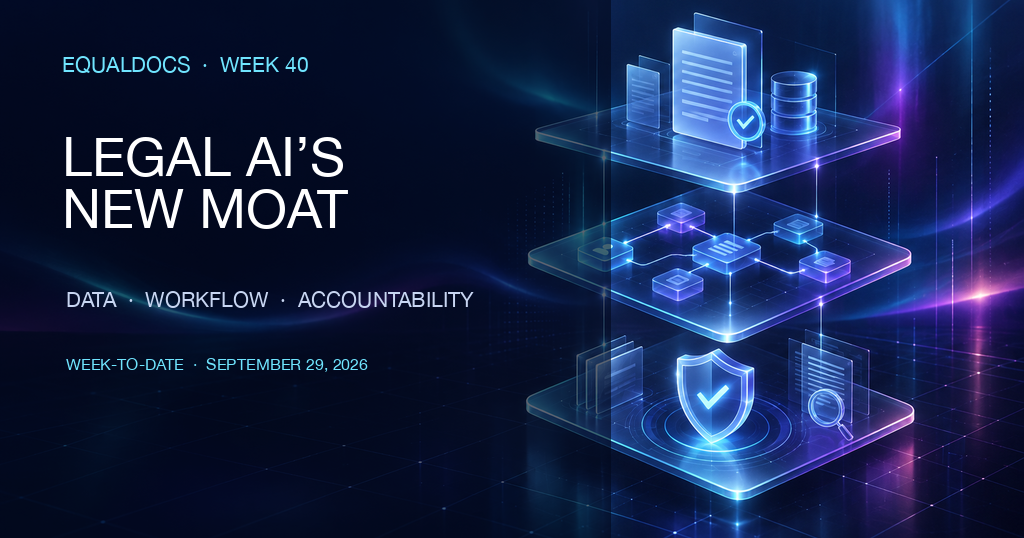
Week 40, week-to-date (September 28 – October 4, 2026) | EqualDocs Weekly Intelligence
Legal AI is moving out of the chatbot window and into the machinery that actually runs legal work. This week’s clearest signals were not bigger prompts or faster drafting demos. They were acquisitions, proprietary data alliances, workflow infrastructure—and a disciplinary reminder that someone still has to verify the result.
The Executive Scan
- Legal services and software are converging. Repario acquired UnitedLex to combine AI-enabled eDiscovery infrastructure with contracts, litigation, legal operations, IP, incident response, and managed services at enterprise scale.
- The durable moat is governed context. C.H.BECK became Noxtua’s majority shareholder in a €100M+ Series C, while Mitratech acquired BotDojo to turn systems of record into agentic “systems of action” through two-way MCP interoperability.
- Automation does not transfer accountability. A USPTO disciplinary matter involving unverified AI-generated patent citations reinforces a simple rule: the professional who submits the work remains responsible for its accuracy.
1. The Market Is Buying Complete Workflows, Not Standalone AI
On September 28, Repario announced its acquisition of UnitedLex. The combination joins Repario’s eDiscovery, managed review, and infrastructure services with UnitedLex’s contracts, litigation, legal operations, intellectual property, AI advisory, and incident-response capabilities.
That is more than consolidation. It reflects a change in what enterprise buyers want. A drafting assistant is useful, but it does not collect the right evidence, route the matter, apply internal policy, verify the output, and deliver a defensible result. Buyers are increasingly paying for the whole operating chain.
Epiq’s acquisition of breach-response platform Canopy points in the same direction. Canopy’s agentic first-level review will sit inside Epiq’s global cyber-response operation, which handles more than 1,800 incidents annually. The product is valuable because it is connected to trained people, established procedures, and an accountable service layer.
For SMEs, the lesson is direct: do not evaluate an AI tool only by the quality of a sample answer. Ask what happens before the answer, what happens after it, and who owns the outcome.
2. Proprietary Data and Governed Connections Are Becoming the Moat
Europe’s Noxtua closed a Series C of more than €100 million, with C.H.BECK becoming the majority shareholder and MANZ joining as an investor. Noxtua says it now serves more than 30,000 users and is building jurisdiction-specific workspaces on curated publisher content, including C.H.BECK’s database of more than 60 million documents.
At the same time, Mitratech acquired BotDojo to accelerate ARIES AI. Its announced architecture uses two-way Model Context Protocol connections so external agents can work with governed matter, spend, document, and historical data—while Mitratech agents can reach other approved tools. The key phrase is not “agentic AI.” It is governed access to institutional context.
8am’s MyCase connector makes the trade-off visible. It gives Claude read-only access controlled by existing MyCase permissions, but its terms also place responsibility for third-party processing, privilege, confidentiality, and use on the customer. The connection may be convenient; the risk allocation still matters.
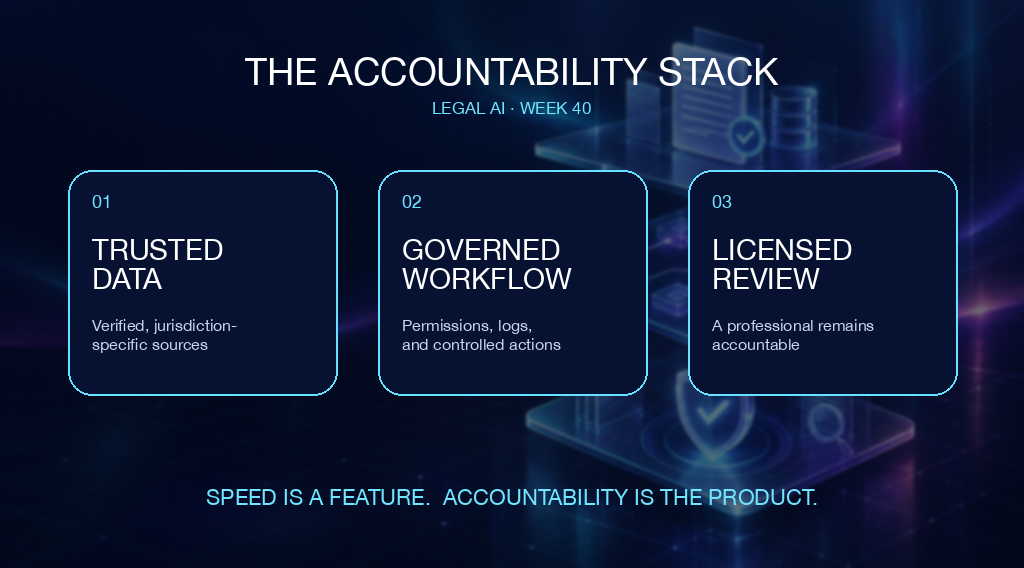
The practical question for a business is therefore not “Which model is smartest?” It is:
- Which data can the system access?
- Which actions can it take?
- Is every step traceable and reviewable?
- Who is professionally responsible if the output is wrong?
3. The Verification Duty Is Now an Enforcement Issue
The USPTO disciplinary matter involving patent attorney Brian E. Mitchell arose from AI-assisted material containing incorrect or fabricated references to a patent’s intrinsic record. The important point is not that AI was used. The problem was that the submitted material was not adequately verified.
This matches the broader direction of courts and regulators: AI can assist, but it does not replace the signer’s duty of competence, confidentiality, candour, and factual accuracy. Casepoint’s new agentic tools are being marketed around the same operational question—where “AI decides” ends and “human decides” begins.
That boundary is especially important for SMEs. A low-cost tool may generate a convincing agreement, assessment, or policy in seconds. But if the provider’s terms disclaim responsibility, the business still owns the error. Speed without accountable review is not protection; it is faster exposure.
The EqualDocs Advantage
EqualDocs is built around the layer the market is now discovering matters most: accountable execution.
- AI-native workflow: multilingual intake, document preparation, risk identification, and routing happen inside one process—not across disconnected chat windows.
- Licensed professional review: work requiring legal judgment is reviewed by licensed lawyers through EqualDocs Avocats inc., registered with the Barreau du Québec and operating across Canada.
- Professional liability coverage: unlike general software vendors, the professional service layer carries real malpractice accountability.
- Transparent pricing: Starter is 19.99/month for 1,000 EC; Growth is 299/month for 12,000 EC. Custom matters receive a clear flat quote before work begins.
The legal AI market is no longer competing on who can produce the fastest paragraph. The winners will connect trusted data to real workflows—and put an accountable professional behind the final result.
Licensed Lawyers, Amplified by AI.