When AI Becomes Infrastructure, Who Signs Off on Your Legal Liability?

Week 37 (September 7 – September 13, 2026) | EqualDocs Weekly Intelligence
For the past three years, the legaltech conversation was dominated by parlor tricks: opening a chat window, dumping in an agreement, and hoping an off-the-shelf large language model didn’t hallucinate an indemnification precedent.
Over the past week, three structural moves across Silicon Valley, Wall Street, and global regulatory bodies signaled that the prompt-and-pray era is dead. Legal technology has transitioned from standalone software tools into foundational business infrastructure:
- Google Cloud launched “Gemini Enterprise for Legal”, embedding autonomous AI workflows directly into BigLaw’s core document management systems via the Model Context Protocol (MCP).
- Stripe acquired Clerky, turning corporate governance and early-stage startup legal formation into code integrated directly into payment and banking rails.
- UK High Court Directive HC142 took full effect, drawing a strict judicial line: AI may assist in drafting, but 100% of professional legal liability remains strictly with licensed human practitioners.
For growing businesses and startups across Canada and North America, this marks both an unprecedented operational opportunity and a critical warning.
1. From Chatbots to Operating Systems: Big Tech’s Land Grab
When Google Cloud connects Gemini directly to iManage, NetDocuments, Everlaw, and Harvey across elite firms like Freshfields and Weil, AI stops being a tool and becomes an operating system. Up to 70% of routine NDA comparison, discovery indexing, and regulatory compliance monitoring is now handled autonomously in the background.
Simultaneously, Stripe’s acquisition of Clerky—the platform that processed over $140 billion in financing and 23% of Silicon Valley pre-seed and seed deals—proves that legal agreements are converging with capital flows. Forming an entity, granting stock options, and executing commercial agreements will increasingly occur inside the same dashboard where you process customer payments.
The question for enterprise leaders is no longer whether legal tasks can be digitized. The question is: when code executes your contracts, who carries the downside when things go wrong?
2. The $650/Hour Efficiency Paradox
With Google, Stripe, and specialized AI platforms slashing document drafting time from days to minutes, one would expect legal costs for Small and Medium-sized Enterprises (SMEs) to plummet.
The opposite has occurred.
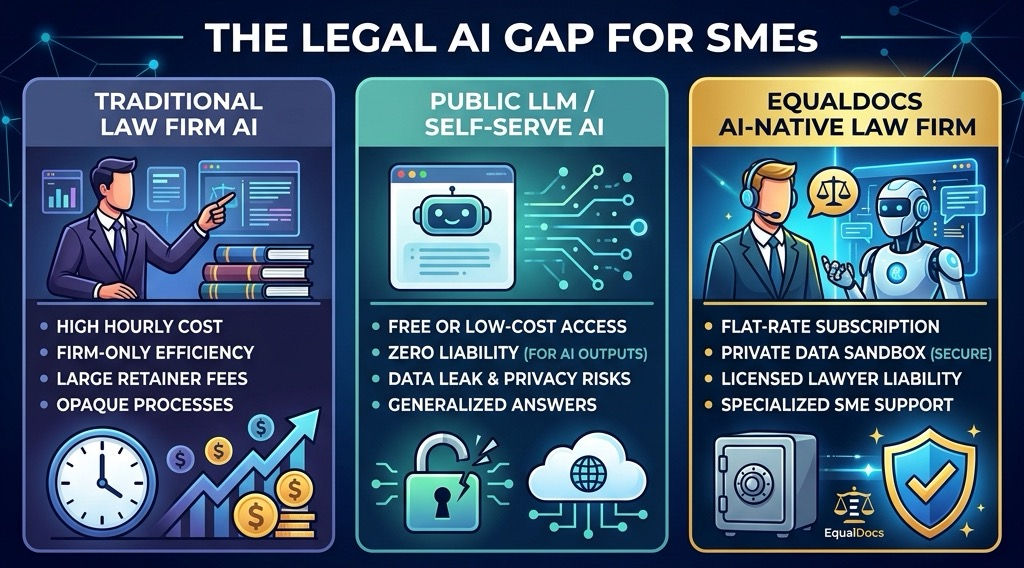
As an extensive industry investigation by Artificial Lawyer revealed this week, the label “AI-first” or “AI-native” has become commoditized—over 80% of commercial law firms now utilize commercial LLMs. But traditional partnerships have transformed these efficiency gains into bloated partner profit margins. Rather than passing savings down to clients, legacy firms continue to bill 850 per hour for “senior partner review” on documents drafted in seconds by algorithms.
Meanwhile, lean startups and SMEs are left stranded: unable to afford $600/hour hourly bills, yet facing complex cross-border compliance, commercial MSAs, and employment regulations.
3. The Disclaimer Trap vs. The NewMod Revolution
Faced with exorbitant legal fees, many founders turn to free online templates or public AI bots. But buried deep within every SaaS terms of service is the universal disclaimer:
“This software is provided ‘as is’ and does not constitute legal advice. We assume zero liability for any errors, omissions, or legal damages.”
Under judicial directives like the UK’s HC142 and tightening North American Bar oversight, courts will not accept “the software generated it” as a commercial defense. If an automated contract misses a consequential damages cap or violates local provincial labor standards, your enterprise carries 100% of the financial damage.
This is why the market is revolting against both the billable hour and unaccountable software tools:
- 50+ Sitting General Counsels from Salesforce, Circle, Rippling, and ElevenLabs joined forces with Wilson Sonsini this week to launch GCVC, a dedicated venture fund backing AI-native legal platforms that deliver fixed-fee outcomes.
- LegalMation veterans Rick Merrill and James Lee launched Merrill, a litigation defense NewMod firm operating strictly under transparent, flat fees.
The EqualDocs Solution: Licensed Lawyers, Amplified by AI
EqualDocs was engineered from inception on NewMod principles: eliminating the billable hour while assuming complete professional accountability.
We are backed by EqualDocs Avocats inc., a licensed Quebec law firm registered with the Barreau du Québec and operating across Canada.
- Attorney-Verified Execution: Our proprietary AI agents handle cross-border contract comparison and risk auditing in seconds, but every agreement is reviewed and signed off by a real licensed attorney.
- Real Malpractice Insurance: Unlike software platforms that disclaim all responsibility, EqualDocs carries full professional liability insurance. We put our professional reputation and balance sheet behind our work.
- Transparent Flat Rates: We pass AI velocity directly to you:
- Starter ($0/mo, 200 EC): Free exploration and contract health checks.
- Pro ($19.99/mo, 1,000 EC): Complete contract review and audit for growing teams.
- Growth ($79/mo, 3,500 EC): Multi-seat compliance and deal negotiation.
- Enterprise ($299/mo, 12,000 EC): Custom cross-border workflows and dedicated counsel.
The era of paying $650 an hour for routine paperwork is over. Don’t leave your company’s balance sheet unprotected by relying on disclaimer-laden chatbots.
Experience attorney-backed, predictable legal protection for your business at equaldocs.com.