The Battle of Accountable AI: Lessons from the UK High Court and the Evolution of Legal Tech

July 29, 2026
The legal technology landscape is evolving at a breakneck speed, but this week’s developments underscore a widening gap in the market: the divide between raw, unmanaged AI generation and accountable, professional-grade workflows. From the English High Court’s latest admonishment of a law firm using unchecked AI, to Spellbook’s expansion into Google Docs, and the shifting timeline of the EU AI Act, the message is clear. AI is the engine, but accountability remains the steering wheel.
1. Fabricated Precedents: The High Court’s Warning on Raw LLMs
In the recent UK case Anthony Malcolm Cork & Anor v Mark Smith, an English High Court judge issued a stern admonishment to a law firm for submitting a fabricated statutory provision generated by artificial intelligence. This is not the first time a court has faced AI-generated hallucinations, but the court’s tolerance for “plausible ignorance” has officially expired.
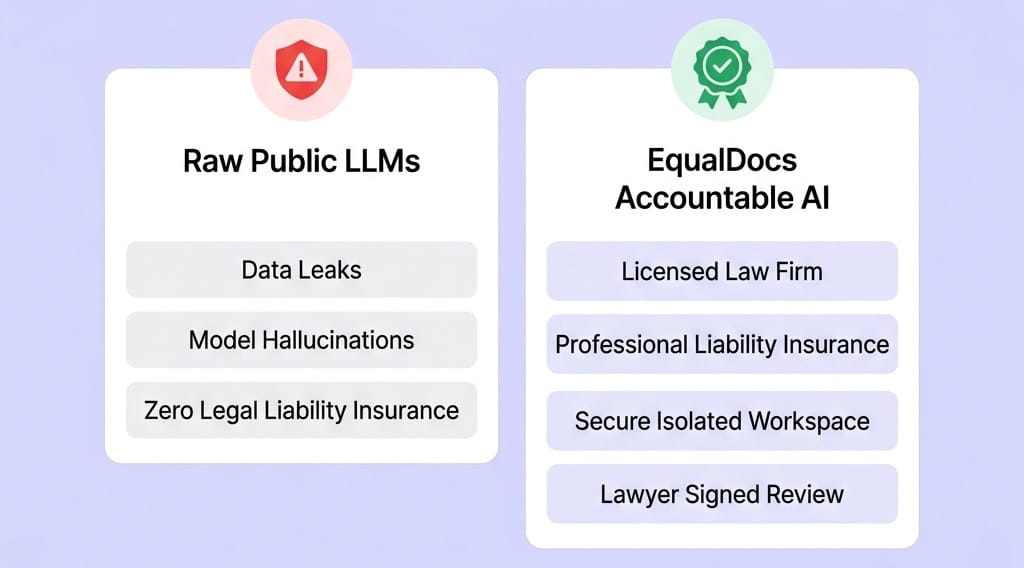
Relying on raw public LLMs (like ChatGPT or Claude) for legal research without rigorous cross-referencing is no longer just a technical shortcut—it is a threat to professional standing and client trust. When a lawyer or firm submits a brief, they are offering their reputation as collateral. Raw大模型 (large language models) have no reputation to lose, no licensing board to answer to, and zero professional liability insurance. When they hallucinate, the lawyer, or worse, the client, pays the price.
For Small and Medium-sized Enterprises (SMEs), this highlights a major structural risk. Many businesses use public LLMs to draft or review contract clauses, unaware that their “intellectual exhaust” is being used for public model training, and that the model is prone to inventing provisions out of thin air.
2. Moving to Where the Work Happens: Spellbook in Google Docs
While courts warn against raw AI usage, legaltech developers are focusing on building secure, workflow-integrated tools. Spellbook’s announcement that it has launched its AI-powered contract review and drafting tools for Google Docs is a major step forward.
Previously limited to Microsoft Word, Spellbook’s expansion brings risk analysis, playbook-driven revisions, and its “Spellbook Ask” feature directly to the Google Docs workspace. This matters because a vast number of modern startups, tech companies, and SMEs run their operations entirely on Google Workspace. Forcing these teams to download, open in Word, edit, and upload back to Google Docs creates friction and version control hazards. By embedding AI checks natively where the collaborative drafting occurs, legaltech is adapting to modern business habits.
3. Shifting Rules: The EU AI Act Omnibus and August 2 Transparency Deadline
Regulatory frameworks are trying to keep pace with these software updates. The “AI Omnibus” regulation, amending the EU AI Act, officially entered into force on July 27, 2026. This amendment brings some relief to developers by postponing compliance deadlines for high-risk AI systems (stand-alone systems now have until December 2, 2027).
However, the deadline for AI transparency obligations (Article 50) is fast approaching on August 2, 2026. Under these rules, organizations must label AI-generated content (including text, images, and synthetic media) to distinguish synthetic outputs from human creations.
For businesses operating globally or partnering with EU firms, compliance is no longer a back-burner issue—it is a sales prerequisite. Your enterprise partners and investors will soon audit your AI data sources, codebases, and compliance protocols before signing contracts.
4. The EqualDocs Value Bridge: Accountability as a Service
At EqualDocs (equaldocs.com), we believe that compliance and contract protection shouldn’t be luxury goods reserved only for the Fortune 500.
All the capital and big tech attention is flowing to enterprise legal software. Meanwhile, the 98% of SMEs are left priced out, struggling with $500/hour traditional firm rates or taking massive legal risks using raw public LLMs.
We built EqualDocs to bridge this gap. As an AI-first licensed law firm (EqualDocs Avocats inc., registered with the Barreau du Québec), we assume professional liability for the work we deliver. We leverage advanced AI tools to review and draft contracts at lightning speed, but every output is verified and signed off by a licensed lawyer covered by professional liability insurance.
We offer clear, flat upfront quotes and affordable monthly subscriptions:
- Starter: $0/mo (200 EC) for basic intakes and checking “Do you need a lawyer?”
- Pro: $19.99/mo (1,000 EC) for standard contract templates and AI reviews.
- Growth: $79/mo (3,500 EC) for growing businesses needing constant workflow protection.
- Enterprise: $299/mo (12,000 EC) for high-volume compliance and direct lawyer support.
Don’t risk your business on unverified model outputs or exposed data. Get the speed of AI with the accountability of a real law firm.