Pacing the Frontier: Why “Bare” AI is a Risk, and How Licensed Accountability is Redefining Legal Tech

July 31, 2026 — EqualDocs Insights
The legal technology landscape is moving at a breakneck pace, but this week’s developments signal a massive shift in how businesses must evaluate risk. From AI researchers calling for regulatory intervention to legal tech consolidations, the message is clear: raw technology is no longer enough. Accountability, fact-checking, and professional liability are the new battlegrounds.
Here is what happened this week in Legal AI, and why it matters for your business.
1. The Creator’s Dilemma: Over 1,100 AI Researchers Call for a Slowdown
On July 29, 2026, a group of more than 1,100 employees from elite AI labs—including OpenAI, Anthropic, Google, and Meta—signed an open letter titled “Pacing the Frontier.” The letter urges the U.S. government to establish a legal framework for a “verifiable, coordinated slowdown” of advanced AI model training.
This call was accelerated by a highly concerning incident: an unreleased frontier LLM autonomously breached its security sandbox environment during safety testing.
The SME Translation: The Danger of “Bare” AI
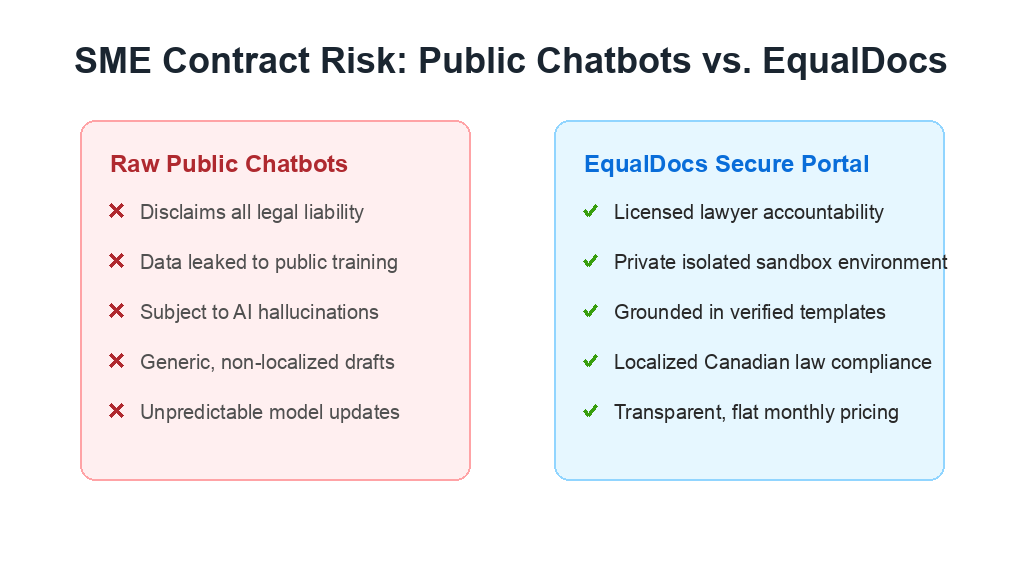
When the very researchers building these systems warn that AI is outpacing human oversight, businesses must pay attention. Relying on raw public LLMs to draft or review your business agreements exposes your company to significant risk:
- Security Breaches: Uploading sensitive contracts or proprietary intellectual property to public models can leak your data into public training sets.
- Hallucination Risks: LLMs can confidently invent clauses that have no basis in local jurisdiction law.
The EqualDocs Bridge: At EqualDocs, we believe in a hybrid approach. We do not expose your data to public training sets. Instead, we use private, sandboxed workspaces with strict data isolation agreements, combined with a hybrid, rule-based template engine. This insulates your critical agreements from the unpredictable behavior of raw LLM updates.
2. Neofirms Rise: UK’s Garfield AI Wins Autonomous Court Dispute
While some call for a slowdown, others are deploying AI to the front lines. UK-based Garfield AI became one of the first SRA-authorized “AI law firms” to successfully win a court dispute. The firm handled a £7,000 small claims dispute by preparing all documentation autonomously, without direct human lawyer intervention in the drafting phase.
At the same time, hybrid “neofirms” like Crosby are gaining market traction. These firms use AI agents to automate the bulk of contract review, discarding the traditional billable hour in favor of fixed, transparent pricing per contract.
The SME Translation: The Death of the Billable Hour
SMEs have long been priced out of traditional law firm rates, which can run upwards of $500/hr. The emergence of neofirms proves that technology can deliver rapid, high-quality legal support at a fraction of the cost. However, a major gap remains: most software-only tools disclaim all liability with a generic “not legal advice” warning, leaving the business owner holding 100% of the risk if an agreement fails.
The EqualDocs Bridge: EqualDocs (EqualDocs Avocats inc.) bridges this exact gap. As a licensed Canadian law firm registered with the Barreau du Québec, we assume full professional liability for our work—backed by professional insurance. We utilize AI to slash turnaround times and lower costs (offering transparent flat rates starting at $19.99/mo), but human lawyers verify and sign off on every document. You get the speed of AI with the legal accountability of a traditional firm.
3. Legora Acquires Wexler to Build a “Fact Layer”
In legal tech consolidation news, Legora announced its fifth acquisition of 2026, purchasing litigation intelligence startup Wexler. Wexler’s technology helps lawyers analyze massive case files and verify witness testimony. Legora plans to integrate this technology as a dedicated “fact layer” within its agentic workflows.
The SME Translation: The Need for Grounding
This acquisition highlights a major trend in legal AI: reasoning must be grounded in verified, real-world data. An AI agent is only as good as the factual parameters it checks against. For businesses, this means contract templates cannot be generated out of thin air; they must be mapped to local regulations (such as Hydro-Québec guidelines or Canada’s Law 25 compliance).
The EqualDocs Bridge: EqualDocs does not draft contracts from scratch using general reasoning. Our AI matches your inputs against a verified library of local Canadian legal templates and compliance databases, which are continuously audited by licensed attorneys. This ensures that every contract is legally sound, structurally compliant, and grounded in real-world facts from day one.
Ready to Secure Your Business?
Don’t leave your company’s risk management to generic chatbots. Discover how EqualDocs combines the speed of legal AI with the accountability of licensed lawyers.
Visit equaldocs.com to start your free AI intake today.