Navigating the Shift: Canada’s Non-Compete Ban, Ontario Holdback Compliance, and the New Tariff Reality

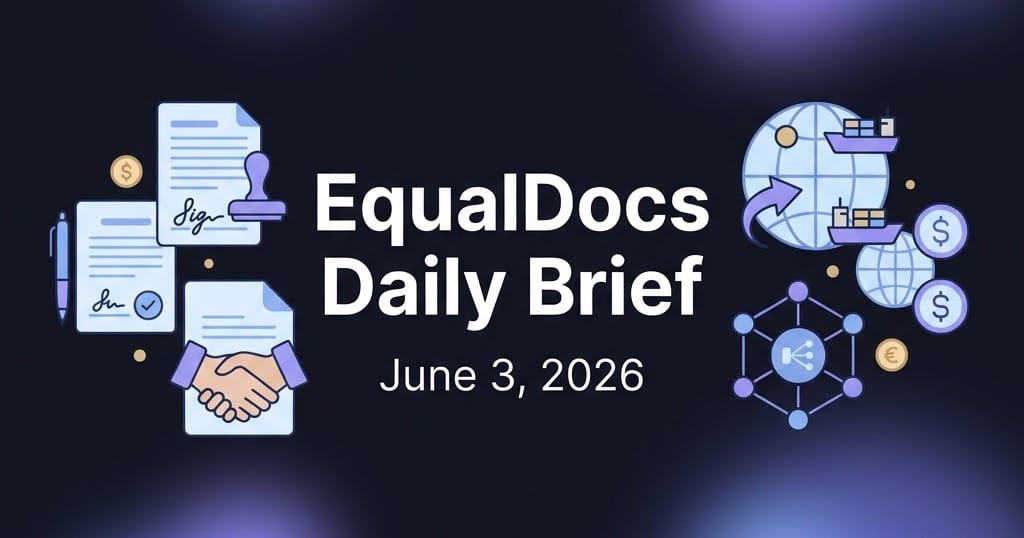
June 3, 2026 | EqualDocs Compliance Insight
Navigating cross-border commerce and employment compliance has become a moving target for small and medium-sized enterprises (SMEs). From shifting non-compete rules and regional construction holdbacks to major tariff alterations and the rise of automated legal-enablement tech, businesses must act preemptively to secure their contracts.
Today’s briefing breaks down the “so what” behind the latest regulatory updates and explores how you can safeguard your business.
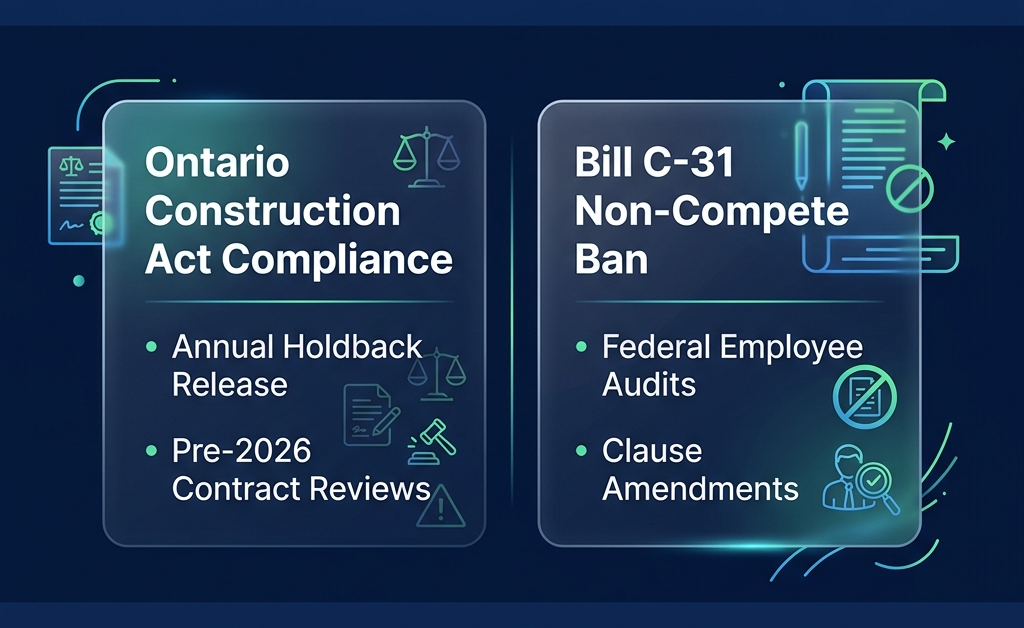
1. Canada’s Proposed Bill C-31: The Federal Ban on Employee Non-Competes
In a major shift for federal employment law, Bill C-31 has passed its first reading in the House of Commons. The bill proposes amending the Canada Labour Code to completely prohibit federally regulated employers from imposing non-compete clauses on their employees.
If passed, this law will affect businesses in telecom, banking, interprovincial transportation, and grain handling. It mirrors similar legislative trends in the United States and various Canadian provinces, reflecting a broader public policy push toward employee mobility and fair competition.
The SME Takeaway:
Non-compete clauses are rapidly becoming legally toothless across North America. If your business model relies on these clauses to protect trade secrets or client lists, you must pivot.
- Contract Action: Review your standard employment and contractor templates. Replace broad non-competes with robust, enforceable non-disclosure agreements (NDAs) and narrowly tailored non-solicitation clausesthat protect proprietary client relationships without restricting an employee’s right to work.
2. Ontario Construction Act: Crucial Compliance on Mandatory Annual Holdbacks
While major amendments to the Ontario Construction Act took effect on January 1, 2026, industry guidance and legal compliance updates in early June highlight ongoing operational challenges for businesses managing multi-year contracts.
Under the updated regime, property owners and general contractors are legally required to release accrued holdbacks annually for contracts that span more than one year. To comply, owners must publish a formal “Notice of Annual Release of Holdback” within 14 days of the contract anniversary, followed by a mandatory 60-day waiting period before funds can be released. Additionally, the window to initiate interim adjudication for dispute resolution has been expanded to 90 days post-completion or termination.
The SME Takeaway:
Old contract templates that allow holdback funds to be retained until the entire project is completed are no longer legally compliant in Ontario.
- Contract Action: Audit all active and pre-2026 multi-year service or development contracts. Ensure that your contract terms explicitly outline the mandatory annual holdback release schedules and prompt payment timelines to avoid severe dispute adjudication penalties.
3. U.S. Proposes 12.5% Tariffs on China Alongside a New Board of Trade
Cross-border supply chains face a highly volatile dual-track policy from the Office of the United States Trade Representative (USTR). On June 3, 2026, the USTR announced a proposal to impose a 12.5% additional tariff on imports from 60 trading partners, including China, following investigations into forced labor import bans. The public comment period for these tariffs runs until July 6, 2026.
Simultaneously, the administration is moving forward with a mechanism to stabilize bilateral commerce: the U.S.-China Board of Trade. Agreed upon during presidential bilateral talks, this board is designed to facilitate government-to-government discussions on “non-sensitive” products and manage ongoing trade. The USTR is currently seeking public input on the board’s scope and which products should be eligible for tariff modifications. Public feedback is due by July 10, 2026.
The SME Takeaway:
Cross-border businesses must manage the risk of sudden 12.5% cost increases on imported goods while positioning themselves to benefit from potential Board of Trade exclusions.
- Contract Action: Insert dynamic tariff adjustment triggers and force majeure clauses into your international supply and vendor agreements. Ensure your contracts specify how tariff-related price changes are split between parties, rather than allowing your business to absorb the entire cost.
4. Wordsmith AI Secures $70M Series B to Scale In-House Legal Enablement
On the technology front, Edinburgh-based legal AI developer Wordsmith AI announced a $70 million Series B funding round led by Highland Europe and Index Ventures. This brings the startup’s total funding to $100 million within 24 months.
Wordsmith’s platform focuses entirely on in-house corporate legal teams rather than law firms. By integrating directly into everyday business tools like Slack, Microsoft Teams, and Salesforce, the platform automates legal intake, contract drafting, and workflow routing. Wordsmith aims to help companies manage their day-to-day legal tasks internally, drastically reducing their reliance on expensive outside counsel.
The SME Takeaway:
The legal industry is rapidly moving toward agentic AI that acts as an automated triage and drafting partner for corporate teams.
- Contract Action: As your business integrates legal automation platforms, audit your software vendor agreements. Ensure that the contracts contain strict data governance and ownership clauses that guarantee your proprietary legal data and contracts are not used to train the vendor’s public AI models.
EqualDocs — Your Digital General Counsel | equaldocs.com