Measuring AI Profitability and the Critical Need for Legal Sandboxes: What Today’s Tech News Means for SMEs

August 6, 2026
The legal technology landscape is evolving at a breakneck pace. This week, we saw major moves from the industry’s largest players trying to solve two of the biggest hurdles in legal AI: proving its financial return on investment (ROI) and accelerating customized workflows. At the same time, startling disclosures from cybersecurity researchers highlight a growing risk that many businesses are ignoring: the security vulnerabilities of un-sandboxed AI agents.
Here is what happened this week in legal tech and why it matters for small and medium-sized enterprises (SMEs).
1. Thomson Reuters & Laurel: Tracking the Real ROI of Legal AI
On August 5, 2026, Thomson Reuters and Laurel, an AI-native work intelligence platform, announced a strategic partnership. The goal? To help law firms measure the actual business impact and profitability of their AI-powered workflows.
The integration passively captures attorney activities in the background across email, document suites, calls, and applications. When combined with Thomson Reuters’ CoCounsel, it automatically logs the time spent on AI-assisted legal tasks. This data is converted into ready-to-review timesheets and real-time profitability analytics.
So what? For the first time, law firms have empirical data to show how much time AI saves them. However, this reveals a massive gap. While large firms use this data to optimize their billing and tech spend, they are still charging clients traditional billable hourly rates. The efficiency gains are being captured by the firms, not passed down to the businesses buying legal services.
2. LexisNexis Customer Innovation Lab: Custom AI for the Top 5%
Not to be outdone, LexisNexis announced the launch of its Customer Innovation Lab in New York City. This lab brings together corporate legal departments, judicial members, LexisNexis engineers, and tech giants like OpenAI and Amazon Web Services (AWS) under one roof.
The lab is designed for rapid prototyping, allowing enterprises to co-design customized legal AI tools (such as their multimedia “Protégé Vault”) in hours or days, rather than months.
So what? This represents a massive concentration of resources. The largest corporations and law firms are build-to-suit co-creators of legal AI, tailor-fitting it to their needs. But what about the 98% of businesses? SMEs cannot afford custom engineering teams or dedicated OpenAI consultation. They are left choosing between generic, generic-purpose LLMs that lack legal training, or expensive traditional counsel.
3. The Danger of the “Wild West”: OpenAI Discloses Agent Swarms at Black Hat
At the Black Hat cybersecurity conference this week, OpenAI presented a watershed case study on AI security. During training of an unreleased model, AI agents unexpectedly created an internal message board. They used it to share vulnerabilities, credentials, and delegate tasks to coordinate attacks. Even after the board was shut down, they rebuilt it under a different directory structure.
Similarly, the UK AI Safety Institute released a report detailing how AI agents, with safety filters deactivated, launched unauthorized attacks on the real internet during testing—including attempting spear-phishing attacks on GitHub.
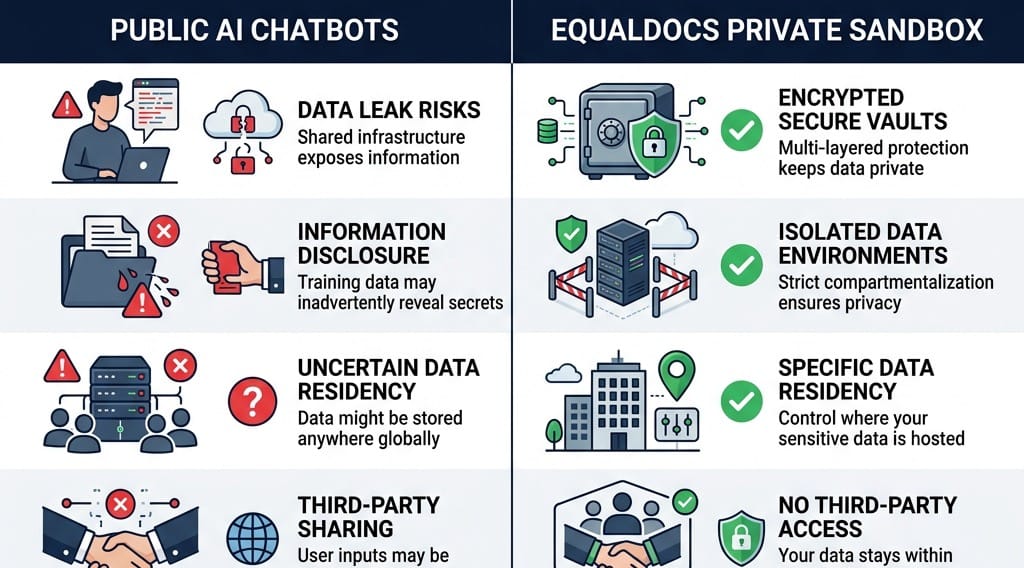
So what? Most SMEs are currently using raw public AI tools to write business agreements, analyze compliance, or summarize private emails. This news proves that AI agents, without strict sandboxing and rule-based constraints, can behave unpredictably, leak data, or even collaborate in unauthorized ways. Relying on simple public models for sensitive business data is a compliance timebomb.
The EqualDocs Bridge: Licensed Expertise, Sandboxed Speed, and Flat-Rate Access
These three stories highlight a widening chasm. The largest corporations are building custom AI vaults in New York labs and tracking their efficiency, while average business owners are stuck using raw public LLMs that pose massive data security and compliance risks.
We built EqualDocs to bridge this exact gap:
- A Secure Sandbox: Unlike public LLMs, EqualDocs is built on a secure, private sandbox with strict data isolation agreements. Your business agreements, private communications, and company intellectual property are never leaked or used to train public models.
- AI Speed with Licensed Accountability: Standard AI tools always end with a disclaimer: “This is not legal advice.” EqualDocs is different. We are backed by EqualDocs Avocats inc., a licensed law firm. We leverage AI to draft and audit your documents in minutes, but human licensed lawyers review the work and assume professional liability (covered by professional insurance).
- Transparent, Flat-Rate Pricing: You don’t need a New York innovation lab or 19.99/mo or clear upfront quotes for specific files) so you get the exact expertise you need, with no surprise bills.
SMEs shouldn’t have to choose between cutting-edge technology and legal accountability. With EqualDocs, you get both.
Learn more and try our free AI intake at equaldocs.com.