Automated Compliance and Courtroom Sanctions: Why Software-Only Legal AI Leaves SMEs Exposed

August 11, 2026
The legal technology landscape is evolving rapidly, marked by major new platform launches, significant regional compliance updates, and rising judicial scrutiny. Today, three key developments highlighted these dynamics: Toronto-based Borderless AI launched “Alberni,” an AI-powered legal operating system automating global employment compliance and entity management across 150+ jurisdictions. Concurrently, a federal court in Washington issued a $3,000 sanction against a lawyer in the case LeDoux v. Outliers, Inc. for filing documents containing hallucinated, AI-generated citations. In the regulatory space, British Columbia’s massive overhaul of consumer protection laws officially took effect, introducing strict pre-contract disclosure and subscription cancellation rules that impact all SMEs using consumer contracts.
While these milestones show that legal automation is scaling up, they also expose a critical vulnerability: relying on software-only AI or unverified tools leaves businesses holding all the professional and financial liability.
Here is what these developments mean for your business, and how EqualDocs bridges this gap.
1. Borderless AI’s Alberni: Global Scale, but Software-Only Liability
On August 11, 2026, Borderless AI officially launched Alberni, an AI operating system designed to manage international workforce compliance, worker classification, and entity maintenance in over 150 countries. The launch aims to reduce the reliance of growing businesses on fragmented local counsel, automating complex HR processes at fraction of the cost.
While Alberni is a great tool for automating HR compliance, it highlights a common limitation in the “legal tech” space: it is software-only. If the AI incorrectly classifies a worker (e.g., classifying an employee as an independent contractor, leading to major tax penalties), the platform’s software license agreement will disclaim all liability. The business owner must assume 100% of the financial fallout.
For growing businesses and exporters, automation is essential for speed, but professional accountability is critical for survival.
2. LeDoux v. Outliers: The Cost of Hallucinations and technological Ignorance
In LeDoux v. Outliers, Inc., a federal court in Washington sanctioned a lawyer with a $3,000 fine for submitting court filings containing fabricated citations generated by an AI tool. The court reiterated that technology ignorance is not an excuse—lawyers are personally responsible for the competence and accuracy of their filings.
This case is a cautionary tale for any SME using raw public AI tools (like ChatGPT or Claude) to draft or review business agreements. If a general AI tool hallucinates a clause, overlooks a crucial liability limitation, or invents a legal standard, you cannot hold the AI developer accountable. Raw public AI tools explicitly disclaim all liability.
Using raw AI without professional sign-off exposes your business to severe operational and financial risk. Speed should never come at the expense of professional responsibility.
3. BC Consumer Protection Overhaul: Regulatory Changes Demand Immediate Audits
In Canada, British Columbia’s consumer protection regulations officially underwent a major overhaul. This update introduces strict rules for pre-contract disclosure, automatic subscription renewals, cancellation rights, and refund policies for any business dealing with consumers or using standardized consumer agreements.
For local SMEs, online service providers, and consultants, this means that existing customer agreements and terms of service may now be legally non-compliant or even void. If your standard terms do not comply with the new BC regulations, customers can legally cancel contracts and demand full refunds.
Staying compliant is no longer just a legal detail—it is a sales prerequisite. SMEs need to audit and update their templates instantly as local regulations change.
4. The EqualDocs Solution: AI Speed, Licensed Firm Accountability
At EqualDocs, we believe that SMEs should not have to choose between the speed of AI and the safety of a traditional law firm. We are not just a software tool; we are a licensed, AI-native law firm (EqualDocs Avocats inc., registered with the Quebec Bar, operating across Canada).
Here is how we deliver instant expertise with complete accountability:
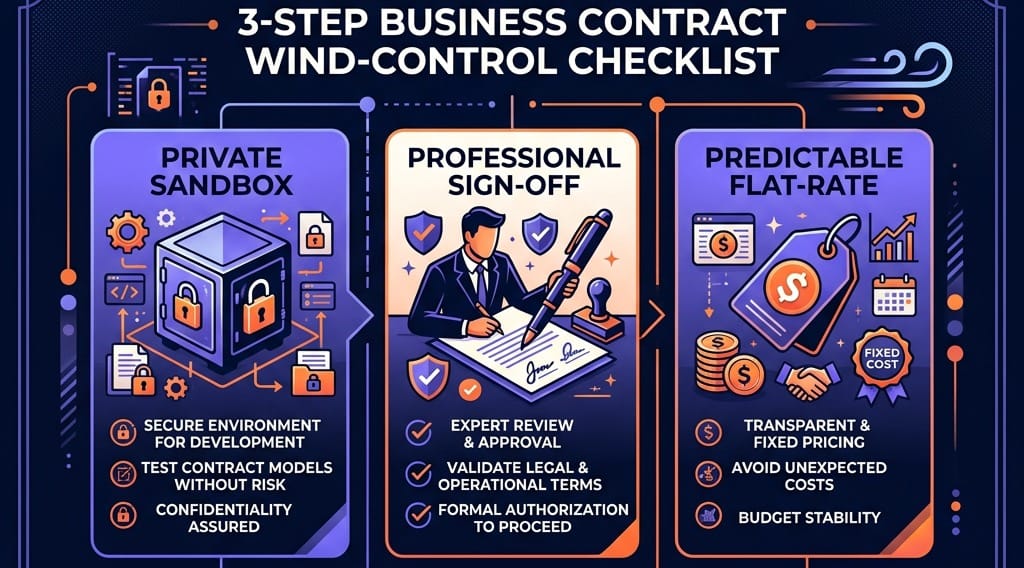
- Licensed Human Sign-Off: Our advanced AI scans, reviews, and drafts documents in seconds, but our licensed, professional lawyers review the output, sign off on the results, and assume full professional liability.
- Professional Liability Insurance: Unlike software platforms that disclaim all liability, EqualDocs is backed by professional liability insurance, protecting your business from the financial fallout of legal errors or hallucinations.
- Private Sandbox Workspace: All contract analyses and uploads occur in a secure, isolated sandbox environment, ensuring your proprietary data is never used to train public models.
- Predictable Flat-Rate Pricing: No hourly bills. We offer transparent subscription tiers to cover all your contract and compliance needs:
- Starter ($0/mo, 200 EC): Free instant AI intake and document risk assessment.
- Pro ($19.99/mo, 1,000 EC): Private sandboxing, custom templates, and export compliance tools.
- Enterprise ($299/mo, 12,000 EC): High-frequency professional lawyer audits and priority support.
Compliance is your greatest sales enablement tool. Protect your business with AI speed and licensed firm protection. Start auditing your contracts today at equaldocs.com.