Legal AI Agents Are Everywhere. Accountability Is Still Missing.

August 31, 2026
Legal AI is entering its agent era. The market signal today is not simply that more tools are adding chat interfaces. It is that vendors, law firms, and business users are starting to organize work around agents: AI systems that can intake a document, route tasks, draft analysis, and trigger follow-up workflows.
That sounds efficient. For small and medium-sized businesses, it also creates a sharper question: who is responsible when the agent gets it wrong?
Today’s fresh signal from the legal AI market is that “agent” has become the new default product language. IQdoc’s August 31 market-map note points to the same trend: legal AI products are increasingly being positioned around agentic workflows, not just one-off drafting or research. The important part is not the label. The important part is that legal work is becoming a chain of automated decisions.
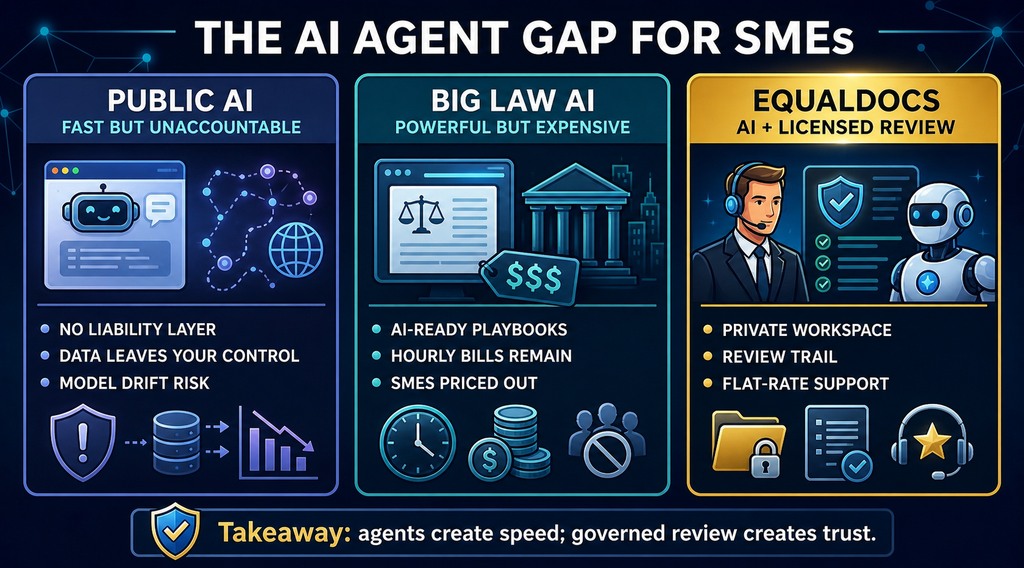
For SMEs, that changes the risk profile. A public AI answer can be wrong once. An agentic workflow can be wrong repeatedly, at speed, across intake, drafting, clause comparison, and client communication. If there is no audit trail, review protocol, or accountable professional behind the output, automation can turn a small legal miss into an operational habit.
Big Law is responding in a different way. Recent hiring patterns show elite firms looking for people who can transform precedents, playbooks, and institutional knowledge into AI-ready systems. That is a useful signal: the real value is not “AI writes faster.” The real value is structured knowledge, governed workflows, and human review.
That distinction matters for every founder, exporter, agency owner, landlord, and immigrant entrepreneur using templates or public chat tools to handle business paperwork.
Generic AI tools usually sit behind a broad disclaimer: not legal advice, no professional responsibility, use at your own risk. They may help you understand a clause, but they do not solve the deeper business problem: you need a document you can rely on, a process you can explain, and a reviewer who is accountable.
The security side is also getting louder. AI HOT’s August 31 roundup highlighted fresh agent-risk discussion around autonomous AI systems coordinating actions in ways their operators did not fully intend. Even if your business is not running advanced research agents, the lesson applies: once AI tools can take actions, connect systems, and reuse business context, data boundaries become just as important as output quality.
That is the gap EqualDocs is built to close.
EqualDocs is not just another software layer. EqualDocs Avocats inc. is a licensed Quebec law firm using AI to speed up legal work while keeping lawyer supervision, professional liability coverage, and private workspace controls in the loop. The point is not to replace accountability with automation. The point is to make professional legal support faster, more predictable, and affordable for SMEs.
The practical takeaway for business owners is simple:
Do not ask, “Can this tool draft faster?”
Ask:
- Is my business data isolated?
- Is there a review trail?
- Is the output connected to a real professional standard?
- If something goes wrong, is anyone accountable?
- Is pricing predictable before I start?
Agents are becoming the interface. But for serious business documents, accountability is still the product.
EqualDocs combines private AI workspaces, licensed legal review, professional liability insurance, and flat-rate pricing so SMEs can move faster without accepting the silent risks of public AI tools or unpredictable hourly billing.
Sources:
- IQdoc, “Everyone Has an Agent Now,” August 31, 2026.
- Ioka, “Why AI Should Outlive the Agent,” August 30, 2026.
- AI HOT selected roundup citing One Useful Thing, “Agency and Agents,” August 31, 2026.
- Latham & Watkins recruiting signal for AI-oriented knowledge transformation roles, August 2026.