USMCA Joint Review and AI Act Deferrals: SME Contract Strategies for May 31, 2026

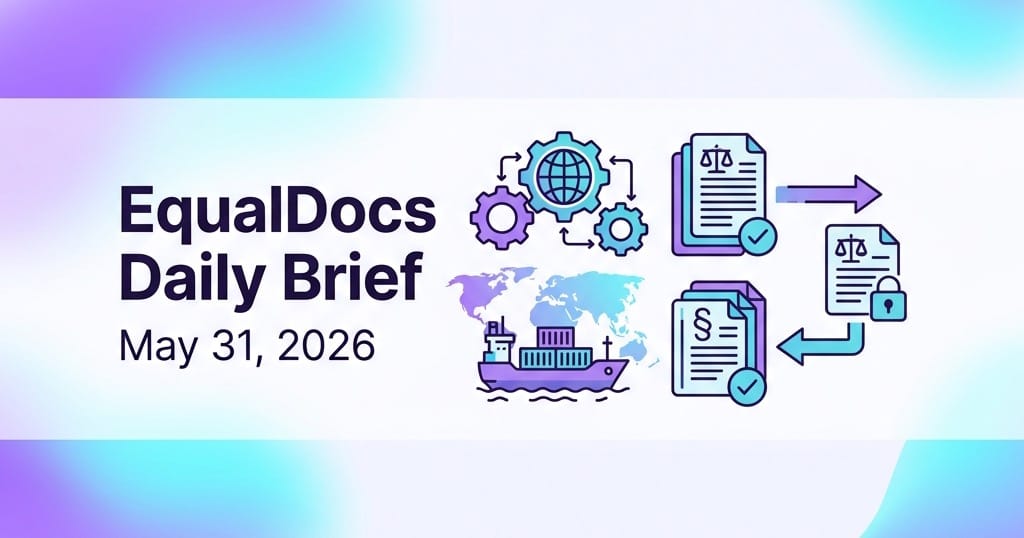
The global trade and regulatory landscape continues to shift rapidly, bringing both new challenges and welcome breathing room for cross-border businesses. From the looming joint review of the United States-Mexico-Canada Agreement (USMCA) to significant compliance timeline extensions under the EU AI Act, small and medium-sized enterprises (SMEs) must proactively adjust their contract strategies.
Here is our analysis of today’s key developments in international trade, legal technology, and compliance—and exactly what steps you should take in your business agreements today.
1. USMCA Joint Review Looming: Preparing for the July 1, 2026 Milestone
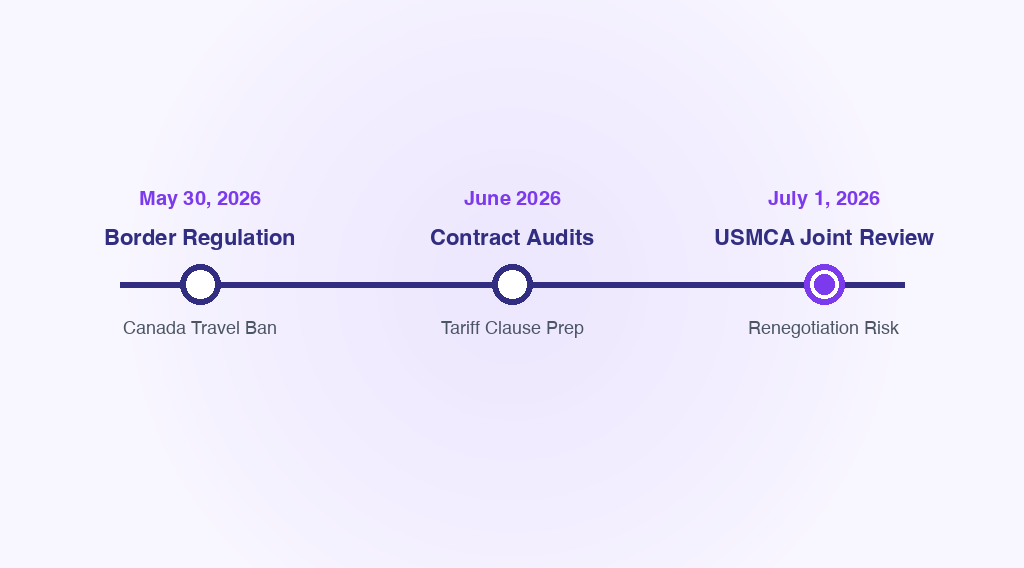
The United States-Mexico-Canada Agreement (USMCA) is facing a critical juncture with a mandatory joint review scheduled for July 1, 2026. This milestone will decide whether the tri-national trade agreement is renewed for another 16 years or subjected to complex renegotiations.
Tensions are currently running high. The U.S. government has indicated it intends to maintain specific tariffs on Canadian imports, citing unresolved trade disputes and trade deficits. Complicating matters, Canada has reportedly been sidelined from initial bilateral trade discussions between the U.S. and Mexico.
The SME Action Plan:
Cross-border businesses operating within North America should immediately audit their supply chain and logistics agreements:
- Insert Tariff-Adaptation Clauses: Build pricing flexibility into supply contracts. Ensure your agreements define how costs will be redistributed or adjusted if new border tariffs are imposed or existing exemptions are rolled back during the USMCA renegotiations.
- Review Supply-Continuity and Sourcing Rules: Ensure contracts account for strict regional sourcing requirements (Rules of Origin). Build alternative supplier provisions into your master agreements to mitigate risk if trade friction arises.
2. Canada Suspends Travel Documents and Mandates 21-Day Quarantine
Effective May 30, 2026, the Government of Canada has implemented urgent, temporary border measures in response to an Ebola outbreak in the Democratic Republic of Congo, Uganda, and South Sudan.
Under these new rules:
- The processing of all immigration and travel documents for residents of these high-risk countries has been suspended for 90 days.
- Any travelers arriving in Canada who have visited or transited through these countries in the previous 21 days must undergo rigorous screening and undergo a mandatory 21-day quarantine.
This sudden change directly impacts multinational operations and remote/specialist talent mobility.
The SME Action Plan:
If your business relies on international talent or conducts business in Central/East Africa, review your employment and independent contractor agreements:
- Implement Remote Work Flexibility: Ensure contracts with overseas contractors or consultants include clauses permitting temporary transition to fully remote work if travel restrictions or visa suspensions delay their relocation.
- Review Force Majeure Clauses: Update contracts to clarify that government-mandated travel bans and quarantines constitute force majeure events, suspending performance obligations without penalty for either party.
3. LegalTech Highlight: Lexroom Secures $50M Series B for Multilingual AI Infrastructure
As legal technology transitions from experimental chatbots to operational infrastructure, legal research and drafting platform Lexroom has announced a massive $50 million Series B funding round led by Left Lane Capital. This brings Lexroom’s total funding to $73 million.
Lexroom’s primary differentiator is its focus on building enterprise-grade AI infrastructure tailored for Europe’s diverse, multilingual legal and regulatory systems. This massive funding round signals that the market is shifting rapidly from general AI assistants to specialized, workflow-integrated software that offers verifiable accuracy.
The SME Action Plan:
For SMEs, this development highlights the availability of professional compliance tools:
- Adopt Specialized Compliance Tooling: Move away from using generic consumer AI tools for contract drafting and review. Consumer tools carry high risks of hallucinations and data leaks.
- Utilize Workflow AI for Global Compliance: Incorporate tools like Lexroom and EqualDocs to manage cross-border contracts across multiple jurisdictions and languages, enabling small in-house teams to handle complex regulatory filings at a fraction of the cost of outside counsel.
4. EU Postpones AI Act Deadlines: A Crucial Grace Period for High-Risk Systems
Under a provisional political agreement known as the “Digital Omnibus on AI” reached in late May 2026, the European Union has agreed to postpone several critical compliance deadlines under the EU AI Act to address operational bottleneck concerns:
- High-Risk AI Systems (HRAIS): Compliance obligations for Annex III (use-case regulated) systems have been deferred from August 2, 2026, to December 2, 2027. Annex I (product-regulated) obligations are postponed to August 2, 2028.
- Transparency and Watermarking: The deadline for ensuring machine-readable watermarking on AI-generated synthetic content for models placed on the market before August 2, 2026, is deferred to December 2, 2026.
While these delays offer much-needed breathing room, many core transparency requirements and prohibitions set for August 2, 2026, remain fully active.
The SME Action Plan:
Do not halt your compliance preparations. Treat this postponement as a strategic grace period:
- Audit AI Vendors and Subcontracts: Use the extra time to perform thorough audits on your AI vendors. Update your vendor contracts to include warranties and representations confirming they will comply with the deferred HRAIS obligations by the new 2027/2028 deadlines.
- Track Internal AI Tool Inventories: Establish clear internal AI governance policies now. Ensure your contracts with employees and IT vendors restrict the unauthorized use of “shadow AI” tools that could expose your corporate data or violate active EU AI Act prohibitions.
EqualDocs is your Digital General Counsel. We help cross-border SMEs navigate global trade, compliance, and contract risk with instant AI expertise. Visit equaldocs.com to secure your business today.