Riding the AI Wave: What Legal AI in 2026 Means for You—and How EqualDocs Fits In

In 2026, the legal industry is being reshaped by AI faster than at any point in its history. AI is no longer a frontier experiment or a bolt-on assistant—it has become a core force redefining how legal work gets done: automated drafting and review, intelligent research, AI-powered content, and complex compliance management. But the same wave that makes law firms faster also raises hard new questions about quality, trust, and data safety.
For the small and medium-sized businesses these firms serve, that creates a genuine dilemma: how do you get real legal help without overpaying, over-sharing your data, or gambling on generic AI answers? This is exactly the gap EqualDocs was built to close.
Three Major Legal AI Trends to Watch in 2026
Trend 1: AI Embeds Deep Into Everyday Legal Workflows—Goodbye “Experimental Phase”
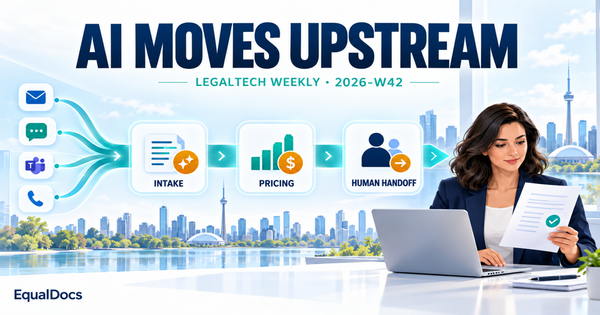
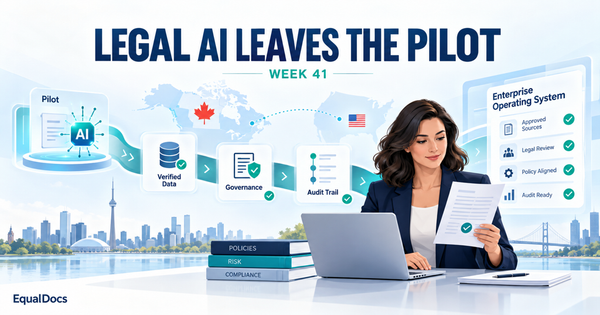
In 2026, AI has officially exited the “pilot project” stage to become an organic part of legal work. As ki-company.ai notes in AI Trends 2026, AI is migrating out of standalone browser tabs and directly into the tools professionals use every day: email, Office suites, CRM, and ERP systems.
For example, ALPMA reports that legal-specific phone systems like VXT can transcribe calls in real time, generate concise summaries, and file the relevant information straight into a matter-management system. It saves lawyers valuable time—and it also creates new, auditable data trails that someone has to be accountable for. The convenience is real; so is the new liability that comes with it.
Trend 2: A New Standard for AI Content and Legal SEO—Content Quality Is King
In the age of AI-driven search, online visibility and trust are being redefined. In a March 31, 2026 article, good2bsocial.com stresses that even though AI can generate answers quickly, high-quality, substantive content remains the undisputed king of legal SEO. LLM-powered search engines now lean heavily on the E-E-A-T framework—Experience, Expertise, Authoritativeness, Trustworthiness—to judge credibility.
For “Your Money or Your Life” (YMYL) fields like law, the bar is especially high. Generic, auto-generated legal advice gets filtered out. To be surfaced and cited by AI answer engines, legal content has to demonstrate real human credentials and verifiable authority. The lesson for everyone: AI should augment genuine legal expertise, not replace it—because on legal questions, the answer is only as trustworthy as the licensed professional standing behind it.
Trend 3: AI Ethics, Data Privacy, and Privilege Become the Industry’s Hot Button
As AI adoption spreads, ethics, data privacy, and compliance have become the “hot topic” of 2026. As gomega.ai notes, firms must prioritize client-data privacy, address latent bias in AI-generated content, and disclose their use of AI appropriately to preserve trust.
The stakes are now being drawn in courtrooms. On February 6, 2026, the federal court for the Southern District of New York issued a ruling in a generative-AI copyright suit against OpenAI, clarifying the boundary between attorney work-product protection and mandatory disclosure. The signal is clear: feeding client data into public LLMs can risk exposing confidential information and eroding privilege. Meanwhile, NACDL (the National Association of Criminal Defense Lawyers) warns that generative AI is amplifying the sophistication of phishing and deepfake fraud—making data security a baseline requirement, not an afterthought.
The takeaway for any business: who handles your legal matter, and where your data goes, matters more than ever.
The SME Dilemma: Real Help Without the Trap
While large enterprises pilot custom compliance agents, small and medium-sized businesses face a harder set of choices:
- Sky-high hourly rates. Hiring a traditional firm for a standard NDA or MSA means slow turnarounds and unpredictable four-figure bills.
- Risky shortcuts. Free online templates or pasting a contract into a public chatbot can leak your data and introduce fatal “hallucination” errors—with no one accountable for the outcome.
- Doing nothing. Putting off legal review until a dispute or audit forces the issue—usually the most expensive path of all.
The honest truth is that not every situation even needs a lawyer. But when it does, you deserve to know that up front—and to be matched with the right one at a price you can see before you commit.
EqualDocs: The Simplest Way to Get the Right Lawyer
EqualDocs is an AI-native law firm—an in-house practice registered with the Barreau du Québec, working alongside partner firms across other provinces and U.S. states. We built it to answer one question honestly before anything else: do you even need a lawyer, and if so, who is the right one?
Here’s how it works:
- Start with a free question—in any language, 24/7. Our AI intake listens to your situation and gives you an honest assessment: sometimes the answer is “you don’t need a lawyer for this,” and we’ll tell you so. No pitch, no pressure.
- Get matched to a licensed lawyer—only if you need one. When your matter calls for real legal work, we pair you with a licensed lawyer suited to it, with transparent pricing shown before any engagement begins.
- Drafting, review, and e-sign as part of a real engagement. AI accelerates the work; a licensed lawyer reviews, signs off, and stands behind it—accountability a software tool with a “not legal advice” disclaimer can never offer.
Pricing runs on Equal Credits (EC)—a transparent currency where 1 EC = $0.10, so you always know the cost of an action before you take it. Plans start at Starter (free), with Pro ($19.99/month) and Enterprise ($299/month) for teams that need more. Sample debits are refreshingly simple: a chat is 2 EC, a document review is 20 EC, a full draft is 150 EC. Sign up and you start with +50 EC on the house.
And because service is trilingual—English, French, and Chinese—the same matter is handled consistently across multicultural and cross-border deals.
Act Now: Start With a Question
The legal AI revolution of 2026 is already here. The firms and businesses that thrive won’t be the ones who chase every tool—they’ll be the ones who pair AI’s speed with real human accountability, and who know when they actually need a lawyer versus when they don’t.
You don’t have to guess. Start with a question—it’s free.
Visit equaldocs.com, describe your situation, and get an honest answer in minutes. If you need a lawyer, we’ll find you the right one—at a price you can see up front.
Sources:
- ki-company.ai: AI Trends 2026: 6 developments for companies
- good2bsocial.com: Content Rules Your Law Firm’s SEO Strategy, Even in the Age of AI (March 31st, 2026)
- jdsupra.com: IP Hot Topic: Privilege Preserved: OpenAI Escapes Forced Disclosure of Attorney Communications in Major Copyright Fight (Feb. 6, 2026)
- alpma.com.au: AI transcripts & summaries: How small savings add up to big wins at law firms (August 29, 2025)
- gomega.ai: AI Content for Law Firms: Benefits, Risks & Best Practices
- nacdl.org: From the President: Generative AI for Criminal Defense Lawyers: Myths, Risks, and Benefits
- attorneyatwork.com: Does This Legal Writing Pass the AI Test? (April 6, 2026)
- jdsupra.com: [Report] Trust, Relevance, & AI in 2026 – What GCs Want from Law Firm Thought Leadership