The Problem Wasn't the Lawyer. It Was the Architecture

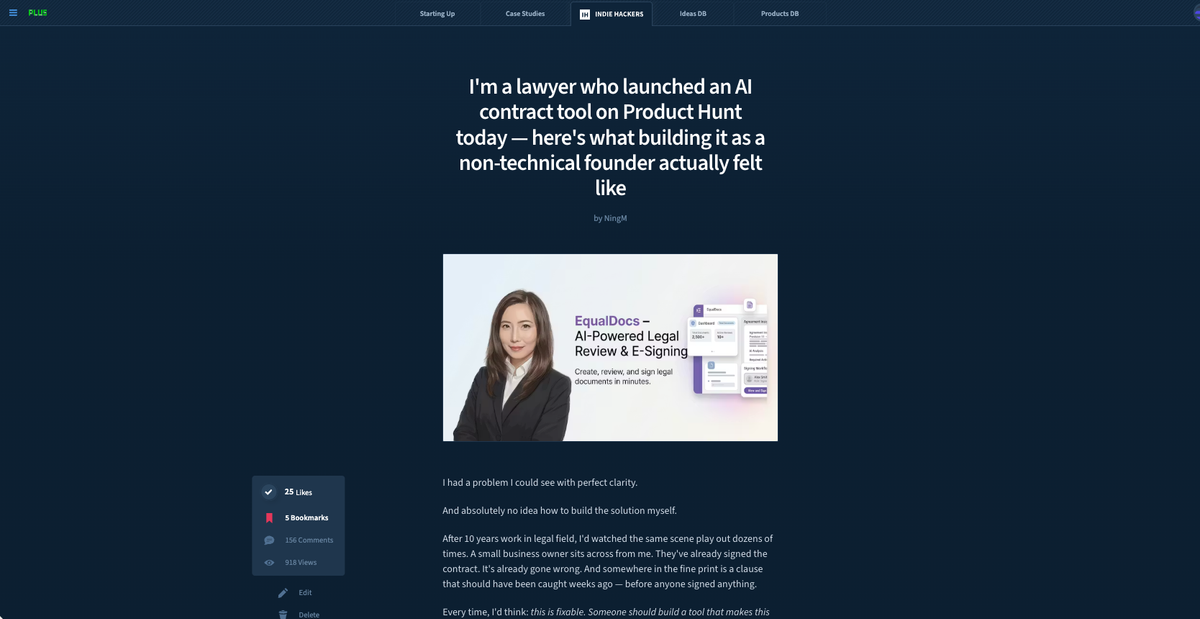
EqualDocs April 20 Upgrade Launch
A months ago I told the Indie Hackers community we were rebuilding. It’s done.
Back in March, someone on IH asked me directly: “The product works, but the UX feels like a v0.1. Are you going to fix it?”
I said yes. And I meant it.
Monday is when it ships.
The honest version of what happened:
I launched EqualDocs on Product Hunt as a lawyer who’d never built software before. I had a clear problem I wanted to solve, and an engineer who believed in it enough to help me build it. The core insight was right — people don’t wake up thinking about “AI contract analysis,” they wake up thinking I’m about to sign this and there’s probably something I’m missing. That anxiety is real, and the product addressed it.
But the experience of using it? We knew it wasn’t where it needed to be. Too many steps. Not obvious enough where to start. The kind of friction that makes a good idea feel hard to trust.
So we rebuilt it. From the interface up.
What’s new in the April 20 release:
1. Cleaner interface — we stripped out everything that wasn’t essential
The old version tried to show you everything at once. The new one shows you what matters first, then gets out of your way. If you’re uploading a contract and want to know the top 3 risks in 60 seconds, that’s now the default path. No setup. No configuration. Just: upload, review, act.
2. Multi-Agent architecture — this is the real upgrade
The previous version used a single AI pass. One model, one read, one output.
I want to be specific about what that means in practice, because “multi-agent” gets thrown around a lot right now.
EqualDocs isn’t a legal Q&A tool. It’s not a smarter chatbot for contracts. What we built is closer to how a law firm’s internal workflow actually runs — different people, different roles, each accountable for a specific part of the review:
- A drafting agent generates or refines contract language with jurisdiction awareness
- A review agent reads clause by clause against your industry and deal context
- A risk agent flags the leverage points and liability traps that get missed under time pressure
They don’t just run in sequence — they cross-check each other. The output isn’t one AI’s best guess. It’s the result of multiple specialized roles running in parallel and verifying each other’s work.
That’s what “law firm workflow in AI” actually means. Not a faster answer. A different process.
Why this matters for complex documents — not just simple contracts
Single-agent AI handles a standard NDA fine. Where it breaks down is the work that actually takes time in legal: multiple contracts with conflicting terms, due diligence packages with 20 attachments, supplementary agreements that modify the original, version conflicts between drafts.
Multi-agent architecture is designed for that complexity. Each agent maintains context across the full document set, not just the page it’s currently reading. If attachment B contradicts clause 7 of the main agreement, that’s the kind of conflict that gets caught — not missed.
What this costs
One thing I didn’t expect to be a differentiator: price.
Most enterprise legal AI is priced for enterprises. Law firms, BigLaw clients, Fortune 500 legal departments. The SME market — importers, exporters, founders signing their first supplier agreement — has largely been priced out.
Multi-agent architecture with smaller specialized models is actually more cost-efficient than one large model trying to do everything. We pass that through. EqualDocs is priced for businesses that don’t have a legal team, not businesses that are trying to replace one.
This matters especially if you’re running a cross-border business. A supplier contract between Canada and China isn’t just a legal document — it’s a set of assumptions about which jurisdiction governs, which language controls, and who’s liable when something goes wrong. A single-pass AI treats that contract like any other document. A multi-agent system can actually reason about the layers.
I’m not a big company. I’m a lawyer who had a clear problem, got help from an engineer to build it, and have been rebuilding it based on what users actually said. When IH users gave hard feedback on the v1 experience, I didn’t spin up a product team. We just went back and fixed it.
Monday is the result.
If you’ve been waiting to try it, or tried v1 and moved on — this is worth another look.
→ Try it free at equaldocs.com → Book a 1-on-1 demo if you want to walk through a real contract together
Ningsi Mei — Founder & CEO, EqualDocs. Lawyer for 10 years. Still learning to ship.