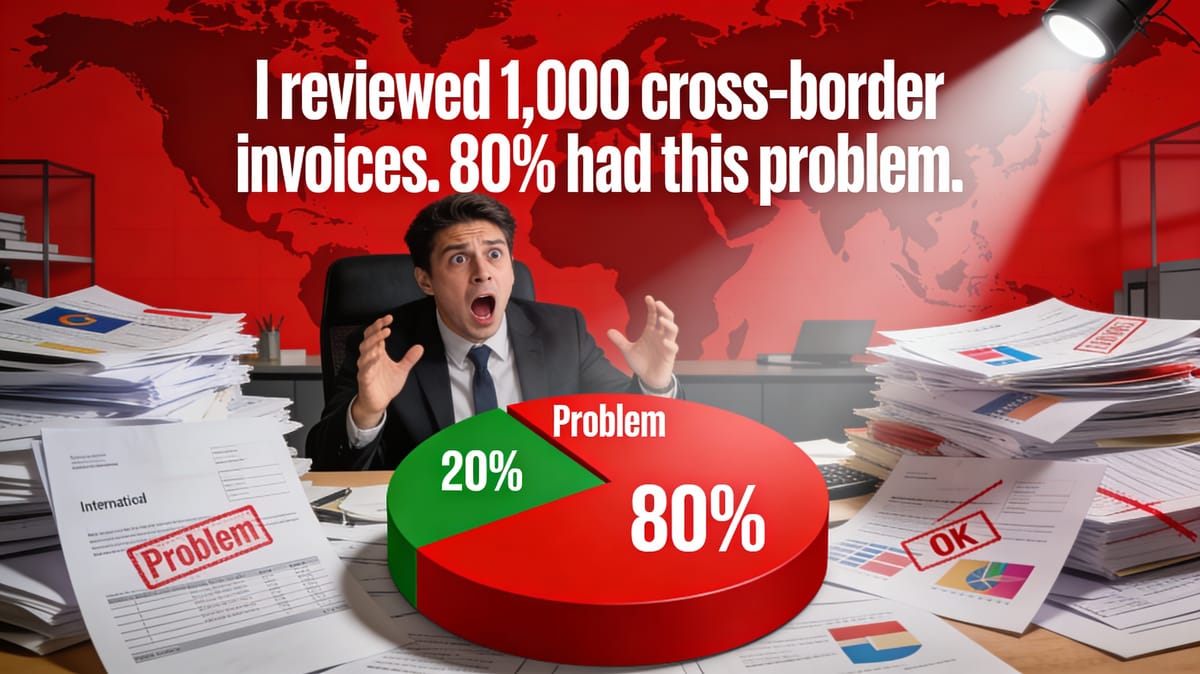
I reviewed 1,000 cross-border invoices. 80% had this problem.

Over the past six months, my team systematically reviewed cross-border trade invoices from businesses in 47 countries.
What we found was sobering.
More than 80% of invoices contained at least one legal deficiency capable of triggering customs holds, tax disputes, or payment delays.
Most of those businesses had no idea — until a shipment was seized, or a wire transfer bounced, and they finally called a lawyer.
Here are the five most common errors we found, each one responsible for real financial losses.
Error 1: Incoterms don't match the underlying contract
The invoice says CIF (seller covers cost, insurance, and freight). The contract says FOB (risk transfers at the port of origin).
This isn't a typo. It's a liability gap. If goods are damaged in transit, both parties have opposite assumptions about who was responsible for insurance. Claims fall through the crack between documents.
We found Incoterms mismatches in 31% of the invoices we reviewed.
Error 2: Wrong or missing HS codes
Customs authorities rely on HS codes to determine tariff rates and import restrictions.
One of our Canadian clients misclassified "industrial lubricants" under a consumer goods HS code. The result: 23 days detained at the Port of Shanghai, and over $18,000 CAD in losses — storage fees, missed delivery windows, and emergency logistics costs.
In certain jurisdictions, HS code errors can be treated as false declaration, carrying fines or import bans.
Error 3: Vague payment terms
"Net 30" — from what date? Invoice date? Delivery date? Acceptance date?
One invoice said "payment within 30 days." The contract said "30 days from receipt and inspection." Each party read it differently. The payment gap was 45 days, and the dispute ended in arbitration.
Complete payment terms require four things: the trigger date, the currency, the exchange rate reference, and late payment penalties. In our review, over 60% of invoices were missing at least one of these.
Error 4: Origin declarations missing or invalid
Claiming preferential tariff rates under trade agreements like CETA or CUSMA requires a valid origin declaration.
What many businesses don't know: once an invoice exceeds €6,000 (EU threshold), a simple notation on the invoice is no longer sufficient. You need a formal statement from an approved exporter.
We found that 22% of the invoices we reviewed qualified for preferential tariff treatment — but paid full duties anyway because the origin declaration was missing or incorrectly formatted.
Error 5: Commercial invoice and customs declaration don't match
The invoice says "Electronic components." The customs declaration says "PCB boards." Same goods — but customs automated matching systems flag the inconsistency, triggering manual review. Best case: a three-day delay. Worst case: weeks of detention.
Quantity, unit of measure, weight, currency — any field mismatch can become the starting point for a serious problem.
Is your invoice compliant?
We've put together a Cross-Border Invoice Compliance Checklist covering 17 critical checkpoints, including:
- Incoterms vs. contract consistency
- HS code classification verification
- Payment terms completeness
- Origin declaration format requirements
- Commercial invoice vs. customs declaration cross-check
Review risks in seconds using EqualDocs AI (Link in comments)
EqualDocs’ contract review feature can audit all the items mentioned above in under a minute and generate a detailed annotated report.
A question for you: Have you or your team ever suffered losses in cross-border trade due to overlooked details in an invoice or contract?
Share your experience in the comments — your story could help someone else avoid the same pitfall.
EqualDocs · Your AI Legal Assistant for Cross-Border SMEs Founded by licensed lawyers from Quebec, Canada · Launched January 2026