Legal AI Has Entered Its Second Half. The Race Is No Longer About the Model

Most people’s first encounter with legal AI is a chatbot that answers questions.
It’s useful. It’s fast. And it’s not what real legal work actually looks like.
Real legal work — contract review, due diligence, compliance checks, multi-document comparison — was never just about generating an answer. It’s a process. Identify the risk. Cross-reference the clause. Compare the versions. Catch the conflict between the attachment and the main agreement. Flag the liability language that shifted between draft 3 and draft 4.
A single AI model doing all of that in one pass is the wrong architecture for the problem.
What we built instead.
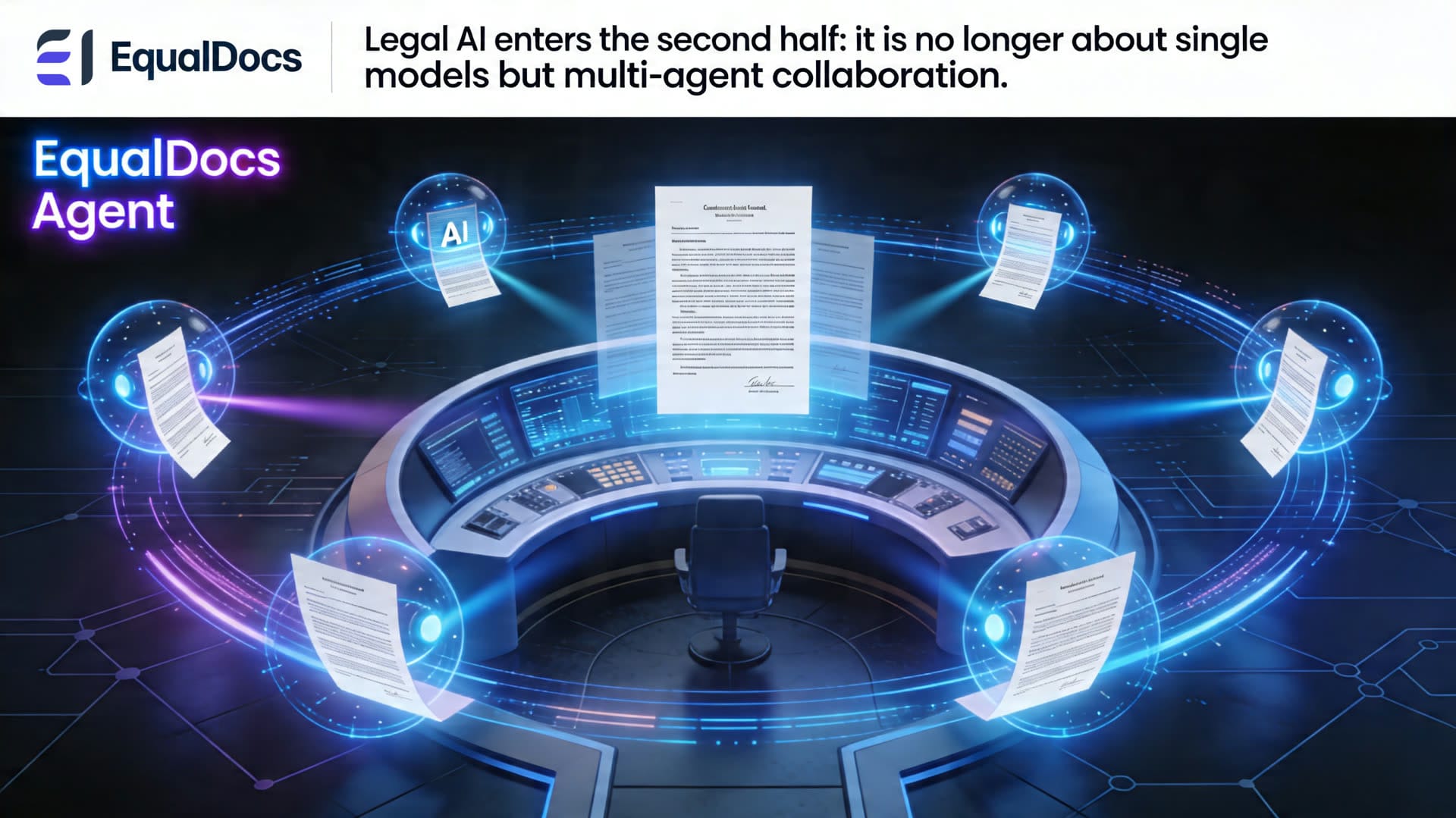
Starting April 20, EqualDocs upgrades to EqualDocs Agent — a Multi-Agent system.
This isn’t a feature update. It’s a structural change in how the product works.
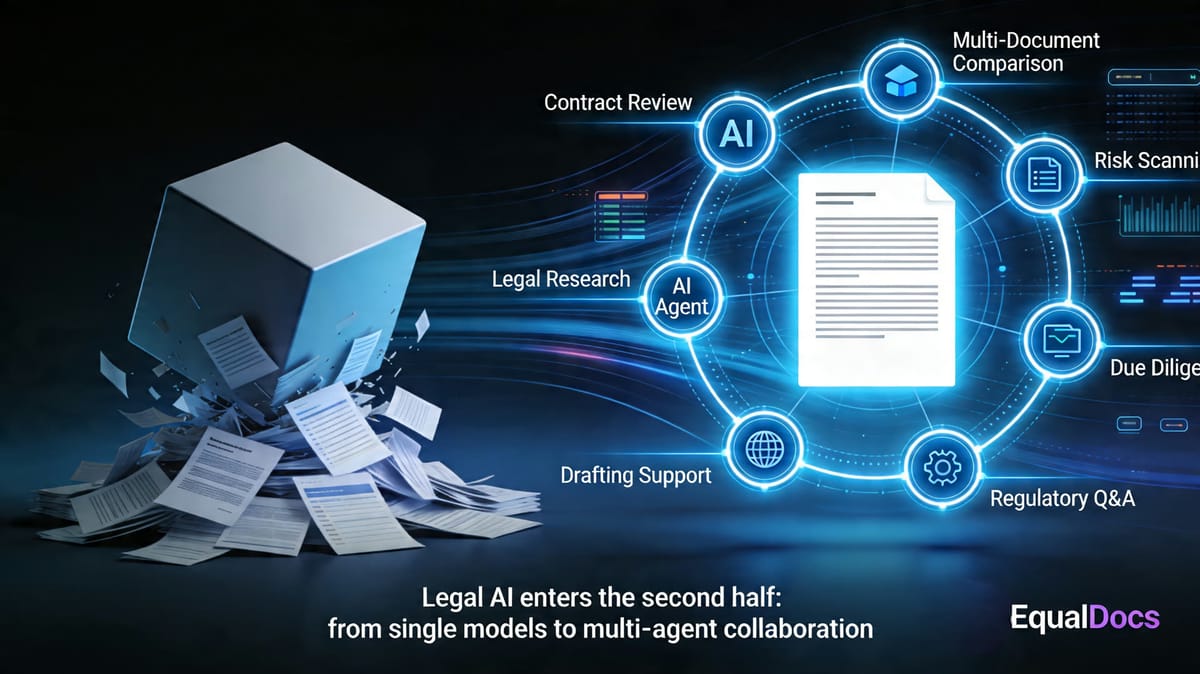
Instead of one model reading a document from top to bottom, the system dynamically allocates specialized agents to work in parallel around the same problem — splitting the task, cross-verifying each other’s outputs, and producing a result that’s been through multiple rounds of internal review before it reaches you.
It’s how a real legal team actually works. Not one person doing everything. A group of specialists, each accountable for one part.
Why this matters — especially for complex documents.
Single-agent AI handles a clean NDA fine. Where it breaks down is the work that actually takes time:
- Main contract and supplementary agreement with conflicting terms
- Attachments that contradict the body of the agreement
- Multiple files with inconsistent party names or liability boundaries
- Due diligence packages across 20+ documents
These aren’t edge cases. They’re the norm in cross-border business. And they’re exactly where a single model sees only the page in front of it, not the conflict three documents away.
EqualDocs Agent maintains context across the full document set. If attachment B contradicts clause 7 of the main agreement — that’s caught, not missed.
Why now, and why does the price point matter.
Legal AI competition used to be about who had the best model. That race is flattening. The new question is: who can build a system that actually does legal work, not just legal answers.
The second shift is on cost. Most enterprise legal AI is priced for enterprises — law firms, BigLaw clients, Fortune 500 legal departments. SMEs have largely been priced out of the tools that would actually protect them.
Multi-agent architecture with smaller, specialized models is more cost-efficient than one massive model trying to handle everything. We pass that efficiency through. EqualDocs Agent is priced for businesses that don’t have a legal team, not businesses that are trying to replace one.
What EqualDocs Agent focuses on:
- Contract review
- Risk scanning
- Multi-document comparison
- Due diligence analysis
- Legal research
- Regulatory Q&A
- Legal drafting assistance
The goal isn’t just speed. It’s certainty — the kind that comes from a process, not a single output.
Legal work at its core isn’t fast. It’s stable.
What we want EqualDocs Agent to bring: more evidence-based review. More layered risk analysis. Clearer reasoning on complex judgment calls. Greater accountability for professional outcomes.
Today, EqualDocs enters the Agent era.
If you’re working on contract review, cross-border compliance, legal research, or risk assessment — try the new version.
→ equaldocs.com
Ningsi Mei — Founder & CEO, EqualDocs. Lawyer for 10 years. Building the system I needed back then.