The Hidden Clauses That Cost Small Businesses the Most

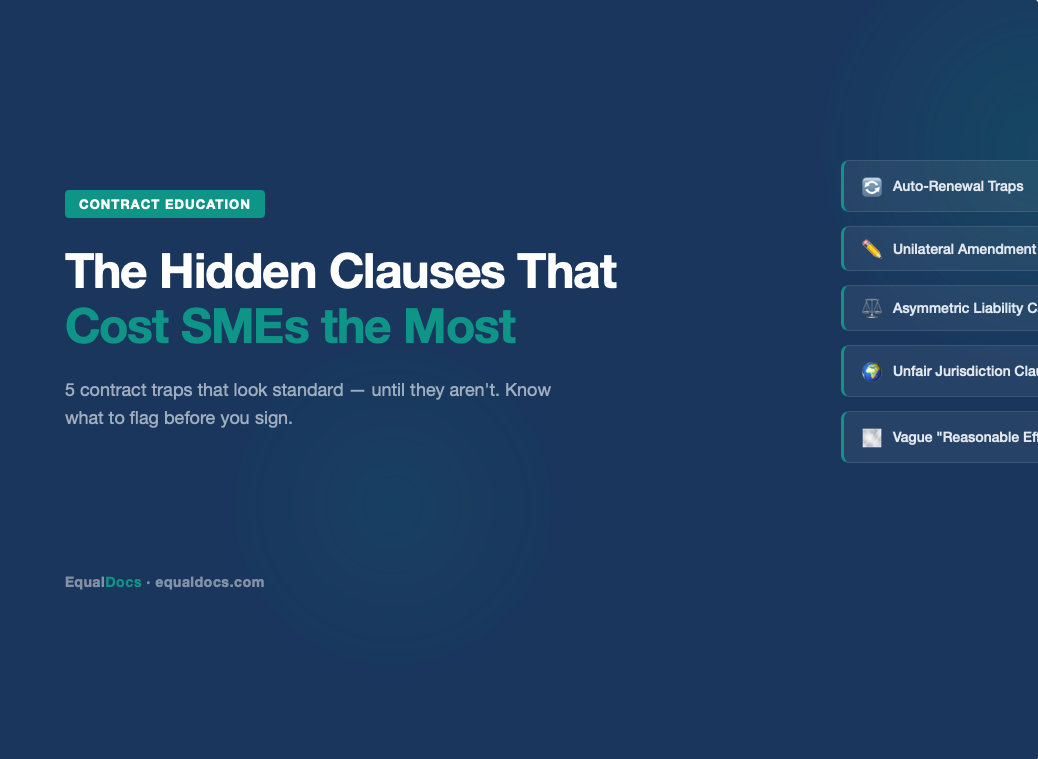
You Read the Contract. You Still Got Burned.
Most small business owners don’t skip contracts. They read them — or at least they try. The problem isn’t carelessness. It’s that the most dangerous clauses are written to be overlooked.
They’re buried in paragraph 14. They use words like “reasonable” and “at our discretion.” They sound standard. They’re not.
EqualDocs was built to catch exactly these clauses — the ones that look fine until they aren’t. Here are the five that show up most often in the contracts our users upload, and what they actually mean for your business.
1. The Auto-Renewal Trap
What it looks like:
“This agreement shall automatically renew for successive one-year terms unless either party provides written notice of non-renewal no less than 90 days prior to the end of the then-current term.”
What it means: You forgot to cancel 90 days in advance. You’re locked in for another year.
Auto-renewal clauses are standard in SaaS subscriptions, vendor agreements, and office leases. The notice window is often buried and the deadline is easy to miss. Many founders discover this clause only after they’ve already been charged for a renewal they didn’t want.
What to do: Flag any clause with “automatically renew,” “successive terms,” or “notice of non-renewal.” Negotiate the window down to 30 days, or add a calendar reminder the moment you sign.
2. Unilateral Amendment Rights
What it looks like:
“The Company reserves the right to modify these terms at any time, with or without notice to the other party.”
What it means: The contract you signed today may not be the contract you’re bound by tomorrow.
This clause is common in platform terms of service, but it also appears in supplier and service agreements. If the other party can change pricing, scope, or obligations without your consent, you don’t have a fixed agreement — you have a moving target.
What to do: Push back on “with or without notice.” At minimum, require 30-day written notice and the right to terminate if you don’t accept the changes.
3. Liability Caps That Only Protect One Side
What it looks like:
“In no event shall [Vendor] be liable for any indirect, incidental, or consequential damages… [Vendor]’s total liability shall not exceed the fees paid in the prior 30 days.”
What it means: If their software fails and costs you 99.
Liability caps are legitimate. Asymmetric liability caps are not. Watch for clauses that cap the vendor’s exposure while leaving yours unlimited — especially in data processing, SaaS, and logistics agreements.
What to do: Check whether the cap applies to both parties equally. If not, negotiate mutual caps or a higher ceiling tied to total contract value.
4. Jurisdiction Clauses (Especially Cross-Border)
What it looks like:
“Any disputes arising under this agreement shall be resolved exclusively in the courts of Delaware, USA, under the laws of the State of Delaware.”
What it means: If something goes wrong, you’re flying to Delaware to sue them.
For a Montreal-based startup dealing with a US vendor, this clause can make litigation practically impossible. The cost of cross-border legal action often exceeds the value of the dispute — which is exactly why the other side puts it there.
What to do: Negotiate for your home jurisdiction, or agree on a neutral arbitration body (like the ICC or AAA) with virtual proceedings. At minimum, understand what you’re agreeing to before you sign.
5. Vague “Reasonable Efforts” Language
What it looks like:
“The Service Provider shall use commercially reasonable efforts to deliver the project within the agreed timeline.”
What it means: “We’ll try.” And if we don’t deliver, we’ll argue about what “reasonable” means.
“Best efforts,” “reasonable efforts,” and “commercially reasonable efforts” are not the same thing — and none of them are as binding as a hard deadline with consequences. This language is a get-out-of-jail-free card for missed deliverables, delayed launches, and underperforming services.
What to do: Replace vague effort standards with specific, measurable obligations. “Deliver Phase 1 by May 15, 2026, with a $500/day penalty for delays exceeding 5 business days” is a contract. “Reasonable efforts” is a wish.
How EqualDocs Catches These Automatically
Spotting these clauses manually requires knowing what to look for — and having the time to look. Most founders don’t have either.
EqualDocs’ Risk Scanner reads your contract and flags:
- Auto-renewal windows with the exact notice deadline highlighted
- Unilateral amendment rights with a plain-language explanation of the risk
- Asymmetric liability caps with a side-by-side comparison of each party’s exposure
- Unfavorable jurisdiction clauses with your geographic context taken into account
- Vague obligation language with suggested replacement phrasing
You upload the contract. In under 60 seconds, you see exactly where the risk is — and what to do about it.
No law degree required.
❓ FAQ
What are the most dangerous hidden clauses in a small business contract?
The five most common hidden clauses that hurt small businesses are: auto-renewal traps, unilateral amendment rights, asymmetric liability caps, unfavorable jurisdiction clauses, and vague “reasonable efforts” language. Each of these can create significant financial or legal exposure that isn’t obvious on a first read.
How can I review a contract without a lawyer?
AI contract review tools like EqualDocs allow small business owners and freelancers to scan contracts for hidden risks in seconds. EqualDocs highlights the exact clauses that need attention and explains them in plain language, so you can make informed decisions without paying 500 per hour for legal review.
Is it safe to sign a contract without legal review?
For standard commercial agreements, AI-assisted review significantly reduces risk. EqualDocs is purpose-built for SMEs and flags the clause types most likely to cause problems — auto-renewals, liability gaps, jurisdiction issues, and more. For high-value or complex deals, we recommend using EqualDocs as your first pass and consulting a lawyer for final review.
Try EqualDocs Free
Upload your next contract and run the Risk Scanner before you sign.
No credit card. No lawyer required. Just clarity.
👉 Try EqualDocs free at equaldocs.comThe Hidden Clauses That Cost Small Businesses the Most
URL slug: hidden-contract-clauses-small-business Date: 2026-04-17 Campaign: Pre-sign Anxiety / EducationKeyword: hidden contract clauses small business Persona: Sarah (startup founder), Alex (freelancer) Featured Image: blogs/banners/hidden-contract-clauses-smb.png
Excerpt: You read the contract. You still got burned. Here are the 5 hidden clauses that quietly cost small businesses the most — and how to spot them before you sign.
You Read the Contract. You Still Got Burned.
Most small business owners don’t skip contracts. They read them — or at least they try. The problem isn’t carelessness. It’s that the most dangerous clauses are written to be overlooked.
They’re buried in paragraph 14. They use words like “reasonable” and “at our discretion.” They sound standard. They’re not.
EqualDocs was built to catch exactly these clauses — the ones that look fine until they aren’t. Here are the five that show up most often in the contracts our users upload, and what they actually mean for your business.
1. The Auto-Renewal Trap
What it looks like:
“This agreement shall automatically renew for successive one-year terms unless either party provides written notice of non-renewal no less than 90 days prior to the end of the then-current term.”
What it means: You forgot to cancel 90 days in advance. You’re locked in for another year.
Auto-renewal clauses are standard in SaaS subscriptions, vendor agreements, and office leases. The notice window is often buried and the deadline is easy to miss. Many founders discover this clause only after they’ve already been charged for a renewal they didn’t want.
What to do: Flag any clause with “automatically renew,” “successive terms,” or “notice of non-renewal.” Negotiate the window down to 30 days, or add a calendar reminder the moment you sign.
2. Unilateral Amendment Rights
What it looks like:
“The Company reserves the right to modify these terms at any time, with or without notice to the other party.”
What it means: The contract you signed today may not be the contract you’re bound by tomorrow.
This clause is common in platform terms of service, but it also appears in supplier and service agreements. If the other party can change pricing, scope, or obligations without your consent, you don’t have a fixed agreement — you have a moving target.
What to do: Push back on “with or without notice.” At minimum, require 30-day written notice and the right to terminate if you don’t accept the changes.
3. Liability Caps That Only Protect One Side
What it looks like:
“In no event shall [Vendor] be liable for any indirect, incidental, or consequential damages… [Vendor]’s total liability shall not exceed the fees paid in the prior 30 days.”
What it means: If their software fails and costs you 99.
Liability caps are legitimate. Asymmetric liability caps are not. Watch for clauses that cap the vendor’s exposure while leaving yours unlimited — especially in data processing, SaaS, and logistics agreements.
What to do: Check whether the cap applies to both parties equally. If not, negotiate mutual caps or a higher ceiling tied to total contract value.
4. Jurisdiction Clauses (Especially Cross-Border)
What it looks like:
“Any disputes arising under this agreement shall be resolved exclusively in the courts of Delaware, USA, under the laws of the State of Delaware.”
What it means: If something goes wrong, you’re flying to Delaware to sue them.
For a Montreal-based startup dealing with a US vendor, this clause can make litigation practically impossible. The cost of cross-border legal action often exceeds the value of the dispute — which is exactly why the other side puts it there.
What to do: Negotiate for your home jurisdiction, or agree on a neutral arbitration body (like the ICC or AAA) with virtual proceedings. At minimum, understand what you’re agreeing to before you sign.
5. Vague “Reasonable Efforts” Language
What it looks like:
“The Service Provider shall use commercially reasonable efforts to deliver the project within the agreed timeline.”
What it means: “We’ll try.” And if we don’t deliver, we’ll argue about what “reasonable” means.
“Best efforts,” “reasonable efforts,” and “commercially reasonable efforts” are not the same thing — and none of them are as binding as a hard deadline with consequences. This language is a get-out-of-jail-free card for missed deliverables, delayed launches, and underperforming services.
What to do: Replace vague effort standards with specific, measurable obligations. “Deliver Phase 1 by May 15, 2026, with a $500/day penalty for delays exceeding 5 business days” is a contract. “Reasonable efforts” is a wish.
How EqualDocs Catches These Automatically
Spotting these clauses manually requires knowing what to look for — and having the time to look. Most founders don’t have either.
EqualDocs’ Risk Scanner reads your contract and flags:
- Auto-renewal windows with the exact notice deadline highlighted
- Unilateral amendment rights with a plain-language explanation of the risk
- Asymmetric liability caps with a side-by-side comparison of each party’s exposure
- Unfavorable jurisdiction clauses with your geographic context taken into account
- Vague obligation language with suggested replacement phrasing
You upload the contract. In under 60 seconds, you see exactly where the risk is — and what to do about it.
No law degree required.
❓ FAQ
What are the most dangerous hidden clauses in a small business contract?
The five most common hidden clauses that hurt small businesses are: auto-renewal traps, unilateral amendment rights, asymmetric liability caps, unfavorable jurisdiction clauses, and vague “reasonable efforts” language. Each of these can create significant financial or legal exposure that isn’t obvious on a first read.
How can I review a contract without a lawyer?
AI contract review tools like EqualDocs allow small business owners and freelancers to scan contracts for hidden risks in seconds. EqualDocs highlights the exact clauses that need attention and explains them in plain language, so you can make informed decisions without paying 500 per hour for legal review.
Is it safe to sign a contract without legal review?
For standard commercial agreements, AI-assisted review significantly reduces risk. EqualDocs is purpose-built for SMEs and flags the clause types most likely to cause problems — auto-renewals, liability gaps, jurisdiction issues, and more. For high-value or complex deals, we recommend using EqualDocs as your first pass and consulting a lawyer for final review.
Try EqualDocs Free
Upload your next contract and run the Risk Scanner before you sign.
No credit card. No lawyer required. Just clarity.