Strengthening Customs and Legal AI Verticals: Analyzing the June 2026 Compliance Adjustments

June 07, 2026
This week, several key adjustments in international trade policies, cybersecurity frameworks, and the legal technology landscape have created new operational requirements for businesses. From stricter importer rules at the U.S. border to the passage of Canada’s new cybersecurity act and OpenAI’s direct entry into the legal tech vertical, cross-border businesses must review their operations to remain compliant.
In this brief, we analyze the four major legal and regulatory developments of the week and detail their immediate implications for small and medium-sized enterprises (SMEs).
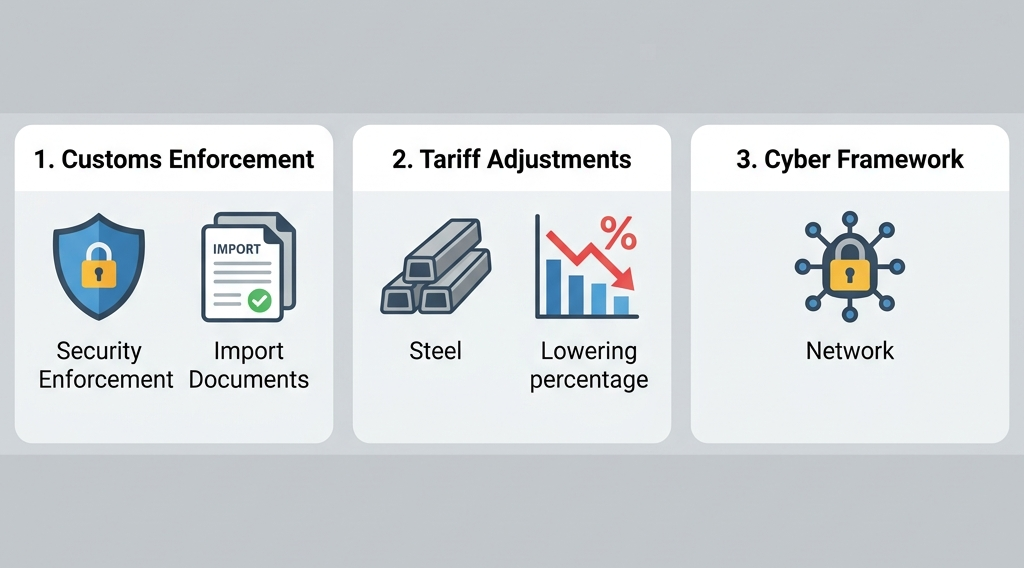
1. U.S. Border Control Overhaul: President Signs “Strengthening Customs Enforcement” Executive Order
On June 3, 2026, President Trump signed a major Executive Order titled “Strengthening Customs Enforcement.” The directive shifts U.S. Customs and Border Protection (CBP) toward aggressive enforcement against customs fraud, duty evasion, and forced labor.
The Executive Order implements three key changes that directly affect importing businesses:
- Stricter Importer of Record (IOR) Requirements: CBP is directed to tighten licensing for IORs. Importers may face higher bond requirements, mandatory disclosures regarding business ownership, and proof of domestic physical assets.
- Low-Value Informal Entry Restrictions: Foreign IORs will face heavy restrictions on using informal entry procedures (e.g., Section 321 de minimis entries) for low-value goods. Instead, they will be forced to route shipments through formal entry processes.
- Minimum Penalty Floors: The order sets a mandatory penalty floor of no less than 50% of the maximum assessed penalty for customs violations and seeks to eliminate administrative mitigation for repeat offenders.
The SME Takeaway: If your business acts as a foreign Importer of Record or ships goods to the U.S., you must prepare for increased audit frequency and higher transaction costs. Review your customs filings for compliance. Ensure your logistics agreements clearly define customs responsibilities and liabilities, as mitigation options for errors will be significantly restricted under the new penalty floors.
2. Dynamic Sourcing Shifts: Section 232 Metals Tariff Adjustments Take Effect June 8
Effective June 8, 2026, a new presidential proclamation modifying the Section 232 tariff regime on steel, aluminum, and copper will go into effect, remaining active through December 31, 2027.
The adjustments include:
- Lowered Rates for Key Categories: Tariffs on specific agricultural machinery (such as harvesters and combines) and certain residential HVAC equipment will drop from 25% to 15%.
- Domestic Sourcing Threshold Shift: The domestic metal content threshold required for products to qualify as “made from U.S. metals” is lowered from 95% to 85%.
- USMCA content limits: For goods qualifying for preferential treatment under the USMCA/CUSMA, the 25% tariff will apply only to the non-U.S. metal content of the product, with a minimum tariff floor of 15%.
The SME Takeaway: Manufacturers and supply chain managers in the agricultural and HVAC sectors should immediately audit their bill of materials (BOM). The drop to 85% for U.S. metals content makes it easier to qualify for tax incentives. For cross-border supply chains, renegotiate procurement contracts to ensure your pricing models adjust dynamically to these updated tariff structures.
3. Canada Establishes New Cybersecurity Framework: Bill C-8 Awaits Royal Assent
On June 4, 2026, the Canadian Senate officially passed Bill C-8 (formerly known as the cybersecurity and telecommunications act), sending it to the final step of awaiting Royal Assent to become law.
The legislation represents a massive overhaul of Canada’s digital infrastructure security:
- Critical Cyber Systems Protection Act (CCSPA): Establishes a mandatory regulatory framework requiring designated vital service operators (finance, telecommunications, energy, and transportation) to implement cybersecurity programs, report incidents, and manage supply chain risks.
- Telecommunications Act Amendments: Grants the federal government the authority to issue binding administrative orders to telecommunications providers. This includes ordering the removal of high-risk equipment or banning products from specific high-risk foreign suppliers.
- Stiff Penalty Penalties: Introduces administrative monetary penalties for operators failing to meet cybersecurity reporting and risk-management guidelines.
The SME Takeaway: While the law directly targets critical infrastructure operators, its effects will cascade down to vendors, subcontractors, and software providers supplying these vital sectors. If your business serves Canadian financial institutions, energy firms, or telecom networks, you must audit your digital security posture to meet these strict supply chain risk-management standards.
4. Legal AI Pivots to Verticals: OpenAI Hires Ironclad CEO Jason Boehmig to Build “AGI for Law”
On June 1, 2026, legal tech pioneer Jason Boehmig—the co-founder and former CEO of contract lifecycle management (CLM) giant Ironclad—joined OpenAI to lead its newly established legal industry vertical.
Boehmig’s role is to act as product lead for OpenAI’s legal sector vertical, with the stated objective to build “AGI for law.” This appointment signals a major pivot for OpenAI: moving away from providing general-purpose foundation models (like GPT-4) and moving toward building specialized, agentic workflows designed to automate complex compliance and legal operations.
The SME Takeaway: Legal tech is shifting from simple chat wrappers to deep, verticalized agentic workflows. When deploying AI for contract lifecycle management or automated compliance, make sure your agreements include clear data-ownership terms. As foundational models become highly specialized, safeguarding your company’s proprietary contract data from being used in public model training remains a top priority.
EqualDocs — Your Digital General Counsel. Global Compliance. Instant Expertise. Learn more about automated compliance at equaldocs.com.