Permanent Tariffs and Modernized Privacy: Navigating the New Cross-Border Regulatory Landscape

Meta Description: The US Supreme Court solidifies Section 301 tariffs on Chinese goods, while USTR opens key comment portals for exclusions and forced labor duties. In Canada, Bill C-36 introduces the most sweeping privacy reform in 25 years. Plus, Relativity launches aiR Assist to scale legal AI.
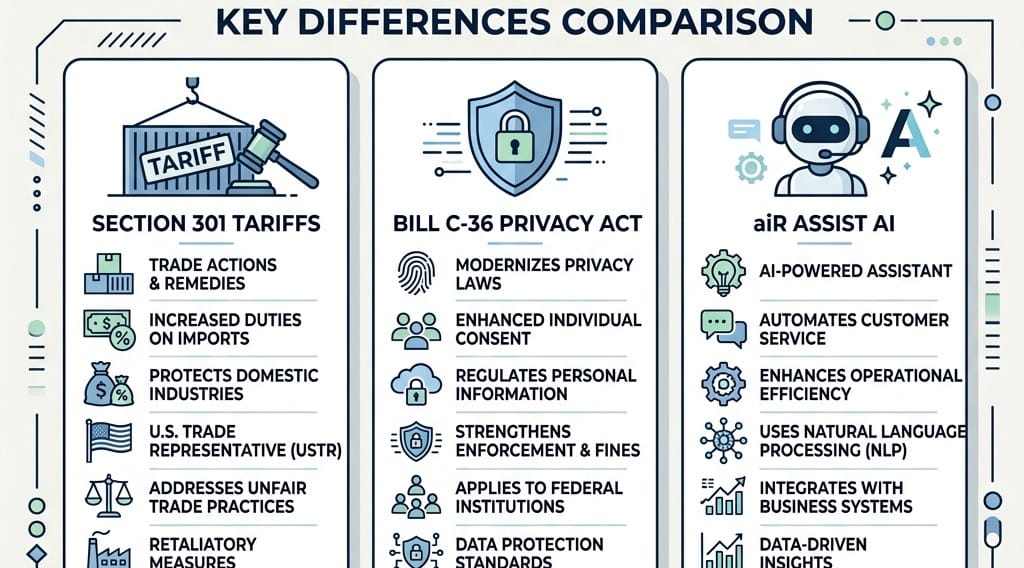
US Supreme Court Ends Challenge to Section 301 Tariffs
On June 15, 2026, the U.S. Supreme Court declined to review a massive legal challenge (HTMX Industries, LLC, et al.) brought by thousands of U.S. importers. The case disputed the federal government’s authority to impose and maintain Section 301 tariffs on hundreds of billions of dollars of Chinese imports originally instituted during the first Trump administration.
By denying the petition for certiorari, the Supreme Court leaves in place the 2025 federal appeals court ruling that upheld the president’s broad authority to enact these duties. This decision brings a six-year, multi-billion-dollar legal battle to a close, establishing absolute legal finality. For cross-border small and medium-sized enterprises (SMEs), this means the Section 301 tariffs are officially permanent operational realities, rather than temporary trade barriers subject to litigation rollback.
USTR Launches Portals for Tariff Modification and Forced Labor Duties
In tandem with the Supreme Court ruling, the Office of the U.S. Trade Representative (USTR) has opened two crucial public comment portals that could shift tariff exposure for importers:
- Forced Labor Tariff Proposals: Following investigation findings that 60 trading partners failed to enforce prohibitions against forced labor imports, the USTR has proposed adding 10% or 12.5% duties to affected goods. Written comments are due by July 6, 2026, ahead of public hearings scheduled for July 7.
- U.S.-China Board of Trade Modifications: Under the newly established U.S.-China Board of Trade, the USTR is accepting public comments until July 10, 2026, allowing businesses to request tariff reductions or exclusions on “non-sensitive” imported Chinese products. This represents a rare window of relief for SMEs to actively campaign for lowering duty rates on critical components.
Canada Introduces Bill C-36: A Massive Privacy Law Overhaul
On June 15, 2026, the Canadian government tabled Bill C-36, the Protecting Privacy and Consumer Data Act (PPCDA). This bill represents the most significant update to Canada’s private-sector privacy legislation in over a quarter of a century and aligns with Canada’s “AI for All” national strategy.
The PPCDA formally establishes privacy as a fundamental right in Canada. It introduces a comprehensive “right to deletion” (with exceptions for fraud and anonymized data), mandates “meaningful consent” for data handling, and restricts “surveillance pricing”—the practice of using individualized user data to adjust prices dynamically. Crucially, the bill moves enforcement authority to a new regulator, the Digital Safety and Data Protection Commission of Canada, which will have the power to issue binding compliance orders and levy significant administrative monetary penalties.
Relativity Launches aiR Assist to Bring Generative AI to Case Workflows
In legal tech, software is evolving from stand-alone tools into deeply integrated intelligence platforms. On June 16, 2026, Relativity announced the general availability of aiR Assist and custom analysis features within Relativity aiR for Review, to be standard for all RelativityOne users by the end of June.
aiR Assist is a native conversational AI engine that allows legal and compliance teams to ask plain-language questions of their case archives. It provides cited, audit-friendly answers to identify facts, outline relationships, and assist in case strategy. Built to scale to 300,000 documents per index, the tool demonstrates how legal operations are shifting away from traditional manual indexing toward real-time, AI-augmented document delivery.
Strategic Checklist for SMEs and Legal Teams
- Assess Tariff Exclusions: Review your supply chain immediately to identify if any imported Chinese components qualify as “non-sensitive” goods, and file modification requests on the USTR portal before the July 10 deadline.
- Audit Canadian Data Handling: If you collect data from Canadian consumers, prepare for Bill C-36 by establishing robust data deletion protocols, reviewing pricing algorithms for surveillance pricing, and drafting clean consent mechanisms.
- Embed Forced Labor Protections: Update supplier agreements to mandate “Reasonable Country of Origin Inquiry” (RCOI) documents and explicit indemnification against customs border hold-ups related to forced labor audits.
- Leverage Integrated E-Discovery AI: Evaluate your legal operations and case management workflows to utilize integrated generative AI platforms like Relativity’s aiR Assist to compress document review times.
Sources
- U.S. Supreme Court: HTMX Industries, LLC, et al. v. United States — Certiorari Denied (June 15, 2026)
- Office of the U.S. Trade Representative (USTR): Public Comment Portals for Section 301 Forced Labor Duties & China Board of Trade Exclusions (June 15, 2026)
- Government of Canada / Parliament of Canada: Introduction of Bill C-36, the Protecting Privacy and Consumer Data Act (PPCDA) (June 15, 2026)
- Relativity / Artificial Lawyer: Relativity Announces General Availability of aiR Assist at RelFest London (June 16, 2026)