Open Models, Chat Integrations, and Grounded Data: The Triple Convergence in Corporate AI

Meta Description: GitHub Copilot integrates its first open-weight model, Kimi K2.7 Code; Kunlun Wanwei Skywork 3.2 launches Skywork Tags to bring AI agents into group chats; Free Law Project and Anthropic partner for verified CourtListener legal data.
The enterprise artificial intelligence landscape is undergoing a silent but significant shift. The initial hype of standalone, closed-source models is giving way to a more practical era of integration. This week, three major announcements highlight this convergence: the entry of open-weight models into mainstream developer environments, the integration of AI agents as active corporate teammates in chat interfaces, and the anchoring of LLMs to verified databases to prevent critical information errors.
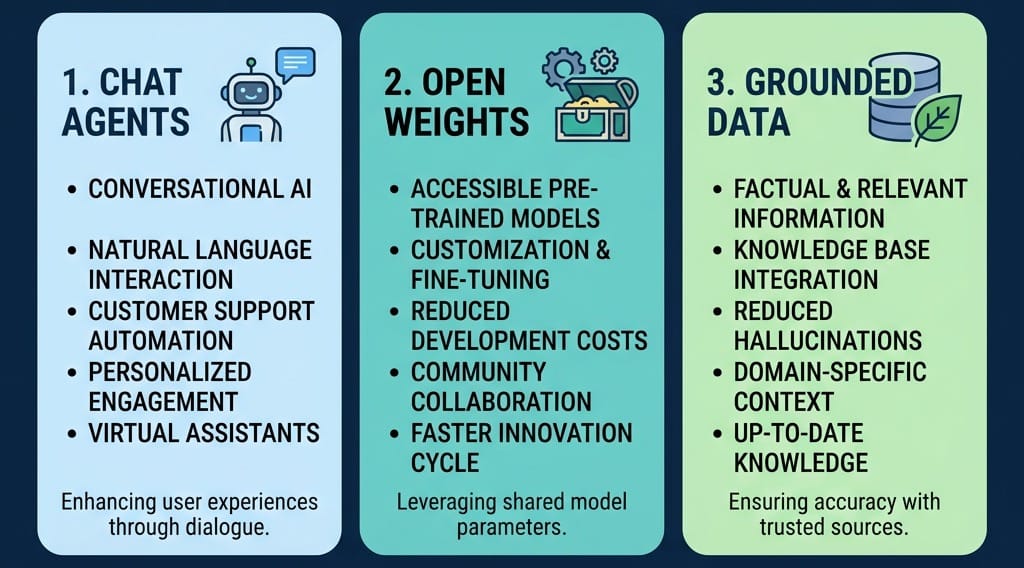
Here is a detailed breakdown of what these developments mean for small and medium-sized enterprises (SMEs) and how they will shape your operations.
1. Open Weights Go Mainstream: Kimi K2.7 Code Joins GitHub Copilot
GitHub has announced that Kimi K2.7 Code is now officially available in the GitHub Copilot model selector. Developed by Moonshot AI, this marks the first time GitHub Copilot has introduced an open-weight model alongside proprietary giants like OpenAI’s GPT-4o or Anthropic’s Claude 3.5 Sonnet.
Hosted directly on Microsoft Azure, the model is billed to enterprise clients based on consumption. It is currently rolling out to Copilot Pro and Max users, allowing developers to switch models dynamically within Visual Studio Code, Visual Studio, and JetBrains IDEs.
The “So What” for SMEs:
For businesses with custom in-house software development, this integration is a massive win for cost efficiency. Open-weight models are significantly cheaper to query at scale than proprietary models. By giving developers the freedom to switch to lower-cost models like Kimi K2.7 Code for standard debugging and refactoring, companies can significantly reduce their software development budgets without sacrificing tool availability or security.
2. AI Agents Join the Team: Skywork Tags Integrates AI into Slack and Feishu
Kunlun Wanwei has announced a major upgrade to its Skywork 3.2 platform, introducing Skywork Tags. This feature allows businesses to deploy AI agents directly into group chats on Slack, Discord, Telegram, Feishu, and DingTalk as formal team members.
Instead of navigating back and forth between a separate browser window and the team chat, employees can simply type @Skywork in their existing group channels to invite the AI to summarize discussions, search internal documentation, or execute background workflows.
The “So What” for SMEs:
While this increases convenience, it also creates significant data security and compliance risks. Once an AI agent is added to an internal group chat, it has access to the full conversational history and any attachments shared in that channel. SMEs must ensure that their company data policies are strictly updated. You must establish boundaries on what channels these bots can enter to prevent the accidental sharing of client privacy, payroll data, or trade secrets with external model training pipelines.
3. Fighting “Hallucinations”: Claude Integrates CourtListener via MCP
To address the recurring issue of AI “hallucinations”—where language models invent non-existent precedents and citations—Anthropic has partnered with the Free Law Project to integrate the CourtListener database into Claude via the Model Context Protocol (MCP).
CourtListener is a massive, verified public resource containing federal and state court opinions, judge profiles, and oral arguments. By using the CourtListener MCP connector, Claude can ground its responses directly in verified databases. This provides lawyers, researchers, and pro se litigants with cited, verifiable references, preventing the embarrassment and sanctions associated with submitting fake citations in legal documents.
The “So What” for SMEs:
Grounding AI in verified data is a critical safety step for corporate compliance. When SMEs use AI assistants to draft agreements, check local regulations, or analyze employee handbooks, they need to know that the referenced codes are real. Using tools that leverage MCP connectors to search verified databases reduces the risk of legal mistakes that could lead to costly contract disputes.
Key Action Checklist for Businesses
- Review Chat Permissions: Audit your Slack or Feishu workspaces to see if employees have added external AI bots. Set strict admin controls on which channels bots can join.
- Optimize Developer Budgets: Encourage your technical team to test open-weight options like Kimi K2.7 Code in GitHub Copilot for routine code reviews to lower query costs.
- Audit Legal AI Tools: If your external law firm or in-house counsel uses AI assistants, ask them to verify that their tools are grounded in verified databases like CourtListener.
For instant, expert compliance guidance and automated document review, visit EqualDocs.