Navigating the June 2026 Compliance Storm: New Section 301 Tariffs, EU AI Act Deferrals, and Canada’s Expanding Disclosure Rules

June 06, 2026
As we enter the first week of June 2026, small and medium-sized enterprises (SMEs) operating across borders are facing a wave of regulatory changes. From sudden tariff proposals in the United States to delayed timelines under Europe’s landmark AI Act and localized franchise laws in Canada, business compliance requirements are moving faster than ever.
In this daily brief, we break down the four key regulatory and legal tech shifts that occurred this week, highlighting what they mean for your business operations and commercial agreements.
1. The Tariff Shake-up: USTR Proposes Forced Labor Section 301 Tariffs (USMCA Safeguards)
On June 2, 2026, the U.S. Trade Representative (USTR) initiated a public comment period proposing new Section 301 tariffs on 60 trading partners. The proposed action follows an extensive investigation into forced labor enforcement globally.
The proposed framework introduces a two-tiered tariff system:
- 10% Additional Tariff: For countries with an active anti-forced labor framework (including Canada, Mexico, the United Kingdom, and the European Union).
- 12.5% Additional Tariff: For countries with minimal to no prohibitory measures (including China, India, and Brazil).
The Crucial Safeguard for SMEs
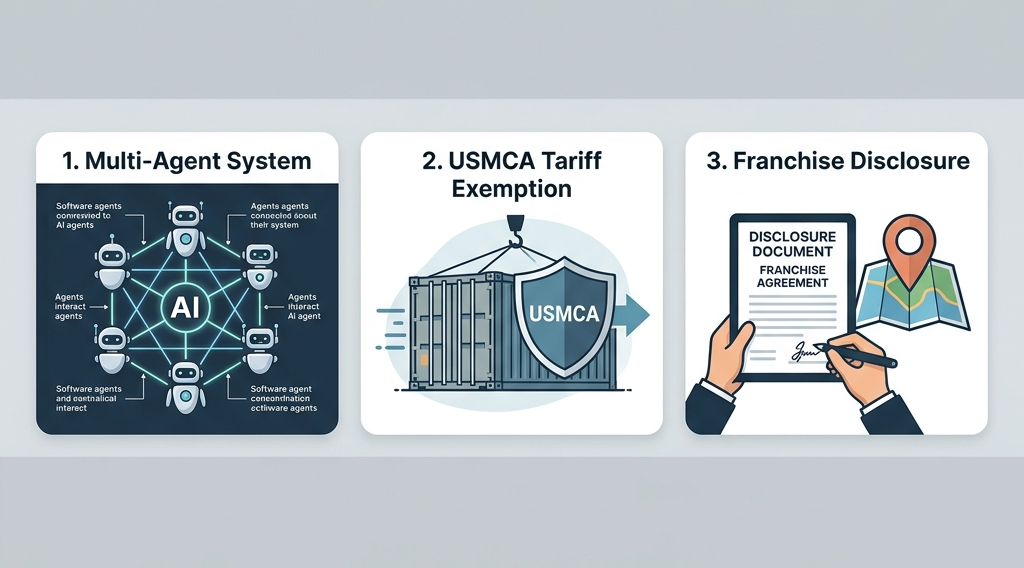
Crucially for North American businesses, the proposal includes a major exemption: goods that are fully compliant with the United States-Mexico-Canada Agreement (USMCA/CUSMA) rules of origin are exempt from these additional duties.
The SME Takeaway: If your business imports components into the U.S. from Canada or Mexico, you must immediately audit your supply contracts. Ensure that your suppliers provide certified documentation verifying compliance with USMCA rules of origin. Additionally, insert a “Tariff-Adaptation Clause” in long-term supply agreements to allocate liability should your products fail to meet the exemption requirements during customs audits.
2. Breathing Room for AI Developers: EU AI Act Timelines Officially Deferred
Following a provisional agreement reached in May 2026 regarding the “Digital Omnibus on AI,” the European Union has officially shifted its implementation timelines for the EU AI Act to simplify compliance for businesses.
- Annex III High-Risk Systems (Use-Based): Compliance obligations have been deferred from August 2, 2026, to December 2, 2027.
- Annex I High-Risk Systems (Product-Regulated): Compliance deadlines have moved from August 2, 2027, to August 2, 2028.
- Generative AI Transparency (Article 50): The deadline for machine-readable marking requirements for existing models is extended to December 2, 2026.
Additionally, the European Commission released draft guidelines clarifying the interpretation of “high-risk” classification under Article 6, with public feedback open until June 23, 2026.
The SME Takeaway: While this provides a massive sigh of relief and valuable breathing room for software developers and companies integrating AI, it is not an excuse to pause compliance planning. Businesses should use the draft Article 6 guidelines as a development roadmap. Keep in mind that extra-territorial reach means any SaaS tool targeting European clients must comply, and commercial agreements should start allocating risk for future audit and transparency demands.
3. Canadian Franchise Shake-up: Saskatchewan’s Franchise Disclosure Act Takes Effect June 30
For businesses expanding through franchise models in Canada, Saskatchewan’s The Franchise Disclosure Act and its accompanying regulations will officially come into force on June 30, 2026. This makes Saskatchewan the seventh Canadian province to implement franchise-specific disclosure legislation.
Under the new law:
- 14-Day Rule: Franchisors must provide prospective franchisees with a compliant Franchise Disclosure Document (FDD) at least 14 days before signing any agreement or accepting non-refundable fees.
- Rescission Rights: Non-compliance carries severe penalties. Franchisees gain a statutory right to rescind (cancel) the franchise agreement within 60 days if the FDD is deficient, and up to two years if the franchisor failed to provide an FDD altogether.
- Saskatchewan-Specific Addenda: Standard national FDDs must be customized with local risk warnings, director/officer certificates, and the designation of an agent for service within the province.
The SME Takeaway: Franchisors planning expansions into Saskatchewan must pause and update their legal templates before June 30. Entering into agreements using outdated FDDs could expose your brand to massive rescission claims and refund liabilities.
4. Legal AI Evolution: Filevine Launches Agentic “LOIS” Console to Accelerate Firm Workflows
On June 2, 2026, legal management platform Filevine announced the launch of its Legal Operating Intelligence System (LOIS). Representing a shift from simple search chatbots to true “agentic” software, LOIS is designed to connect directly with a law firm’s core database.
Instead of just summarizing documents, LOIS behaves as a virtual staff member: it can draft specialized documents, update calendars, create task lists, and monitor deadlines across an entire matter.
The SME Takeaway: The legal industry is rapidly transitioning from “feature-based” AI tools to “agentic” platforms that manage end-to-end workflows. This allows traditional firms to speed up contract drafting, review, and matter management. When collaborating with external counsel or implementing internal tools, ensure that your vendor agreements include strict data privacy terms. Restrict the vendor’s ability to use your proprietary business contracts to train their AI models.
EqualDocs — Your Digital General Counsel. Global Compliance. Instant Expertise. Learn more about automated compliance at equaldocs.com.