Navigating Evolving Tariffs, Legal AI Upgrades, and the Deferred EU AI Act Timelines

By Ningsi Mei, Co-founder of EqualDocs | May 29, 2026
Compliance management for small-to-medium enterprises (SMEs) is undergoing a major evolution. For cross-border business owners and tech founders, staying ahead of regulatory compliance and technological shifts is no longer a luxury—it is a core survival requirement. Today, three critical developments across international trade, legal tech, and global artificial intelligence regulations are reshaping how SMEs manage contract liability, supplier origins, and software tools.
Here is the strategic breakdown of what happened today, and what it means for your business.
🌐 USMCA Joint Review: U.S. and Mexico Launch Talks Amid Steel Tariff Friction
On May 28–29, 2026, bilateral negotiating teams from the United States and Mexico kicked off a crucial series of talks in Mexico City. Led by Deputy U.S. Trade Representative Jeff Goettman, these sessions are the opening salvo in preparation for the mandatory USMCA (CUSMA) Joint Review scheduled to officially commence on July 1, 2026.
The stakes are high. The Joint Review will decide whether the free trade agreement is renewed for another 16 years, or if it enters a state of uncertainty that could lead to its termination. During the initial rounds, U.S. trade officials have maintained a hardline stance, signaling that tariffs on North American partners will remain active as long as the U.S. faces significant trade deficits.
Concurrently, Mexico is raising strong opposition to the U.S. 50% Section 232 tariffs on Mexican steel and aluminum, labeling them “unsustainable.” Mexico plans to push for a systemic automotive sourcing agreement that does not rely exclusively on tariff penalties.
The “So What” for SMEs:
If your business imports or exports goods across North American borders, tariff volatility and changing rules of origin are direct threats to your margins.
- Audit Your Bill of Materials (BOM): With rules of origin for industrial and automotive goods under heavy renegotiation, you must audit your upstream supplier origins to ensure you maintain tariff-free preferences.
- Build Tariff-Adaptation Clauses: Do not rely on fixed-price shipping or supply contracts. Update your agreements via EqualDocs to include automatic price adjustments or exit clauses triggered by tariff changes.
🤖 Legal AI Sector: SimpleAI Launch and Crimson’s $2.5M Seed Round
In the legal tech sector, AI is shifting from standalone chat tools directly into the environments where lawyers and business owners already work.
First, the Illinois State Bar Association (ISBA) announced a partnership with SimpleDocs on May 28, 2026, to provide its members with access to SimpleAI. Rather than requiring lawyers to copy and paste text into an external browser, SimpleAI operates directly within Microsoft Word, automating transactional document analysis, risk detection, and contract drafting in real-time.
Second, Crimson, a London-based litigation and document drafting AI startup, announced the closure of an oversubscribed $2.5 million seed funding round led by Y Combinator. Crimson, which helps legal teams parse complex evidence, draft documents, and manage case workflows, is expanding its footprint with a new office in New York.
The “So What” for SMEs:
AI legal tools are rapidly integrating into daily business software. By adopting platforms like EqualDocs, small business owners gain access to the same grade of contract analysis and risk identification as enterprise legal teams—without the $400-per-hour lawyer fees. The integration of AI into Microsoft Word and daily workflows shows that contractual protection is becoming frictionless.
📋 EU AI Act: Key Compliance Deadlines Postponed
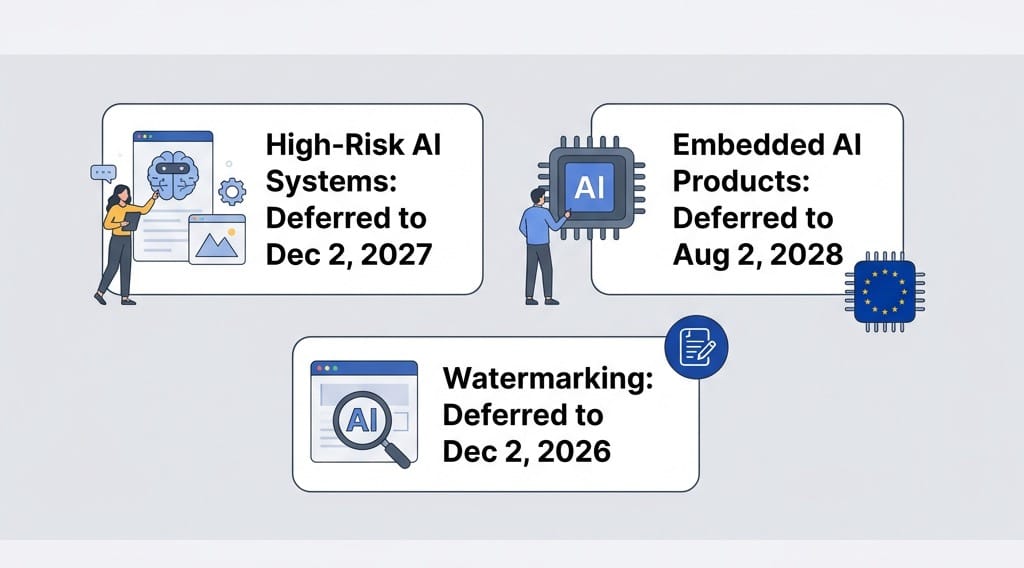
In a major relief for businesses worldwide, the European Commission provisionally agreed to the “Digital Omnibus on AI” in late May 2026. This omnibus package delays several key compliance deadlines for the EU AI Act to give companies more time to prepare their governance frameworks:
- Standalone High-Risk AI Systems (Annex III): The compliance enforcement deadline has been moved from August 2, 2026, to December 2, 2027.
- Embedded High-Risk AI Systems (Annex I): Enforcement is deferred to August 2, 2028.
- Watermarking & Synthetic Transparency (Article 50): The deadline for machine-readable watermarking of synthetic content is pushed back to December 2, 2026.
The European Commission also published draft guidelines on May 19, 2026, to clarify which systems qualify as “high-risk,” opening a public consultation that runs through June 23, 2026.
The “So What” for SMEs:
While the extensions provide breathing room, the regulatory trajectory has not changed. Businesses using AI for document generation, HR screening, or client services should use this grace period to establish an AI tool inventory and perform risk assessments. EqualDocs helps you maintain compliance with evolving transparency rules by ensuring your AI-generated contracts are traceable, clear, and legally compliant.
EqualDocs is your digital general counsel. We provide small businesses with automated, compliant contract drafting and review. Try it free today at equaldocs.com.