Governing the Autonomous Agent: What the AI AGENT Act and New Ethics Rules Mean for Businesses

Meta Description: U.S. Senator Mark Warner drafts the AI AGENT Act to regulate autonomous AI agents; Ohio Supreme Court issues new AI ethics guidance for legal professionals; EU adjusts compliance timelines for the EU AI Act.
As artificial intelligence moves from static drafting assistants to autonomous agents that act on behalf of businesses, the regulatory landscape is shifting at breakneck speed. For small and medium-sized enterprises (SMEs), keeping track of these updates is no longer optional—it is a core risk management priority. This week, three major regulatory updates from the US and EU have outlined the future of autonomous agent governance.
1. The AI AGENT Act: The U.S. Federal Bid to Regulate Autonomous Bots
On June 29, 2026, Senator Mark Warner (D-Va.) released a draft bill titled the AI AGENT Act (Artificial Intelligence Access, Gatekeeper Exchange, and Nondiscriminatory Transfer Act). The bill addresses the rise of autonomous AI systems acting as intermediaries in commerce—negotiating agreements, executing transactions, or buying inventory on behalf of businesses.
Key provisions include:
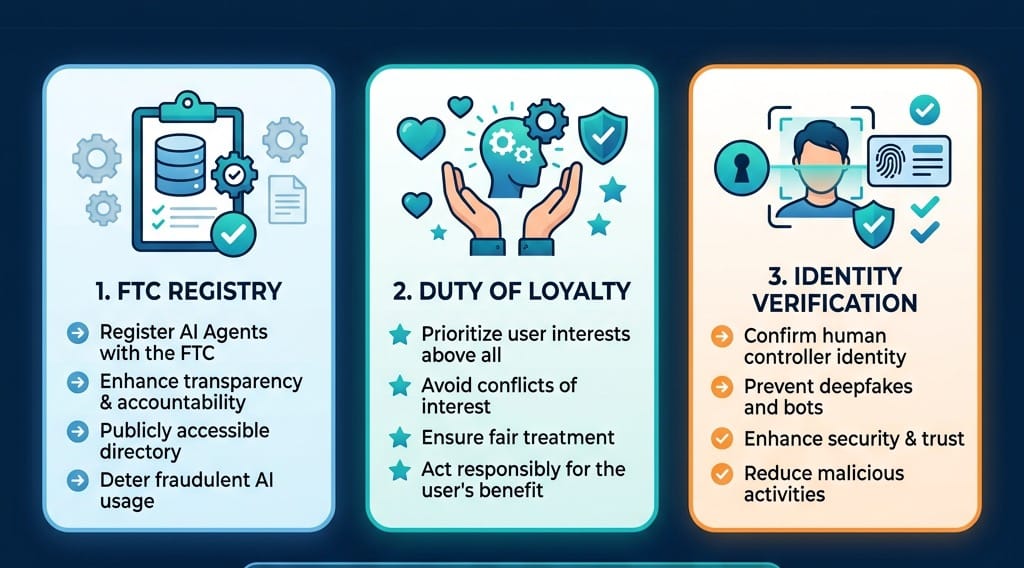
- The FTC Registry: The Federal Trade Commission will manage a database of “custodial user agents” (CUAs). Platforms with more than 50 million monthly active users must provide fair access only to registered agents.
- The Duty of Loyalty: In a landmark move, the draft establishes a fiduciary-style “duty of loyalty” for AI agents. An agent must act in the sole interest of its human user. It cannot secretly prioritize specific suppliers, vendors, or platforms because of backend kickbacks or developer affiliate fees.
- Identity Mapping: Providers must link every autonomous agent to a verifiable human operator, ensuring there is always a legal entity accountable for the agent’s actions.
The “So What” for SMEs:
If your business is planning to use AI agents to automate purchasing, vendor negotiations, or client scheduling, the AI AGENT Act will change the liability model. When these bots register with the FTC, your business must ensure the developer contract contains strict compliance assurances. You must be legally protected if an agent violates its duty of loyalty or incurs unauthorized expenses.
2. Ohio Supreme Court Sets Rules for Ethical Legal AI Use
On June 30, 2026, the Supreme Court of Ohio published its official Ohio Ethics Guide: Artificial Intelligence for Lawyers and Judicial Officers. Rather than discouraging the use of AI, the guide serves as a practical blueprint for integrating Large Language Models (LLMs) into law practices and judicial duties.
The guide outlines that while lawyers can use AI for legal research, contract drafting, and document analysis, they remain fully responsible for the final output. Crucially, the court emphasizes:
- No Unverified Citations: Lawyers must check all AI outputs for “hallucinated” citations. Self-represented litigants and, increasingly, licensed practitioners have faced sanctions for submitting fabricated case laws generated by AI.
- Client Confidentiality: Inputting sensitive case data into public AI models violates client confidentiality. Any tool used must feature enterprise-grade data protection.
The “So What” for SMEs:
When hiring external counsel or using digital legal tools, SMEs should ask: Is this service compliant with Supreme Court guidelines like those of Ohio? Traditional law firms must actively verify AI-drafted contracts, ensuring that the cost-saving benefits of AI are safely passed to the client without compromising quality or introducing critical legal errors.
3. EU Relaxes High-Risk Timelines under the EU AI Act
Across the Atlantic, the Council of the EU finalized amendments to the EU AI Act on June 29, 2026. The new legislative package aims to simplify administrative burdens and extend compliance deadlines for software companies.
Under the new terms, stand-alone high-risk AI systems have had their compliance deadlines pushed to December 2027, and embedded high-risk systems are delayed to August 2028. Additionally, the act introduces immediate, strict bans on using AI to generate non-consensual deepfakes.
The “So What” for SMEs:
The delayed compliance timelines give software developers more breathing room to align their products with the rigorous standards of the EU AI Act. For SMEs importing or exporting digital services to Europe, this buffer minimizes the immediate risk of software disruptions due to non-compliance. However, the absolute ban on non-consensual deepfakes means businesses must enforce strict usage policies internally to prevent intellectual property and reputational liabilities.
Action Plan for Small Businesses
- Audit AI Implementations: Catalog all tools in your workflow that act autonomously (e.g., automated email follow-ups, chatbots, or automated bidding tools).
- Verify Data Privacy: Confirm with your vendor contracts that no sensitive business or client data is being used to train public LLM models.
- Draft Agent Loyalty Agreements: If you deploy custom AI agents, work with a digital general counsel to draft strict guidelines ensuring these bots do not engage in unauthorized transactions.
For instant, expert compliance guidance and document review, visit EqualDocs.