From Chatbots to Agentic Operating Systems: The Next Phase of Legal AI Integration

July 7, 2026
The legal technology sector is moving away from basic chatbot interfaces and heading straight toward comprehensive workflow automation. In early July 2026, major industry moves—ranging from enterprise product launches to BigLaw partnerships and B2B acquisitions—reveal a clear trend: the winning tools are no longer just “smart assistants.” They are fully integrated operational systems that manage the entire lifecycle of legal operations.
For small and medium-sized enterprises (SMEs), this evolution represents a major opportunity to automate document workflows and eliminate administrative bottlenecks without adding headcount. Today, we break down three major updates in the legal tech space and what they mean for your business.
1. Spellbook Launches “Autonomous Contract Management” (ACM)
Legal tech pioneer Spellbook has officially launched Autonomous Contract Management (ACM), an end-to-end AI workflow system designed specifically for enterprise agreements. Unlike traditional Contract Lifecycle Management (CLM) systems that require extensive manual tagging and routing, ACM aims to automate the entire lifecycle.
The system handles intake, performs first-pass risk reviews, tracks negotiation edits, and manages final storage. This launch follows a Spellbook Labs study of over 3,000 public contracts, which found that 60% contained drafting errors—with 40% of those classified as “high-risk.”
The “So What” for SMEs:
For small businesses, traditional CLM platforms are often too expensive and complex to implement. Spellbook’s shift to “Autonomous Contract Management” shows that the market is moving toward zero-setup, agentic systems. SMEs can now use AI to automate the tedious work of tracking contract negotiations and identifying high-risk clauses before signing, significantly reducing transaction costs and legal errors.
2. Fasken Partners with Legora to Deploy Agentic Workspaces Firmwide
Top Canadian law firm Fasken has announced a strategic partnership with Legora, an “agentic operating system” built for legal professionals. Fasken plans to deploy Legora’s collaborative AI workspace firmwide.
The goal is to enhance efficiency in reviewing, analyzing, and drafting complex legal documents. Instead of lawyers copying and pasting text into separate AI tools, Legora functions as a firmwide operating system that runs multi-step workflows directly within the firm’s document repositories.
The “So What” for SMEs:
When elite law firms integrate agentic operating systems, it signals that the speed of legal service delivery is about to accelerate. For SMEs who hire external counsel, this means you should expect faster turnaround times and more transparent pricing. It also highlights a key operational lesson: true efficiency does not come from using isolated chatbots, but from integrating AI directly into your daily document workflows.
3. Hyve Acquires LegalTechTalk to Enter the “Legal SuperVertical”
Global events giant Hyve has announced the acquisition of LegalTechTalk, one of Europe’s leading legal technology and transformation conferences. This acquisition is a key component of Hyve’s “Ascend30” growth plan to expand into high-value B2B sectors.
The transaction signals massive capital interest in the legal tech sector, with the organizers already planning a major U.S. expansion event in Miami for 2027.
The “So What” for SMEs:
Capital consolidation in the legal tech space means that the tools SMEs rely on will become more stable, well-funded, and widely adopted. Legal tech is no longer a niche market; it is a mainstream business priority. As investment floods the sector, expect to see more user-friendly, enterprise-grade tools tailored to help small businesses automate compliance and contract operations.
Actionable Strategy: Transitioning to Workflow Automation
To leverage these industry shifts for your business:
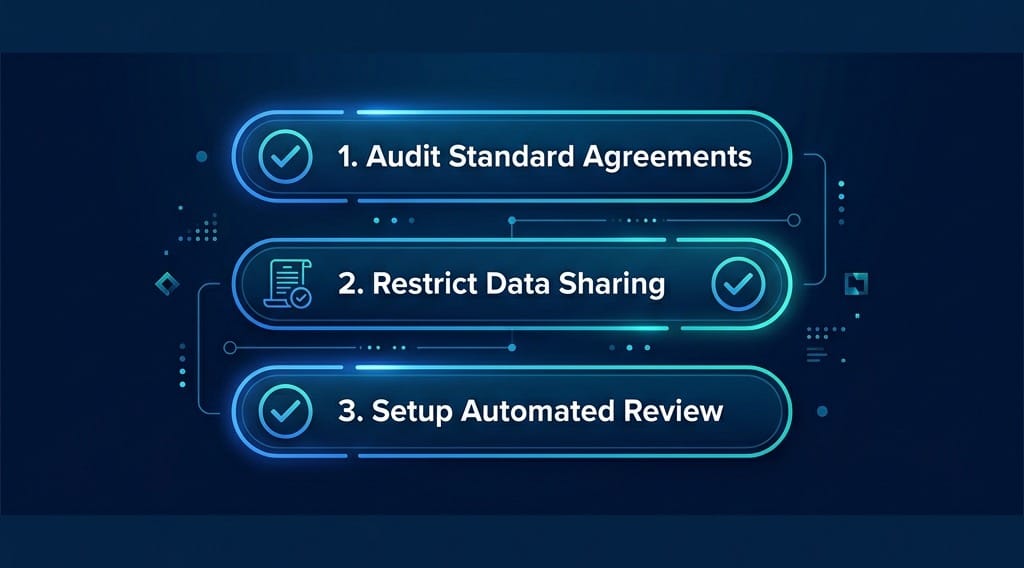
- Move Beyond Chatbots: Stop copying and pasting contracts into general AI chat windows, which exposes your business to data-sharing risks.
- Implement Flow-Based Reviews: Standardize your contract review process by using tools that automatically flag missing or high-risk clauses based on pre-defined guidelines.
- Focus on Integration: Choose tools that connect directly to your document storage, ensuring that every contract is automatically categorized, audited, and logged.
EqualDocs — Your Digital General Counsel | equaldocs.com