Democratizing Legal Access and the Governance Deficit: A Look at Corporate AI This Week

Meta Description: Descrybe launches its legal research engine in the ChatGPT App Directory; Frontline Justice and Josef expand the Frontline Q AI assistant for SNAP benefits; Litera report finds Fortune 1000 legal departments lag in AI risk governance.
The democratization of legal knowledge is accelerating, placing professional-grade research and compliance tools directly into the hands of non-lawyers. However, as public AI platforms and specialized tools become more accessible, corporate legal leaders are warning of a significant “governance deficit.” This week’s updates demonstrate how specialized AI is breaking down barriers to justice while highlighting the urgent need for robust compliance frameworks in the enterprise.
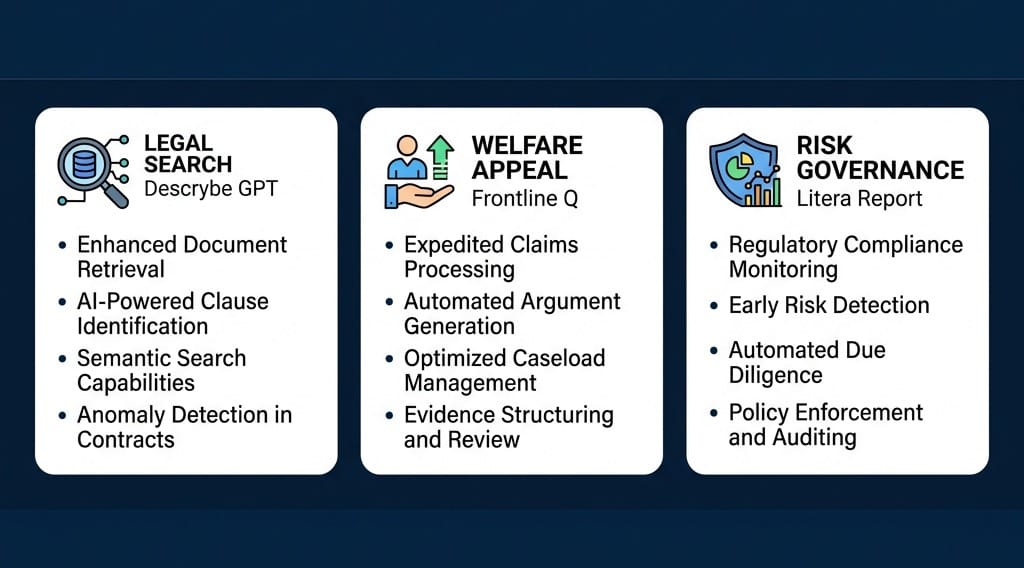
1. Descrybe Legal Engine: Professional Research for Every ChatGPT User
Legal technology startup Descrybe has announced the launch of its legal research engine in the ChatGPT App Directory (formerly the GPT Store). The tool allows users to query verified court opinions, statutory codes, and case citations directly inside the standard ChatGPT chat interface.
Rather than relying on general knowledge, which is prone to hallucinations, the Descrybe GPT grounds its answers in verified legal databases. It provides source citations with direct links, allowing users to verify the case law behind every AI answer.
The “So What” for SMEs:
For small and medium-sized enterprises (SMEs) that cannot afford expensive legal databases like Westlaw or LexisNexis, Descrybe’s integration makes initial compliance checks and regulatory research virtually free. Business owners can search for local business rules or standard lease regulations using natural language, gaining an initial overview before engaging external counsel.
2. Frontline Q: Deploying AI to Navigate Complex Social Benefits
In a significant move for public interest tech, Frontline Justice has partnered with legal automation platform Josefto launch “Frontline Q.” The tool is an AI-powered assistant designed to help community justice workers and advocates challenge wrongful denials of Supplemental Nutrition Assistance Program (SNAP) benefits.
Following a successful pilot program in Alaska, the tool is expanding to Arizona and Texas. Built on Josef’s platform, the tool uses a curated database of state and federal regulations to help advocates identify administrative errors and draft appeal letters. Crucially, the system features oversight from legal aid attorneys to verify the accuracy of the generated arguments.
The “So What” for SMEs:
Frontline Q represents a successful model for deploying AI in regulated environments: combining structured database queries with expert human oversight. For businesses looking to automate internal operations, the lesson is clear: AI should act as a force multiplier for trained personnel, backed by a clear layer of expert review to prevent operational and compliance errors.
3. The Litera Report: The Gap Between AI Adoption and Risk Governance
While AI tools are spreading rapidly, a new study from Litera reveals a major gap in corporate risk management. The report, Legal Departments at the Leading Edge, surveyed legal leaders from Fortune 1000 companies.
Key findings include:
- Widespread Impact: The vast majority of corporate legal departments report measurable business value from AI, primarily in contract drafting, legal research, and billing reviews.
- The Governance Deficit: Despite this adoption, nearly half of the surveyed companies admit they lack the formal risk governance frameworks needed to regulate AI use. Many do not have policies addressing data privacy, intellectual property leaks, or the risk of hallucinated citations in external agreements.
The “So What” for SMEs:
If Fortune 1000 legal departments are struggling with AI governance, SMEs are at even higher risk. Employees may use ChatGPT or other assistants to review sensitive vendor agreements or draft client contracts without understanding that inputting proprietary data into public models can void trade secret protections.
Action Guide for Business Leaders
- Enforce AI Input Policies: Establish a clear rule: Never input proprietary code, unannounced financial data, or sensitive client contracts into public AI models.
- Audit AI Outputs: If your team uses tools like the Descrybe ChatGPT App, ensure that every citation or rule is double-checked by a human before finalizing documents.
- Implement Governance Frameworks: Draft a basic AI usage policy that specifies which tools are approved for business use and how data must be handled.
For instant, expert compliance guidance and automated document review, visit EqualDocs.