Cross-Border Trade Is Booming. So Are the Legal Landmines.

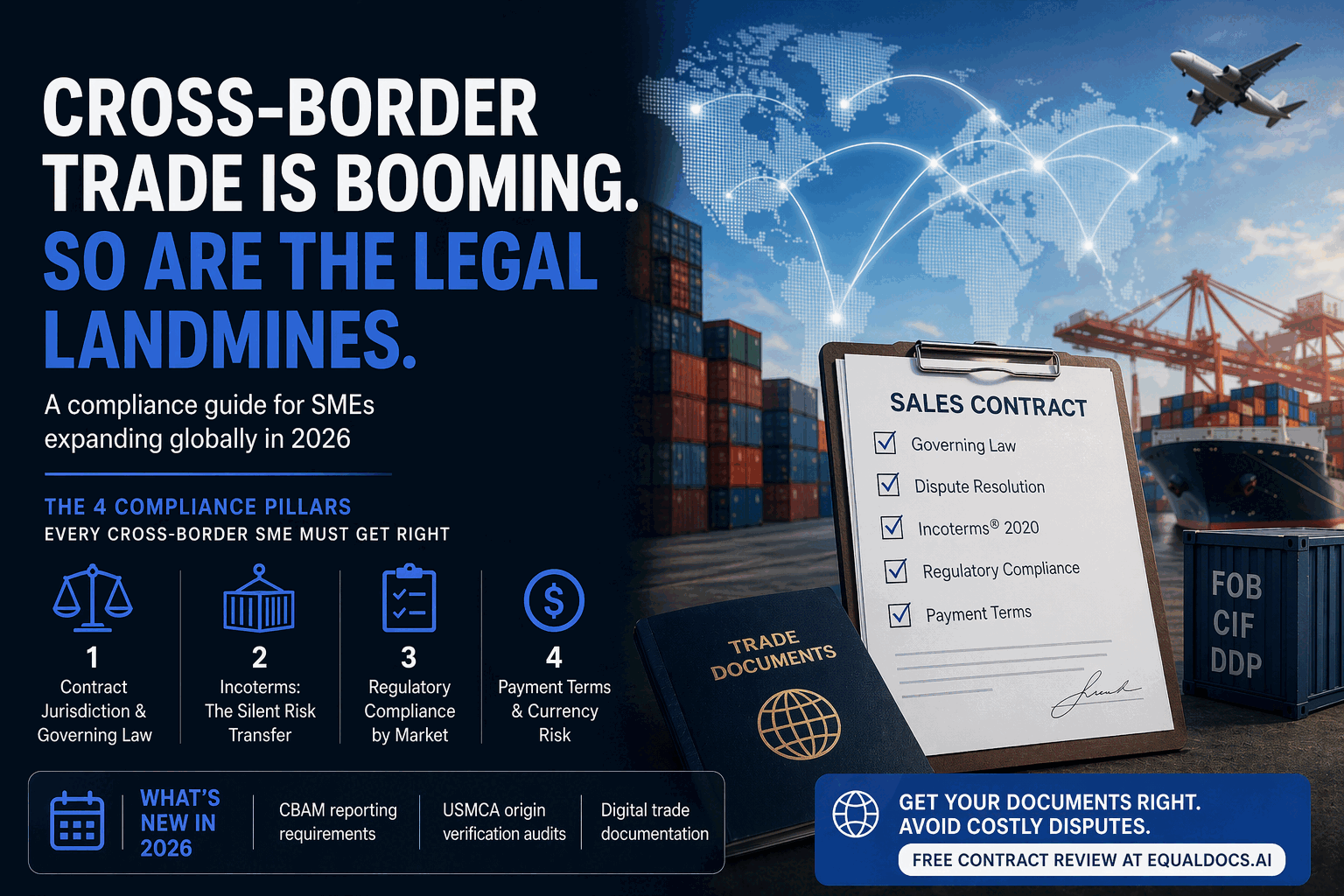
A compliance guide for SMEs expanding globally in 2026
Here's a number that should concern every founder building a cross-border business:
$4.2 trillion.
That's the estimated value of global trade disputes, delays, and penalties attributable to contract and compliance failures every year — and the businesses absorbing most of that cost aren't multinationals with legal departments. They're small and mid-sized companies who assumed that a signed contract and a shipped order meant the deal was done.
It isn't. Not even close.
After working with cross-border SMEs across North America, Asia, and Europe, I've seen the same compliance gaps appear again and again — not because business owners are careless, but because international trade law is genuinely complex, changes constantly, and almost no one explains it in plain language.
This article is an attempt to change that.
The 4 Compliance Pillars Every Cross-Border SME Must Get Right
1. Contract Jurisdiction & Governing Law
This is the clause most founders skip, and it's the one that matters most when things go wrong.
When a dispute arises between a Canadian seller and a Taiwanese buyer, which country's courts have jurisdiction? Which country's law governs the contract? If your agreement doesn't specify — or specifies incorrectly — you may find yourself litigating in a jurisdiction where enforcement is prohibitively expensive, or where the law simply doesn't favor your position.
What you need:
- An explicit governing law clause ("This agreement shall be governed by the laws of the Province of Quebec, Canada")
- A dispute resolution mechanism — arbitration (ICC, UNCITRAL) is usually preferable to litigation for cross-border SMEs because it's faster, more neutral, and more internationally enforceable
- Clarity on whether UN CISG (the international sales convention) applies or is expressly excluded — many businesses don't realize CISG can override their domestic assumptions about contract formation and remedies
The practical risk: A missing jurisdiction clause cost one of our clients 14 months and $60,000 CAD in legal fees to resolve a $22,000 payment dispute — because the case had to be argued in two jurisdictions simultaneously before a forum was agreed.
2. Incoterms: The Silent Risk Transfer You're Probably Getting Wrong
Incoterms (International Commercial Terms) define exactly where the risk and cost of goods transfers from seller to buyer during transit. They are updated periodically by the International Chamber of Commerce — the current version is Incoterms® 2020 — and they are legally binding when incorporated into your contract.
The most common mistake we see: the invoice and the contract specify different Incoterms.
This creates an invisible gap in liability. If goods are damaged during transit:
- Under FOB (Free On Board), risk transfers when goods are loaded onto the vessel — the buyer's problem from that point
- Under CIF (Cost, Insurance, Freight), the seller arranges insurance to the destination port
- Under DDP (Delivered Duty Paid), the seller is responsible for duties, taxes, and delivery to the final destination
A one-word difference can mean a six-figure insurance dispute.
What you need: Ensure every commercial invoice, bill of lading, and underlying sales contract reference the same Incoterms version and the same named place. Then make sure that place is specific — "FOB Shanghai Port" not just "FOB China."
3. Regulatory Compliance by Market: The Layer Most SMEs Miss
Every market has its own layer of import regulations, product standards, and documentation requirements — and they don't coordinate with each other.
Some examples that routinely catch SMEs off guard:
Canada–EU trade (CETA): To claim preferential tariff treatment under CETA, exporters must include a valid origin declaration on the commercial invoice. For shipments over €6,000, the declaration must come from a registered "approved exporter." Many Canadian businesses claim CETA benefits incorrectly and face retroactive duty assessments.
US import compliance: CPSC (Consumer Product Safety Commission) regulations require testing and certification for many product categories before US customs clearance. The documentation must be in place before the goods arrive — not after.
China customs: China's customs authority has significantly tightened documentation requirements since 2022. Discrepancies between commercial invoices and packing lists — even minor ones — can trigger holds of 2–6 weeks.
What you need: Before entering a new market, map the regulatory requirements specific to your product category, HS code, and trade corridor. This is not a one-time exercise — regulations change, and what was compliant last year may not be this year.
4. Payment Terms & Currency Risk Documentation
"Net 30" sounds simple. In cross-border trade, it's a potential dispute waiting to happen.
The documentation failures we see most often:
- No specification of which date triggers the payment clock (invoice date? delivery date? customs clearance date? inspection acceptance date?)
- No agreed currency for payment, or no exchange rate reference when payment is in a currency other than the invoiced currency
- No late payment penalty clause, meaning a buyer in default faces no contractual consequence for delaying
- No force majeure provisions addressing the specific cross-border risks (port strikes, customs delays, sanctions changes) that don't appear in domestic contracts
Each of these gaps has a simple fix in drafting. Each of them becomes expensive when they're missing and a dispute arises.
What's Changed in 2026
Three regulatory developments that every cross-border SME should be tracking right now:
1. CBAM (EU Carbon Border Adjustment Mechanism) — The EU's carbon pricing mechanism is now in its transitional reporting phase. If you export goods to the EU in carbon-intensive categories (steel, cement, aluminum, fertilizers, electricity, hydrogen), you need to be tracking and reporting embedded carbon content. Non-compliance will carry financial penalties.
2. USMCA/CUSMA origin verification — US Customs and Border Protection has significantly increased origin verification audits under USMCA. Canadian and Mexican exporters claiming preferential treatment need contemporaneous records supporting their origin claims — retroactive documentation is not accepted.
3. Digital trade documentation — Several major jurisdictions are moving toward accepting electronic bills of lading and digital trade documents. If you're still relying entirely on paper-based documentation, your counterparties in some corridors may now be ahead of you.
The Honest Reality for Most SMEs
Most small and mid-sized businesses handle cross-border compliance one of two ways:
Option A: Hire a trade lawyer for every transaction. Thorough, but at $300–$600/hour, it's prohibitive for the volume of transactions most growing businesses need to process.
Option B: Wing it with templates from the internet and hope nothing goes wrong. Works fine until it doesn't — and when it doesn't, the cost is multiples of what proper documentation would have been.
There's now a third option. AI-powered legal platforms like EqualDocs — which launched its upgraded platform on April 20, 2026 — can generate jurisdiction-specific contracts, review existing agreements for compliance gaps, flag Incoterms inconsistencies, and produce regulatory analysis reports across multiple trade corridors, in a fraction of the time and cost of traditional legal services.
This isn't about replacing lawyers for complex disputes. It's about making sure the foundational documents are right, so you never need to hire one for a problem that could have been prevented.
Your Next Step
If you're moving goods, services, or contracts across borders in 2026, here's a simple three-question compliance check:
- Does every cross-border contract you've signed in the last 12 months specify governing law, dispute resolution, and Incoterms — and do those terms match across all related documents?
- Have you verified your HS code classifications and origin documentation for the specific trade corridors you use?
- Do your payment terms specify the trigger date, currency, exchange rate reference, and late payment consequences?
If you answered "I'm not sure" to any of these — that's the gap.
EqualDocs can help you close it. Start with a free contract review at equaldocs.ai and see exactly where your documents stand.
What's the cross-border compliance challenge that's cost your business the most time or money?
Share it in the comments — I read every response, and the patterns we're seeing across the community are worth discussing openly.
Repost this if you know a founder who's expanding internationally and could use a compliance reality check.
EqualDocs · AI-powered legal support for cross-border SMEs · Founded by a Quebec-licensed lawyer · equaldocs.ai