Corporate Governance vs. Risk Instinct: Why Legal Tech Automation is the Next Big SME Hurdle

July 6, 2026
As AI adoption transitions from early-stage chat interfaces to multi-step agentic workflows, the legal sector is experiencing a double-sided squeeze. On one side, regulatory sandboxes are opening up to streamline legal tech compliance; on the other, corporate legal departments are admitting they lack the operational infrastructure to manage the risks these new tools introduce.
For small and medium-sized enterprises (SMEs) navigating this transition, the message is clear: reliance on “risk instinct” without automated governance is a recipe for operational vulnerability. Today, we break down three major shifts in the legal tech landscape and what they mean for your business.
1. The UK’s New AI Sandbox: Bridging the Regulatory Gap
In a bid to accelerate AI deployment while maintaining safety, the UK Department for Science, Innovation and Technology (DSIT) alongside the Ministry of Justice has launched the Advisory AI Growth Lab. This regulatory sandbox is designed specifically for the legal sector, allowing LawTech innovators to test their systems in collaboration with major regulators, including the Solicitors Regulation Authority (SRA) and the Information Commissioner’s Office (ICO).
Simultaneously, the UK government is piloting AI case-management and document-summarization assistants in Crown Courts to address massive case backlogs.
The “So What” for SMEs:
The launch of the Advisory AI Growth Lab means a new wave of highly compliant, vetted legal tech tools is coming to market. For businesses, this reduces the vetting burden—you can soon choose tools that have been battle-tested in government-sponsored sandboxes. However, the pilot in Crown Courts serves as a reminder: AI is only an assistant, and human oversight is non-negotiable. If judges must verify every AI-generated document to avoid hallucinations, your business must do the same.
2. The Litera Report: The GC Infrastructure Gap
Litera’s newly published report, “Legal Departments at the Leading Edge: How General Counsel Are Navigating a New Era of Corporate Risk,” reveals a stark reality. While General Counsel (GCs) at Fortune 1000 companies are successfully stepping up as strategic advisors, their underlying governance infrastructure has failed to keep pace with AI risks.
Key findings include:
- 64% of legal leaders state that AI is actively reshaping their business models.
- 66.3% admit they have not updated key contract clauses in the past year to reflect emerging AI risks.
- 57.6% state that their departments desperately need automation and legal technology (specifically contract workflows and NDA tools) to manage this capacity gap.
The “So What” for SMEs:
If Fortune 1000 legal teams are struggling with AI governance, SMEs are at even higher risk. Most businesses are using AI tools without updating their standard vendor agreements, service contracts, or non-disclosure agreements (NDAs) to cover AI data-sharing, model training, and IP ownership.
To bridge this gap, you don’t need a massive legal team; you need automated contract workflows that enforce standard AI governance guardrails. Ensure that your NDAs explicitly dictate whether counterparties are permitted to feed your proprietary data into third-party AI models.
3. Utah’s Shift Toward Formal AI Rulemaking
Utah has long been a pioneer in legal services innovation through its Supreme Court Sandbox. However, the state is now shifting its focus. As of mid-2026, the Ad Hoc Committee on Regulatory Reform is moving away from temporary standing orders toward formal, permanent rulemaking to govern AI integration and technology-enabled services.
Meanwhile, Utah’s general AI Sandbox recently authorized Doctronic—an AI-powered platform that autonomously handles prescription renewals under regulatory mitigation agreements—demonstrating a growing regulatory comfort with autonomous AI agents executing professional, regulated tasks.
The “So What” for SMEs:
The transition to formal rules in pioneer states like Utah signals that “AI-assisted” and “sandbox-authorized” professional services are gaining institutional permanence. For SMEs, this lowers the entry barrier to affordable, high-quality legal support. Virtual, tech-enabled services will become more accessible, but they will operate under strict regulatory mitigation agreements. Ensure any legal tech provider you partner with complies with these emerging state-level standards.
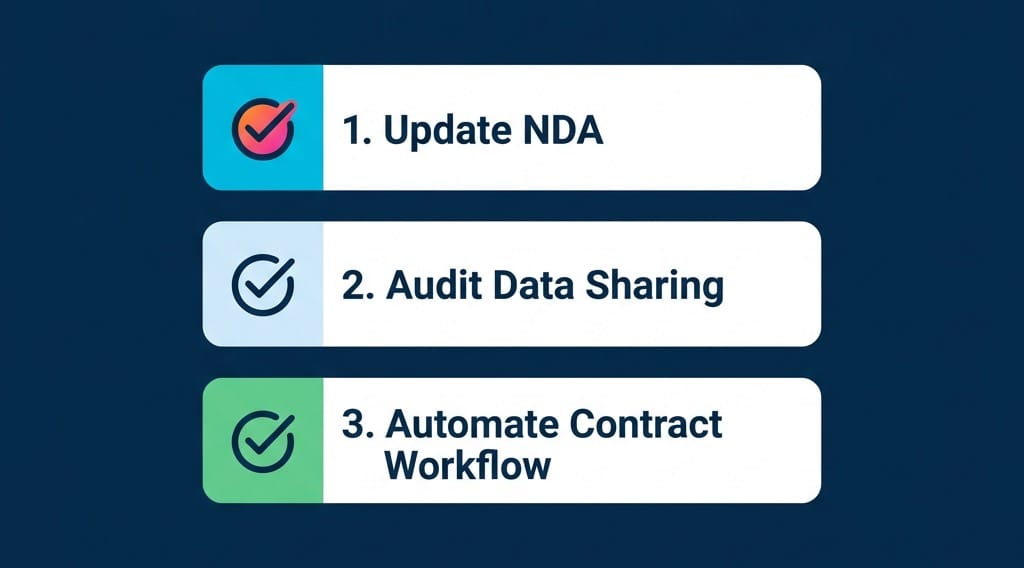
Actionable Strategy: The 3-Step AI Governance Audit
To ensure your business is not left behind by the gap in governance infrastructure:
- Audit Your Contracts: Review your current NDAs and vendor agreements. Add explicit “AI data-use” clauses that prohibit vendors from using your company’s intellectual property or confidential data for AI model training without consent.
- Implement Guardrails: Define which internal processes can use public AI models and which require closed, enterprise-grade systems.
- Automate the Workflow: Use dedicated tools like EqualDocs to standardise contract ingestion, ensuring every incoming agreement is automatically checked against your risk tolerances.
EqualDocs — Your Digital General Counsel | equaldocs.com