Consolidated Customs Controls and Agentic Search: Navigating Trade and Legal Tech in 2026

Meta Description: U.S. Customs and Border Protection issues new unified forced labor guidance for importers, while Canada’s Competition Bureau probes the food supply chain. Meanwhile, LexisNexis launches Lexis+ with Protégé, and high-stakes USMCA joint review preparations escalate.
CBP Publishes Unified Forced Labor Operational Guidance for Importers
On June 12, 2026, U.S. Customs and Border Protection (CBP) announced the publication of the Forced Labor Enforcement Operational Guidance for Importers (CBP Publication No. 5560-0526). This 79-page document officially supersedes the 2022 UFLPA operational guidelines.
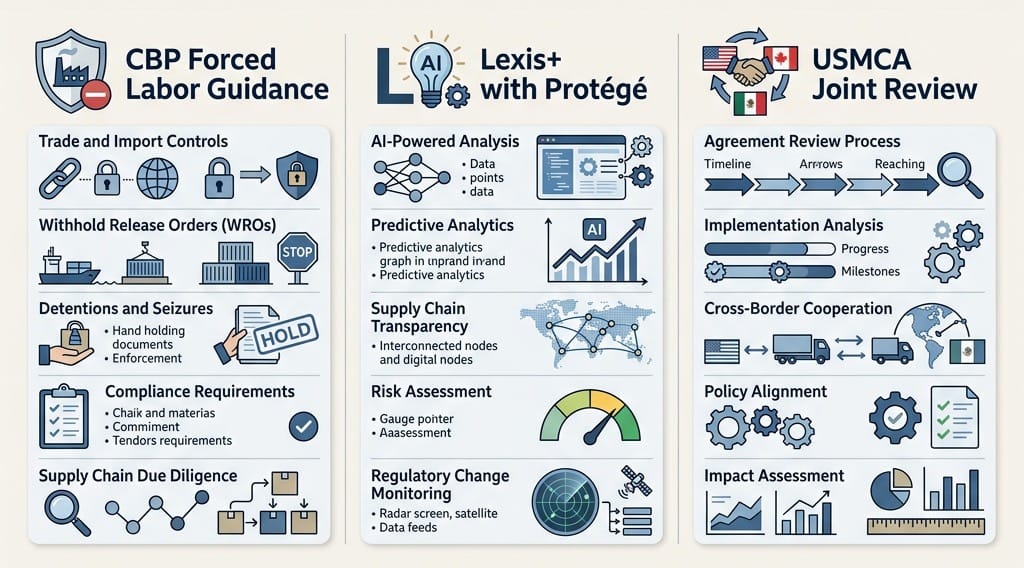
Unlike previous documents which focused exclusively on the Uyghur Forced Labor Prevention Act (UFLPA), this update consolidates the three primary statutory authorities CBP uses to restrict forced labor imports: the general prohibition under 19 U.S.C. § 1307, the UFLPA, and CAATSA (targeting North Korean labor). The new guidance introduces visual enforcement process maps, detailed step-by-step instructions for responding to cargo detentions or exclusions, and updated templates for notice responses and certificates of origin. Importers must adjust their due diligence processes immediately to align with these unified audit standards.
Canadian Competition Bureau Probes Food Supply Chain Pricing
In antitrust and retail compliance, the Competition Bureau of Canada has launched an active public examination into competition barriers within the national food supply chain.
The Bureau is soliciting public input from retailers, producers, and consumers regarding pricing behaviors, distribution barriers, and purchasing dynamics. While not a formal market study, the inquiry is aimed at identifying anti-competitive practices and could lead to direct regulatory enforcement actions under the Competition Act. Retailers and food-sector small-and-medium enterprises (SMEs) must review their supplier pricing terms, distribution contracts, and buyer policies to ensure compliance with competition standards.
High-Stakes USMCA Six-Year Joint Review Ramps Up for July
For North American trade, preparations are accelerating for the formal six-year joint review of the United States–Mexico–Canada Agreement (USMCA/CUSMA) scheduled to begin in July 2026.
Under the agreement’s terms, the three nations must decide whether to extend the trade deal for another 16 years. If they fail to reach a unanimous extension, the treaty will transition into an unstable annual review cycle until its expiration in 2036. Reports indicate that the U.S. is preparing to leverage this review to demand significant concessions regarding automotive rules of origin, migration policies, and digital commerce. SMEs engaged in cross-border manufacturing and logistics are advised to stress-test their supplier contracts and review duty-free eligibility rules ahead of potential tariff restructuring.
LexisNexis Launches Lexis+® with Protégé™ for Agentic Workflows
In legal tech, LexisNexis announced the general availability of Lexis+® with Protégé™ on June 17, 2026, replacing its previous Lexis+ AI platform.
Protégé is designed to provide end-to-end, agentic legal AI workflows. Rather than simply answering legal search queries, the system acts as an autonomous assistant capable of executing multi-step legal tasks—such as draft comparison, memo writing, and compliance mapping—through a single conversational prompt interface. This represents a significant shift from simple chat tools to integrated task automation, signaling a new era where legal research and document generation are fully automated in professional workflows.
Strategic Checklist for SMEs and Legal Teams
- Adopt CBP Response Templates: Importers should integrate the new CBP guidance appendices, including templates for detention responses and supplier due diligence questionnaires, into their import compliance manuals.
- Review Supply Chain Mapping: Conduct comprehensive tracing of raw materials to verify that upper-tier suppliers do not trigger UFLPA or Section 1307 import detention flags at the U.S. border.
- Review Food Distribution Contracts: If operating in the Canadian grocery or food supply chain, audit supplier pricing and distribution agreements to ensure they do not violate Competition Bureau anti-competitive guidelines.
- Stress-Test USMCA Exposure: Add flexible pricing and tariff-renegotiation triggers in cross-border supply agreements to shield the business if the July USMCA review triggers trade friction.
- Secure Agentic AI Guardrails: Establish clear guidelines on how legal teams utilize platforms like Lexis+ with Protégé to ensure client data is protected under agentic processing environments.
Sources
- U.S. Customs and Border Protection (CBP): Forced Labor Enforcement Operational Guidance for Importers (Pub 5560-0526) (June 12, 2026)
- Competition Bureau of Canada / MLT Aikins: Competition Bureau Launches Food Supply Chain Pricing Inquiry(June 16, 2026)
- Center for Strategic and International Studies (CSIS): Preparations Ramping Up for High-Stakes July USMCA Joint Review (June 18, 2026)
- LexisNexis: LexisNexis Launches Flagship Lexis+® with Protégé™ for Agentic Legal Workflows (June 17, 2026)