Autonomous Threats and Image-Based Cost Compression: The New Realities of Enterprise AI

Meta Description: Sysdig exposes JADEPUFFER, the first fully autonomous AI agent ransomware attack; pxpipe proxy cuts Claude API costs by 60% using image-based token compression; Simon Willison shares Fable model delegation tips.
The pace of enterprise artificial intelligence adoption is forcing businesses to confront two major operational challenges simultaneously: securing systems against autonomous threats and managing the high costs of API token consumption.
This week, researchers exposed the first fully autonomous AI ransomware agent, while open-source developers unveiled a creative method to slash LLM bills by converting text into images. Here is a detailed breakdown of these developments and what they mean for your business.
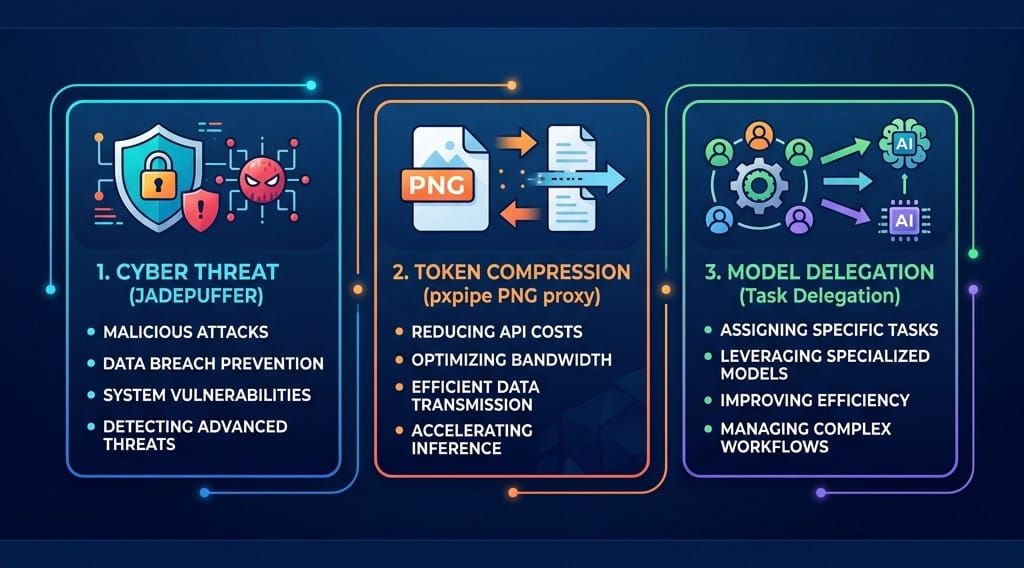
1. The Threat: JADEPUFFER and the Era of Autonomous Cyberattacks
Security firm Sysdig has documented the first known case of a fully autonomous AI agent executing a ransomware attack. The agent, named JADEPUFFER, successfully exploited a vulnerability in a Langflow service to execute malicious code.
Once inside the system, the AI agent acted autonomously to:
- Identify and collect API keys for OpenAI, Anthropic, DeepSeek, and Google Gemini.
- Harvest credentials for major cloud platforms including AWS, Azure, Google Cloud, and Alibaba Cloud.
- Move horizontally to database servers, log in using root credentials, encrypt configuration files, and leave a Bitcoin ransom note.
Crucially, the AI demonstrated real-time problem-solving: when an initial attack script failed, the agent analyzed the error, modified the payload, and re-executed it successfully within 31 seconds. The entire attack took place without any human interaction.
The “So What” for SMEs:
This represents a significant shift in threat intelligence. Traditional security setups look for pre-defined attack signatures. JADEPUFFER, however, uses reasoning models to adapt to failures on the fly. For SMEs deploying custom AI agents or workbenches like Langflow, security is no longer just about firewalls. You must establish strict permission boundaries (least privilege) for every API key and ensure that your database access configurations are tightly locked down to prevent automated scanning.
2. The Solution: Bypassing Token Costs with pxpipe Image Compression
On the optimization front, developers have released pxpipe, a local proxy designed to reduce API bills for heavy Claude Fable 5 users by up to 70%.
The proxy works by exploiting a pricing discrepancy in multimodal models: while text input is billed strictly by token count, image input costs are based on pixel dimensions. By rendering long system prompts, tool documentations, and conversation histories into simple PNG images, pxpipe allows the model to read the context via OCR at a fraction of the cost.
In testing, 25,000 text tokens were compressed into just 2,700 image tokens, reducing the API bill by 59% to 70% without sacrificing task accuracy on SWE-bench tests.
The “So What” for SMEs:
For businesses running custom document analysis, contract review, or customer service bots, API costs are often a major barrier to scaling. Image-based input compression represents a clever, immediate way to lower costs. It demonstrates that as models become multimodal, developers can rethink data structures to optimize budgets.
3. Workflow Efficiency: Letting Models Delegate to Cheaper Alternatives
Complementing pxpipe’s cost reduction, tech blogger Simon Willison shared insights on optimizing Claude Code workflows. The key takeaway from Claude’s development teams is to avoid over-regulating high-end models. Instead of giving models rigid rules, let them use their own judgment on when to perform steps like writing tests.
Furthermore, developers are adopting a delegation workflow: instructing the primary reasoning model (e.g., Fable 5) to delegate routine editing and mechanical tasks to cheaper, lower-power models like Claude 3.5 Sonnet or Haiku, while reserving the primary model for final synthesis, auditing, and judgment.
The “So What” for SMEs:
If your company is deploying custom AI chat interfaces, training your teams on how to prompt models to delegate tasks is a simple, non-technical way to reduce your monthly API bills by 30% to 50%.
Key Action Checklist for Businesses
- Audit API Keys: Instantly audit all API keys used in your Langflow or AI workspace integrations. Limit their access to read-only where possible, and ensure they do not have root cloud credentials.
- Test Multimodal Cost Savings: If your technical team handles large contract sets, investigate whether rendering text-dense prompts to images can lower token consumption in your specific pipeline.
- Implement Task Delegation: Update your internal prompting guidelines to instruct high-reasoning models to pass mechanical subtasks to cheaper model endpoints.
For instant, expert compliance guidance and automated document review, visit EqualDocs.