Autonomous AICs and the Billable Hour: The Next Frontier of Legal AI

Meta Description: Delaware drafts legislation for AI-run companies (AICs) under regulatory sandboxes; Deloitte Legal report projects AI agents will manage 30% of corporate legal work, causing billable hours to decline; UT School of Law adopts AI training.
The Delaware AI Sandbox: Autonomous Companies (AICs)
In a groundbreaking move for corporate governance, Delaware lawmakers are drafting legislation to establish a regulatory testing ground for Artificial Intelligence Companies (AICs).
This proposed sandbox aims to allow businesses operated entirely by autonomous AI agents to perform core corporate tasks—such as signing contracts, providing professional services, and even engaging in litigation—under temporarily eased state regulations. The goal is to collect real-world data on AI operations to help shape future corporate governance frameworks.
For companies incorporated in Delaware, this initiative signals that the state is preparing for a future where corporate entities can function independently of constant human intervention, introducing a new era of business automation.
The Billable Hour Plunges: Deloitte Legal’s AI Agent Projections
The legal industry’s traditional business model is facing disruption. According to a new market report released by Deloitte Legal in June 2026, titled “The AI Imperative: Reshaping the Legal Industry,” AI agents are set to transform corporate legal departments and law firms:
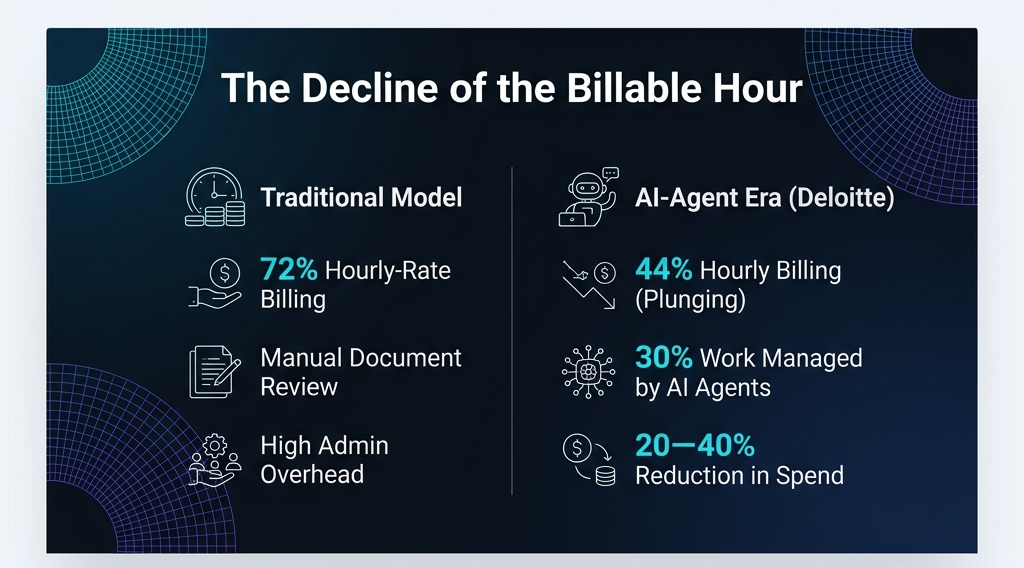
- Workload Displacement: Deloitte projects that AI agents will handle 30% of the workload within corporate legal teams in the next three to five years.
- Hourly Billing Decline: Driven by these efficiencies, the share of hourly-rate billing is projected to plummet from 72% today to just 44% in the next two to three years.
- Legal Spend Reduction: General Counsel anticipate reducing external legal spend by 20% to 40% over the next three years as they insource routine work and demand AI-driven efficiencies from outside firms.
This shift indicates that corporate clients will increasingly refuse to pay for junior associates’ hours spent on document review or basic drafting, forcing firms to transition toward flat-fee, value-based pricing structures.
Law Schools Adapt: UT School of Law Integrates AI
To ensure future lawyers are prepared for this automated landscape, the University of Texas School of Law has integrated enterprise AI tools directly into its core curriculum.
Led by Robert Chesney, the administration has formalized its strategy in a memo detailing student access to AI platforms including Harvey, Claude, and ChatGPT. The tools are used in first-year legal research, writing, and professional responsibility courses.
Crucially, the school is structuring its pedagogy to avoid “cognitive deskilling”—ensuring that students still master foundational Socratic reasoning and analytical skills, rather than treating AI outputs as unverified shortcuts.
Sources
- Spotlight Delaware: Delaware Drafts AI Sandbox for Autonomous Companies (June 2026)
- Deloitte Legal Report: The AI Imperative: Reshaping the Legal Industry (June 2026)
- University of Texas School of Law: AI and Legal Education Strategy Memo (June 2026)