Agentic Legal Ecosystems & The EU’s Three-Click Cancellation Rule

June 26, 2026
As AI technologies mature, the focus of the legal tech industry is shifting from search engines to active, agentic workflows. Instead of just answering questions, modern legal AI is now preparing court bundles, automating client intake, and connecting directly to daily document repositories. For small and medium-sized enterprises (SMEs), today’s compliance and technology updates highlight how to leverage these tools for efficiency while adapting to new regulatory rules in international markets.
Perplexity Connects the Dots with “Computer for Counsel”
AI search startup Perplexity has officially entered the legal market with the launch of Computer for Counsel. Unveiled at an event in New York City, this new workflow layer is built on the company’s “Computer” agentic platform.
Importantly, Perplexity is not trying to build another massive legal research database like Westlaw or LexisNexis. Instead, it positions itself as the connective tissue between a firm’s internal files and specialized databases. The platform utilizes API connectors to link up with NetDocuments, Clio (including its “Vincent” legal assistant), Box, Docusign, and Carta. For research, it partners with Midpage to pull verified, citable legal sources.
By breaking down complex workflows—such as analyzing a contract or gathering relevant precedent—into smaller tasks, Computer for Counsel dispatches specialized AI agents to execute them and compile the results. For SMEs, this represents a new wave of workflow engines designed to eliminate administrative tasks, allowing lean corporate teams to triage contracts and draft research briefs without switching between multiple disconnected platforms.
Automating Law Firm Operations: JUPUS Raises €13 Million
To address the shortage of legal secretaries and administrative assistants, Cologne-based startup JUPUS has secured €13 million in a Series A funding round. Led by Semapa Next and supported by NRW.BANK and Acton Capital, the platform provides an AI-powered “secretarial service” specifically built for small and mid-sized law firms.
JUPUS automates repetitive client-facing and administrative tasks:
- Handling inbound calls and structuring client inquiries.
- Managing the initial client intake process.
- Automatically drafting documents and case summaries.
The platform is already used by over 2,000 lawyers and processes thousands of cases daily. By automating the administrative front office, platforms like JUPUS allow small firms to handle higher case volumes, which in turn reduces the cost of counsel for small business clients.
Landmark Win: SRA-Regulated AI Law Firm Secures Court Victory
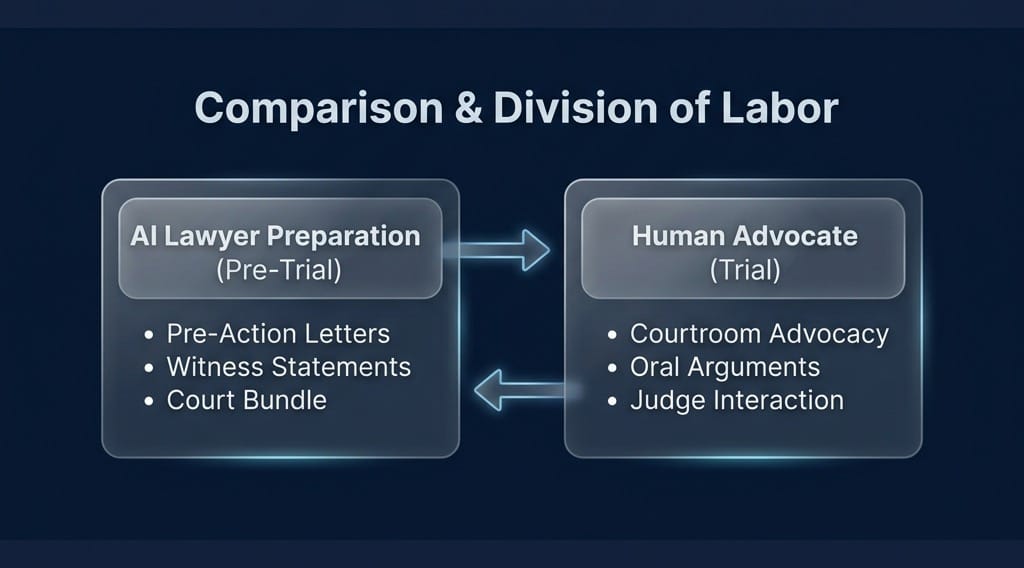
In a historic case at Wandsworth County Court, the UK-based, SRA-authorized firm Garfield AI secured the world’s first trial victory prepared by an AI lawyer. The dispute involved a freelance HR consultant seeking to recover £7,000 in unpaid fees from a hospitality business.
Garfield AI managed the entire pre-trial lifecycle, including:
- Generating pre-action letters.
- Filing the initial court proceedings.
- Managing document disclosure.
- Drafting witness statements and compiling the trial bundle.
While the AI handled the heavy preparation—resulting in a service fee of only £400 for the claimant—the firm instructed a human barrister to manage the oral advocacy during the three-hour court trial. The judge ruled in favor of the claimant, demonstrating that AI can successfully handle pre-trial administration. This hybrid approach significantly lowers the barrier to justice, making it economically viable for SMEs to pursue modest commercial claims that would otherwise be abandoned due to traditional litigation costs.
Regulatory Update: The EU’s “Three-Click” Withdrawal Mandate
On the regulatory compliance front, a new EU directive has gone into effect mandating a standardized “Three-Click” Withdrawal Rule for consumer contracts.
Under the new regulations, any online retailer or digital service provider targeting consumers in the European Union must implement a clear, two-step cancellation process:
- Click 1: A prominent, easily accessible “Withdrawal Button” or cancellation link.
- Click 2: A standardized confirmation page.
- Click 3: The final submit action to execute the cancellation.
This rule applies to all digital merchants selling to EU residents, regardless of the company’s physical headquarters. Businesses targeting European markets must immediately audit their digital checkout and subscription cancellation flows. Failing to comply can result in severe regulatory fines or voided contract terms.
Key Actions for Businesses
- Audit Subscription Flows: If your business sells products or services to European customers, check your subscription interfaces to ensure a simple “Three-Click” cancellation flow is in place.
- Review Small Claim Options: For unpaid invoices or small commercial disputes, look for AI-supported legal services that reduce pre-trial administration costs.
- Explore Workflow Integrations: As platforms like Perplexity connect with document hubs like Box and Docusign, evaluate how your legal or procurement teams can use connected agents to automate contract triaging.
For more information on managing your global compliance and legal operations, visit equaldocs.com.