Why EqualDocs Has Two Layers — Not One

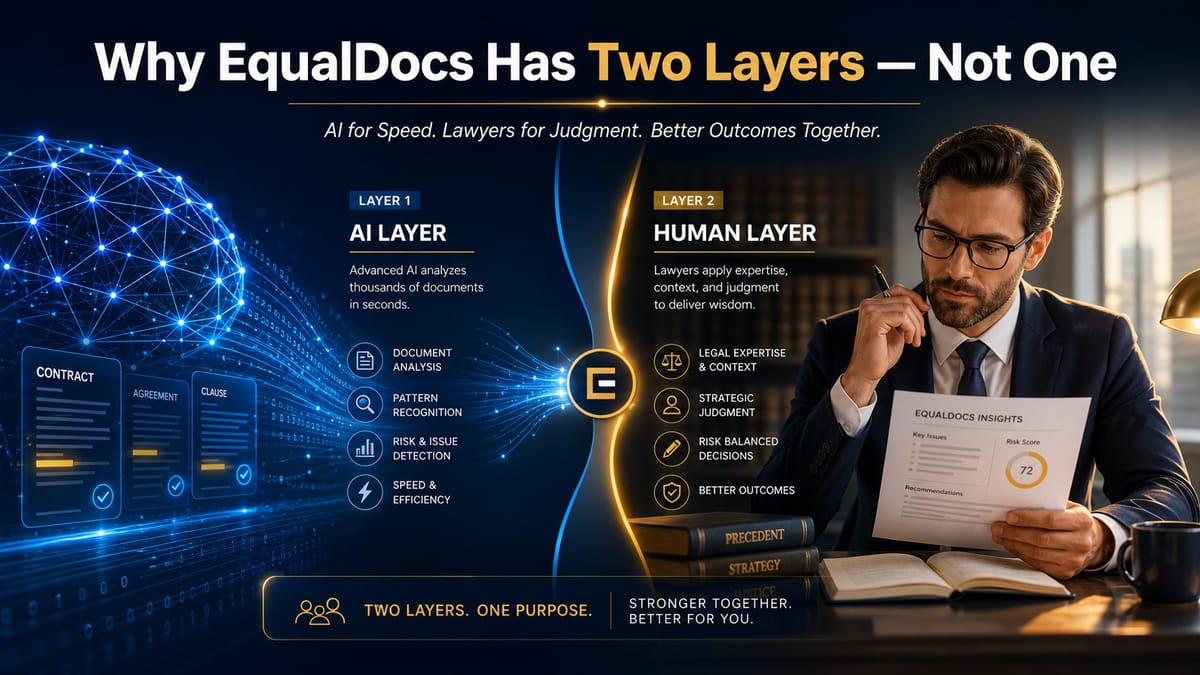
AI handles what AI is actually good at. Lawyers handle the rest. Here’s why that distinction matters.
When we were designing EqualDocs, we kept running into the same uncomfortable question:
What happens when AI isn’t enough?
It’s easy to build a legal AI product that promises everything. Harder to build one that’s honest about where it stops — and actually has a plan for what comes next.
We made a product decision early on that still shapes everything we build: not every legal need is the same, so the service can’t be either. That decision led us to what we now call our hybrid legal service model.
Here’s what it actually means.
What AI Does Well
Our AI Legal Assistant is genuinely fast and genuinely useful for a specific set of tasks.
Contract review: it reads agreements, flags unusual clauses, surfaces liability risks, and summarizes key terms in plain language. A founder reviewing a vendor contract at 10pm no longer has to choose between signing blind and waiting two weeks for a lawyer’s calendar to open up.
Legal Q&A: it answers questions clearly, without a billable clock running. What does “indemnify” mean in this clause? Does this non-compete apply to me? Is a verbal agreement enforceable in Québec? These are the questions most people never bother a lawyer about — not because they’re not important, but because the friction of getting an answer is too high.
Document generation: NDAs, service agreements, standard legal forms — drafted and tailored to your situation in minutes, not days.
None of this replaces the judgment of a licensed lawyer. But it handles the volume of everyday legal moments that most people currently navigate alone, with Google, and a vague feeling of unease.
What AI Doesn’t Do
Litigation. Court representation. Disputes where strategy, accountability, and the ability to stand in a room and argue your position genuinely matter.
We’re not going to hand those off to a chatbot. And we think any legal AI product that implies otherwise is overpromising in a way that will eventually hurt the people it claims to serve.
This isn’t a liability disclaimer. It’s a product philosophy. The most useful thing we can do for a client is be accurate about what they actually need — and make sure they can get it.
The Lawyer Network
So we’re building one.
Starting in Québec, EqualDocs is connecting clients directly with licensed legal professionals for the cases that require human judgment. Not a referral list. A real integrated experience — so that moving from AI-assisted review to legal representation doesn’t mean starting over from scratch.
Within the next 12 months, we’re expanding that human layer across all of Canada.
The goal is a platform where the right service shows up at the right moment. AI when it’s the right tool. A lawyer when it isn’t. And nothing falling through the gap between them — which is currently where most people end up.
Why This Matters
There’s a version of legal AI that’s built to replace as much of the legal profession as possible, as fast as possible. We’re not building that.
We’re building the thing that’s actually missing: a coherent legal service experience for the people who currently have no good options. Too small for a General Counsel, too exposed to go without one. Able to afford a lawyer for the big moments, but left alone for everything in between.
That gap is where EqualDocs lives. And filling it properly requires both layers — not just the faster, cheaper one.
Ningsi Mei is a lawyer and co-founder of EqualDocs, an AI-powered legal platform for SMEs. She writes about practical legal risk for founders and small business owners.