Meta Tried to Buy Manus. China Said No — After the Deal Was Done.

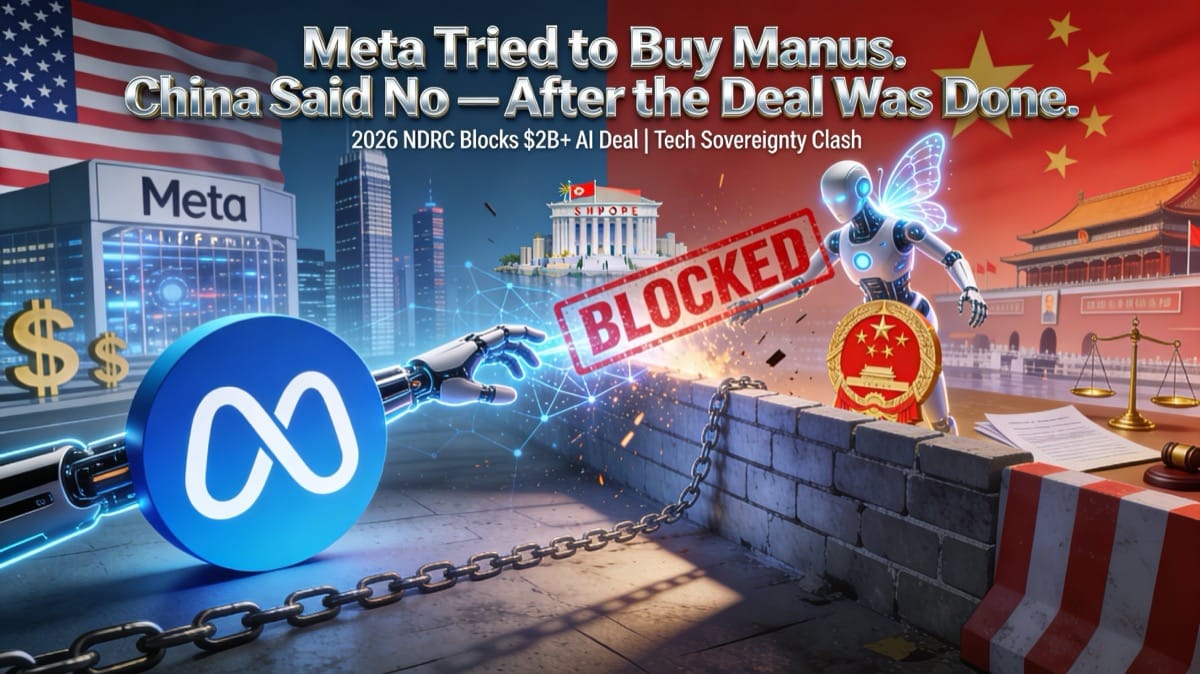
In late 2025, Meta announced a US$2–3B acquisition of Manus, a Singapore-registered AI agent startup whose engineers and core technology came out of Beijing and Wuhan. The deal moved fast — term sheet to signed agreement in roughly ten days. On April 27, 2026, China’s NDRC ordered it unwound. Not blocked before signing. Unwound after close.
That’s the part worth sitting with. Not that the deal failed, but when it failed.
This is what “geopolitical washing” looks like when it stops working: build the technology in China, move the holding company to Singapore, sell to US Big Tech, pocket the exit. Regulators have seen it enough times that they now have a name for it. And a playbook for stopping it.
What Actually Went Wrong
The Singapore structure didn’t change where the technology came from
Manus relocated its parent entity to Singapore in mid-2025, renamed it Butterfly Effect Pte, and migrated key personnel offshore. China’s MOFCOM went back to the source: where were the core models trained? Where did the training data come from? Who wrote the original code, and where were they sitting when they wrote it?
The answers were Beijing and Wuhan. The Singapore address was a cap table decision, not a technical one.
The legal exposure: transferring export-controlled AI technology to a US acquirer without a license, structured as a share sale between two foreign entities to obscure the transfer. The reorg became the evidence, not the defense.
The thing regulators have figured out: export-control jurisdiction follows the origin of the technology, not the registered address. If the model was built in China, the model is subject to Chinese export-control analysis — regardless of where the holdco lives.
NDRC didn’t just review — it reversed
On April 27, NDRC invoked the 2020 Foreign Investment Security Review Measures and ordered the parties to unwind completed equity transfers and business integration. The agency didn’t name Meta in the announcement, but there was no ambiguity about what it meant.
Three things drove the decision. First, Manus’s general-purpose agent model and its training dataset were classified as strategic assets — “critical technology” and “important data” in regulatory terms. Second, full absorption by Meta would shift the competitive balance in AI in a way that couldn’t be reversed. Third, and this is the part that matters for everyone else: if this structure worked, it would become a template. Early-stage Chinese AI companies restructure offshore, sell to US giants, and the technology leaves. The NDRC decision was partly about Manus, and partly about closing that door.
The cleanup made it worse
To satisfy US political pressure — the “clean break from China” requirement that’s become standard in China-linked tech deals — Meta reportedly pushed Manus to shut down Beijing operations and dissolve the local team before close. That triggered Chinese labor regulators. It also made the transaction look, from Beijing’s perspective, like an accelerated asset strip rather than a commercial deal. The political gesture designed to reduce US scrutiny increased Chinese scrutiny.
This is the trap that’s easy to miss: actions taken to satisfy one regulator are regularly read as evidence of bad faith by another.
Brussels and Washington were watching too
The EU has been scrutinizing Meta’s ability to leverage WhatsApp and its social infrastructure to extend dominance into AI. The FTC hasn’t directly blocked any Meta deals recently, but its ongoing antitrust posture means every large tech acquisition runs through a political filter. Neither blocked this deal — China got there first — but the multi-jurisdictional pressure environment is part of why the Manus structure was always fragile.
The Risk Map
Antitrust. FTC, UK CMA, and the European Commission are all running active programs around “killer acquisitions” — Big Tech buying nascent competitors before they can threaten the incumbent. Post-deal API access, data gates, and distribution channel control are now part of the analysis, not just market share numbers.
National security review — both directions. CFIUS has expanded its scope to cover AI models, foundational compute, and sensitive personal data. Minority investments can trigger mandatory review. China’s security review framework retains retrospective jurisdiction over offshore entities with Chinese origins — the Manus decision confirmed that this isn’t theoretical. For most Sino-US tech deals, either regulator can kill the transaction. The structural reality now is that you need both clearances, and you can’t optimize for one at the expense of the other.
Data sovereignty. Buyers need to prove they can technically isolate China- or EU-resident data post-close. Under 2026 norms, a change of control is a consent-refresh event — users have the right to refuse their data being transferred or used for model training by the new owner.
Export controls beyond hardware. Model weights, training datasets, and algorithm internals are covered. So is the movement of key engineers across borders. “Offshore reorg + quick sale” is now read as a structural workaround, not a legitimate corporate strategy.
What to Do Differently
Start the regulatory conversation before you sign. Not after. Not at the time of filing. Before the SPA. For any deal with China, US, or EU exposure, counsel should be soft-sounding key regulators through informal channels before the term sheet becomes public. The goal is to find out whether there’s a path and what it costs — not to get surprised after close.
Don’t make extreme decoupling gestures to satisfy one government. Wholesale shutdown of one jurisdiction’s operations to please another is the move that triggered the labor investigation and the political backlash in this deal. Ring-fence, license, or carve out — don’t dissolve.
Build the regulatory risk into the deal structure. Reverse break-up fees sized to actual regulatory exposure. Pre-negotiated carve-out plans if a specific jurisdiction objects. Clean room protocols during DD and integration so that if the deal falls apart, there’s no “you already took the technology” exposure.
Do the IP provenance work. Where was the model first trained? Did the founders take government grants or industrial development funding? Does the technology touch any military/dual-use classification list in any relevant jurisdiction? These questions used to be optional. They’re not anymore.
Understand what “substantive compliance” actually means. Renaming the holdco, moving the registered address, and reshuffling the ownership structure no longer survive sovereign-level review. Regulators ask: where was this built? Where does the data live? Who controls the product roadmap? Where do the lead engineers pay taxes? A real compliance architecture means having answers to those questions that hold up — not a structure designed to avoid the questions.
The Part That Matters Most
The Manus deal didn’t fail at closing. It failed four months later. That’s the new timeline for cross-border AI M&A with China exposure: the regulatory risk doesn’t end when the wire clears. It ends when every relevant jurisdiction has either cleared the deal or run out of time to object — and China, as of April 2026, has demonstrated it will use the time it has.
The compliance work needs to start before signing, not after.
EqualDocs runs 48-hour multi-jurisdictional risk scans for cross-border tech deals — mapping export-control exposure, national security review triggers, and data sovereignty requirements before the term sheet goes out.
EqualDocs AI © 2026. For informational purposes only — not legal advice. Consult licensed counsel for transaction-specific guidance.