Procurement Policy Shifts, CUSMA Uncertainties, and Arbitration Precedents


June 12, 2026
For small and medium-sized enterprises (SMEs) operating across the US-Canada border, staying ahead of legal and regulatory changes is the difference between capturing new market share and facing unforeseen liabilities. Today’s brief covers three critical developments: a major shift in Canada’s “Buy Canadian” federal procurement policy, growing instability surrounding the CUSMA/USMCA trade pact renewal, and a landmark ruling from the Court of King’s Bench of Alberta reinforcing the primacy of commercial arbitration agreements.
Here is the “so what” for your business and how you should adapt your agreements today.
1. Lower Thresholds for “Buy Canadian” Strategic Procurement
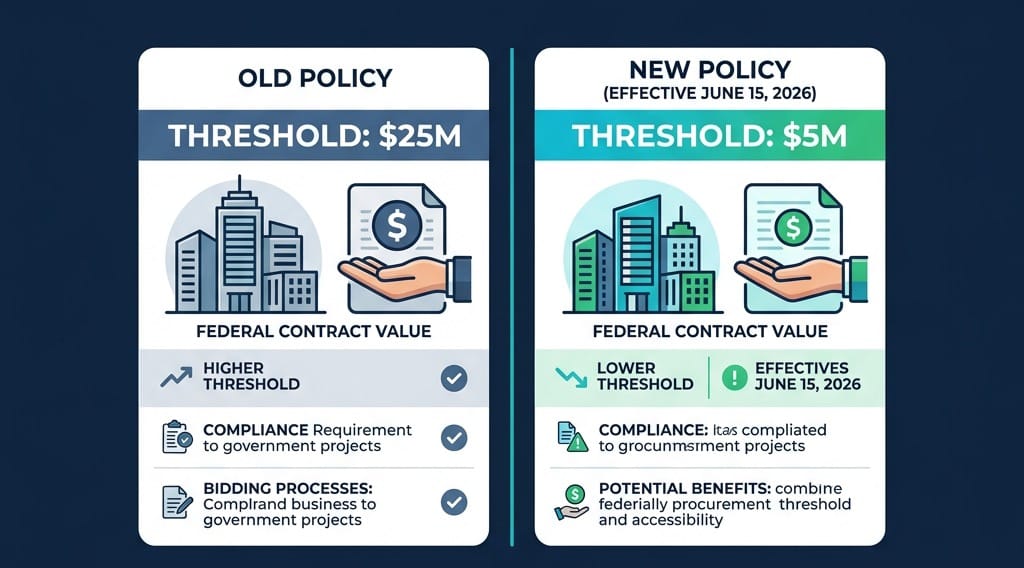
The News: Effective June 15, 2026, the Government of Canada is lowering the value threshold for its “Policy on Prioritizing Canadian Suppliers and Canadian Content in Strategic Federal Procurement.” Originally applicable only to massive procurements valued at $25 million or more, the rules prioritizing Canadian bids and local supply chains will now apply to competitive procurements of $5 million or more.
The SME “So What”: While the policy aims to direct federal dollars to domestic businesses, trade advocates like the Canadian Federation of Independent Business (CFIB) recently testified that a $5 million threshold remains too high for true micro-enterprises.
However, for established SMEs who frequently bid on mid-market federal tenders, this represents a massive operational shift. If you are bidding on a project valued between 25M:
- Audit Your Supply Chain: You must verify the origin of your subcontractors, materials, and services. Under the strategic policy, foreign components can disqualify your bid from priority status.
- Update Subcontractor Agreements: Ensure all downstream agreements contain Local Content Representations and Warranties. If a subcontractor’s component origin is audited and found to violate the local procurement threshold, you must have immediate contractual recourse to recover lost bid costs or contract penalties.
2. CUSMA Joint Review: Trump Signals Reluctance to Renew
The News: As the July 1, 2026 joint review deadline for the Canada-United States-Mexico Agreement (CUSMA/USMCA) approaches, U.S. President Donald Trump publicly stated on June 10 that he is “not looking to renew” the pact. While the treaty remains active until 2036, a refusal to renew would push the agreement into a cycle of rolling annual reviews, severely impacting long-term cross-border business planning.
The SME “So What”: Capital investment in cross-border manufacturing and logistics is already showing signs of a slowdown. For SMEs exporting goods between the U.S. and Canada, policy volatility is the new baseline.
- Draft Tariff Escalation Clauses: When entering long-term supply or distribution agreements, do not assume tariff-free trade will persist indefinitely. Your contracts should explicitly detail who bears the cost of newly imposed duties.
- Define “Change of Law” Events: Ensure your contracts include flexible termination or pricing renegotiation triggers if trade relations degrade into annual rolling reviews, allowing your business to pivot without breaching long-term volume commitments.
3. Alberta Court Reinforces Arbitration as a Receivership Shield
The News: In Alberta Finance & Mortgage Corporation v. Westana Asset Management Corp. (decided June 11, 2026), the Court of King’s Bench of Alberta denied an application for a receivership order. The Court ruled that the underlying business dispute must instead be resolved through the contract’s binding arbitration clause. Crucially, the court bound a closely associated corporate non-signatory to the arbitration, emphasizing judicial respect for alternative dispute resolution over disruptive court-ordered insolvencies.
The SME “So What”: Court-ordered receivership is a blunt tool that can freeze a business’s operations, damage its reputation, and erode its value overnight. This ruling confirms that a robustly drafted arbitration clause is a highly effective shield against rogue shareholders or partners trying to bypass agreed dispute resolution mechanisms by running to court.
- Review Dispute Resolution Clauses: Ensure your B2B agreements, joint venture contracts, and shareholder agreements feature mandatory, binding arbitration clauses rather than permissive litigation clauses.
- Extend Clauses to Affiliates: Explicitly draft your arbitration clauses to cover “the parties, their affiliates, parent companies, directors, and closely related non-signatory entities.” This prevents adversarial partners from launching court actions through corporate shells to circumvent the arbitration mandate.
Actionable Strategy Checklist
- For Tenders ($5M+): Integrate strict origin-tracking requirements into all subcontractor templates.
- For Cross-Border Supply: Draft tariff-sharing mechanisms in sales contracts to hedge against USMCA renewal volatility.
- For Shareholder Agreements: Structure binding arbitration clauses to cover corporate affiliates and prevent receivership maneuvers.
EqualDocs provides instant, AI-driven document automation and wind-down templates to help businesses navigate compliance, trade changes, and dispute drafting.
This brief is prepared by the EqualDocs Industry Intelligence Team for informational purposes and does not constitute formal legal counsel.