The Acceleration of AI in Legal Workflows and Shifting Contract Risks

EqualDocs Daily Brief: June 20, 2026
The legal technology landscape is accelerating rapidly this month. As traditional law firms and corporate legal departments move past the “hype” phase of AI, we are seeing deep, structural integrations designed to automate complex contract workflows and massive educational initiatives to upskill legal professionals. Meanwhile, the regulatory and trade environments in North America continue to shift, requiring immediate attention to contract templates.
1. Ironclad and Legora Forge AI-to-AI Contract Integration
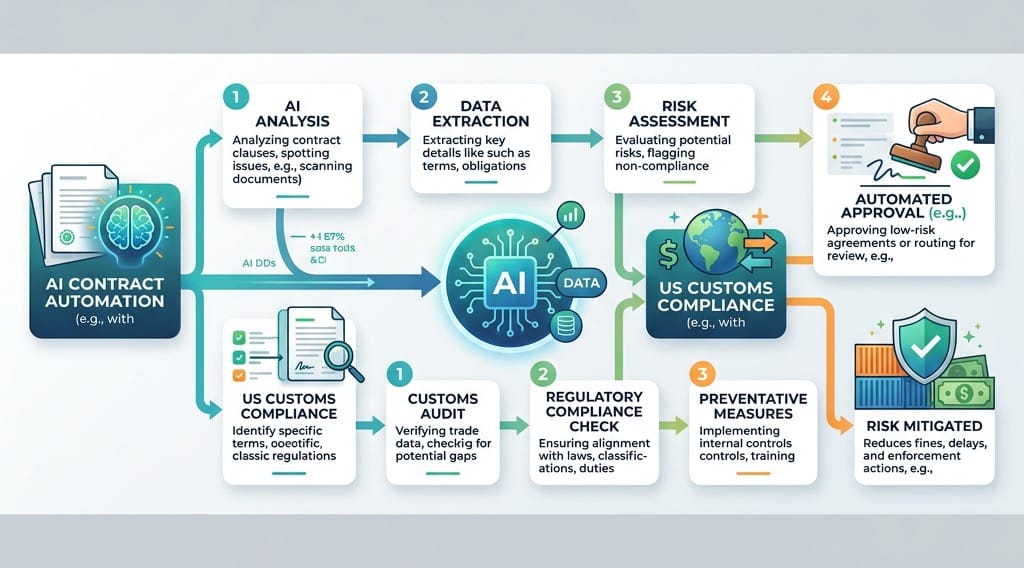
The News: On June 17, Ironclad announced a deep, bidirectional AI-to-AI integration with Legora. This partnership allows legal intelligence generated by Legora to automatically trigger and execute contract workflows within Ironclad. The Impact for SMEs: Contract management is no longer just about storage; it’s about active intelligence. For SMEs, this means the barrier to automating complex legal workflows is dropping. Routine contract approvals and compliance checks that previously required manual legal review can now be handled by communicating AI agents, significantly reducing legal overhead and deal cycle times.
2. Clio’s Massive AI Upskilling Push and Jurisage Acquisition
The News: Clio has launched the “Legal AI Accelerator,” an ambitious program aiming to train 25,000 legal professionals on AI by ClioCon 2026. Simultaneously, Clio acquired Jurisage, a Canadian legal AI and data company, to enhance its Canadian legal data capabilities. The Impact for SMEs: This signals a permanent shift in how legal services will be delivered. As tens of thousands of lawyers become AI-fluent, SMEs should expect—and demand—faster turnaround times and more predictable pricing from their outside counsel. The acquisition of Jurisage also indicates that Canadian-specific AI models will become much more sophisticated, improving local compliance tools.
3. Stricter U.S. Customs Enforcement and Tech Blacklists
The News: Amidst ongoing “selective decoupling” between the U.S. and China, the U.S. government issued a June 2026 executive order directing Customs and Border Protection (CBP) to aggressively prioritize the enforcement of trade laws and import revenue collection. Additionally, the DoD expanded its “Chinese Military Companies” blacklist. The Impact for SMEs: Cross-border businesses must immediately audit their supply chains. Stricter CBP enforcement means a higher risk of cargo seizures or unexpected tariffs at the border. SMEs must ensure their supplier agreements contain robust indemnity clauses and strict requirements for origin-tracing documentation to avoid being caught in geopolitical crossfire.
4. CCDC Updates Canadian Design-Build Contract Suites
The News: On June 18, the Canadian Construction Documents Committee (CCDC) released updated versions of its design-build contract suite, including CCDC 14 (2026) and a new CCDC 32 (2026) for progressive design-build projects, altering the allocation of design risk. The Impact for SMEs: For any SME involved in the Canadian construction or real estate sector, these new standard forms require immediate review. The shifting of design risk and new definitions like “Ready-for-Takeover” mean that relying on outdated contract templates could leave your business exposed to significant liability if a project goes off track.
EqualDocs — Your Digital General Counsel. Global Compliance. Instant Expertise.