Google Cloud Launches Gemini Enterprise for Legal, LexisNexis Upgrades AI Engine: Why the Legal AI Gold Rush Still Leaves SMEs Behind

August 28, 2026
The legal tech landscape is undergoing a massive structural shift as tech giants and venture capitalists race to build the next generation of “agentic” legal platforms. This week, Google Cloud officially debuted Gemini Enterprise for Legal, a purpose-built AI workspace integrated with major legal databases like iManage and NetDocuments. At the same time, LexisNexis rebranded its flagship assistant into the Legal Intelligence Engine, deploying an “orchestration layer” to coordinate multiple AI agents. Even startup accelerators are shifting focus, with Y Combinator accepting Erinys—an AI-native, turnkey plaintiff-side law firm network—into its Summer 2026 cohort.
Yet, as billions of dollars flow into legal AI systems designed for elite law firms, a critical question remains: How does this help the millions of small and medium-sized enterprises (SMEs) that cannot afford traditional counsel?
The short answer is: It doesn’t. Under the current trajectory, the legal AI boom is widening the gap between massive corporations and everyone else.
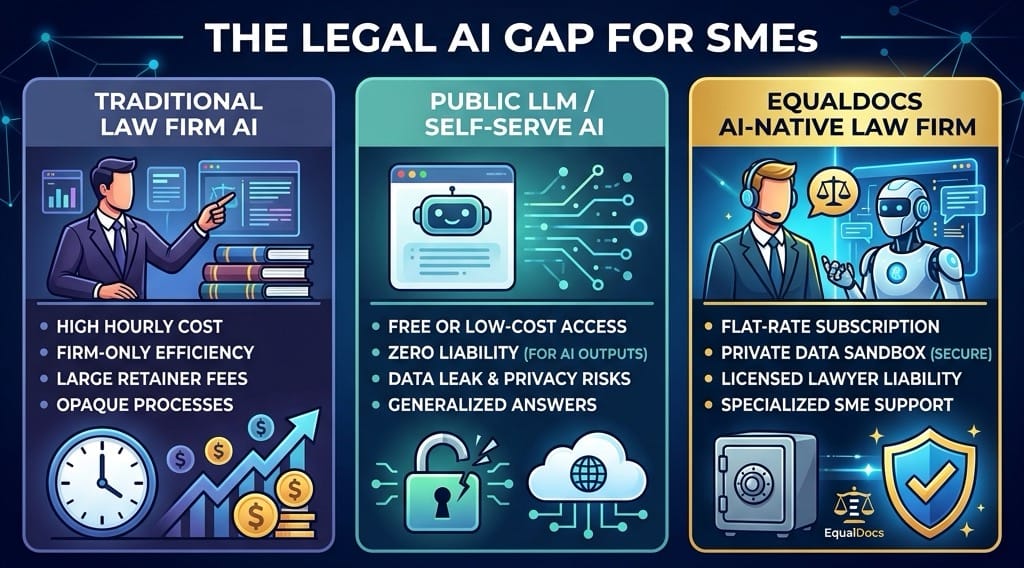
The Am Law 100 AI Boom: Boosting Lawyer Margins, Not Lowering SME Bills
Google Cloud’s launch of Gemini Enterprise for Legal features integrations with elite Am Law firms like Cleary Gottlieb, Freshfields, and Weil Gotshal. Similarly, LexisNexis’s Legal Intelligence Engine is designed to sit inside corporate legal departments and massive law practices.
These tools are incredibly powerful. They allow a lawyer to draft a complex cross-border joint venture agreement or review a hundred-page master services agreement (MSA) in minutes rather than hours.
However, because traditional law firms bill by the hour—often charging between 1,000+ per hour—the efficiency gains of AI do not translate into cheaper bills for the client. Instead, firms use automated time-tracking tools to bill for every prompt, review, and verification. The result? Traditional firms use AI to dramatically boost their profit margins, while the small business client still gets hit with the same four-figure invoice.
For a startup founder, an e-commerce exporter, or a local property owner, the cost of standard contract drafting and regulatory compliance remains prohibitively high.
The AI Sandbox Shift: “Firm-as-a-Product” vs. Software Tools
Venture capital is beginning to recognize that selling software to traditional, slow-moving law firms is not the most efficient way to scale legal services. Y Combinator’s backing of Erinys represents a new paradigm: Firm-as-a-Product.
Erinys is not a SaaS tool sold to lawyers. It is a turnkey, AI-native plaintiff-side litigation law firm network. It provides the technological infrastructure, client intake engines, and operational capital for lawyers to spin up their own practices.
This model proves that the future of law lies in vertically integrated networks where technology drives operations, allowing lawyers to focus solely on legal practice. But while plaintiff-side litigation networks help people file lawsuits more efficiently, they do not solve the day-to-day transaction and compliance needs of businesses trying to prevent lawsuits in the first place.
The Safety Trap of Public AI and Disclaimers
Faced with high lawyer bills, many business owners turn to public LLMs like ChatGPT or generic free contract analyzers. This introduces severe business risks:
- The Liability Vacuum: Every generic AI tool carries a loud disclaimer: “Not legal advice. Use at your own risk.” If the AI misses a critical indemnity clause or hallucinated a liability cap that costs your business thousands, the software company bears zero responsibility.
- Data Leakage: Pasting sensitive commercial drafts, vendor lists, or price sheets into public models often exposes that intellectual property to public model training.
- Model Drift: A model update can silently change how an AI interprets a clause, rendering previous automated reviews unreliable.
The EqualDocs Bridge: Licensed Lawyers, Amplified by AI
This is why we built EqualDocs.
EqualDocs bridges the massive gap between high-priced traditional law firms and self-serve, disclaimer-heavy AI tools. We operate as a licensed Canadian law firm (EqualDocs Avocats inc.) under the regulatory oversight of the Barreau du Québec. We assume professional liability for the work produced in our sandboxed workspaces, backed by professional liability insurance.
- Private AI Sandbox: Your sensitive agreements and data are completely isolated, ensuring your commercial secrets never train public models.
- Licensed Accountability: Unlike software tools that disclaim all liability, our human lawyers supervise and sign off on the AI-generated work, taking full professional responsibility.
- Transparent Flat Rates: We eliminate the hourly bill shock. We offer flat-rate subscription models (Starter Free, Pro at 299/mo) alongside upfront flat quotes for specific contracts and filings.
As Google, LexisNexis, and VC networks rebuild legal technology for elite corporations, EqualDocs remains dedicated to delivering what SMEs actually need: instant, secure, and affordable legal protection backed by real accountability.