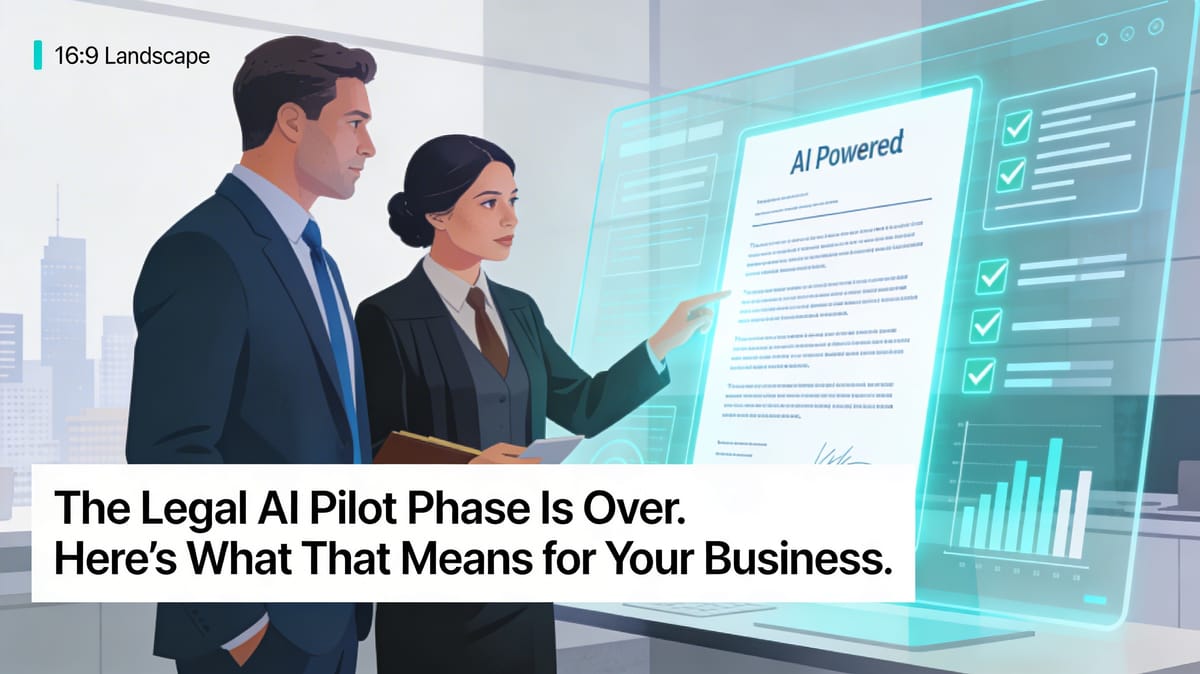
The Legal AI Pilot Phase Is Over. Here’s What That Means for Your Business

By Ningsi Mei, Lawyer & CEO of EqualDocs
For two years, businesses ran AI pilots. They tested tools, measured ROI, and wrote internal reports. That era is over.
In 2026, AI is operational infrastructure — or you’re behind.
What Changed (and It Changed Fast)
The numbers are no longer speculation. Corporate AI adoption in legal nearly doubled in a single year: from 23% to 54%, according to the ACC/Everlaw AI Adoption Survey. That’s not a gradual shift — that’s a market tipping point.
In-house legal teams at large organizations are cutting outside counsel costs and building their own AI capability. Law firms that haven’t automated are losing mandates. And the gap between companies that adopted early and those still evaluating is widening by the quarter.
The businesses that waited are now catching up under pressure — and pressure is a terrible environment for making good technology decisions.
What This Means for SMBs Specifically
Enterprise legal is moving fast. But here’s what gets overlooked: the downstream effect on small and mid-sized businesses is just as significant.
First, legal costs are shifting. As law firms automate more work, their pricing models are changing. Hourly rates are holding steady — but the volume of work they’re willing to take on at those rates for smaller clients is shrinking. More firms are pushing SMB clients toward self-service or AI-assisted options. The era of affordable hourly legal help for routine business contracts is quietly ending.
Second, DIY legal is more viable than ever — but only with the right tools. Not all AI legal tools are equal. The ones built for US markets don’t understand Canadian contract law. The ones built for large enterprises charge enterprise pricing. And the ones that are just “AI with a legal prompt” can produce contracts that look right but miss critical jurisdiction-specific requirements.
Third, Canadian AI regulations now apply directly to SMBs. As of 2025–2026, Canadian businesses using AI for document generation, HR screening, or customer-facing contracts are operating in a regulated environment. The compliance expectation is real — and “I used a free AI tool and didn’t know” is not a defence.
The Founder Perspective
I built EqualDocs because I saw this shift coming from inside law.
For a decade, I watched both sides of the same transaction: large companies with legal teams who could negotiate every clause, and small business owners who signed whatever was put in front of them because they couldn’t afford to do anything else. The power imbalance was structural. And no one was building tools to fix it.
EqualDocs isn’t just an AI that drafts contracts. It’s a platform where both parties can work together — drafting, reviewing, proposing edits, and signing in one place. The goal is to give both sides equal standing. Not just the one that can afford a lawyer.
Equal rights to every contract. That’s not a tagline. It’s the design principle.
What You Should Do Right Now
If your business is still using contract templates downloaded from the internet, or a general-purpose AI tool that wasn’t built for legal work, this is the moment to change that.
Ask yourself three questions:
- Does the tool you’re using understand Canadian contract law — not just generic legal language?
- Can you explain what the AI did with your data and how it reached each clause?
- Would you bet your business on the contracts it produces?
If any of those answers are uncertain, you have a gap worth closing.
The pilot phase is over. The businesses that move from “trying AI” to “running on AI” in the next 12 months will have a structural advantage — in speed, in cost, and in risk management — that compounds every year.
Try EqualDocs free — no credit card required. ▶️ equaldocs.com
Sources: ACC/Everlaw AI Adoption Survey 2025; Gartner CLM Report 2025; Onley Law AI Regulation Brief, February 2026