Texas, Colorado, California, EU: Is Your Legal AI Compliant?

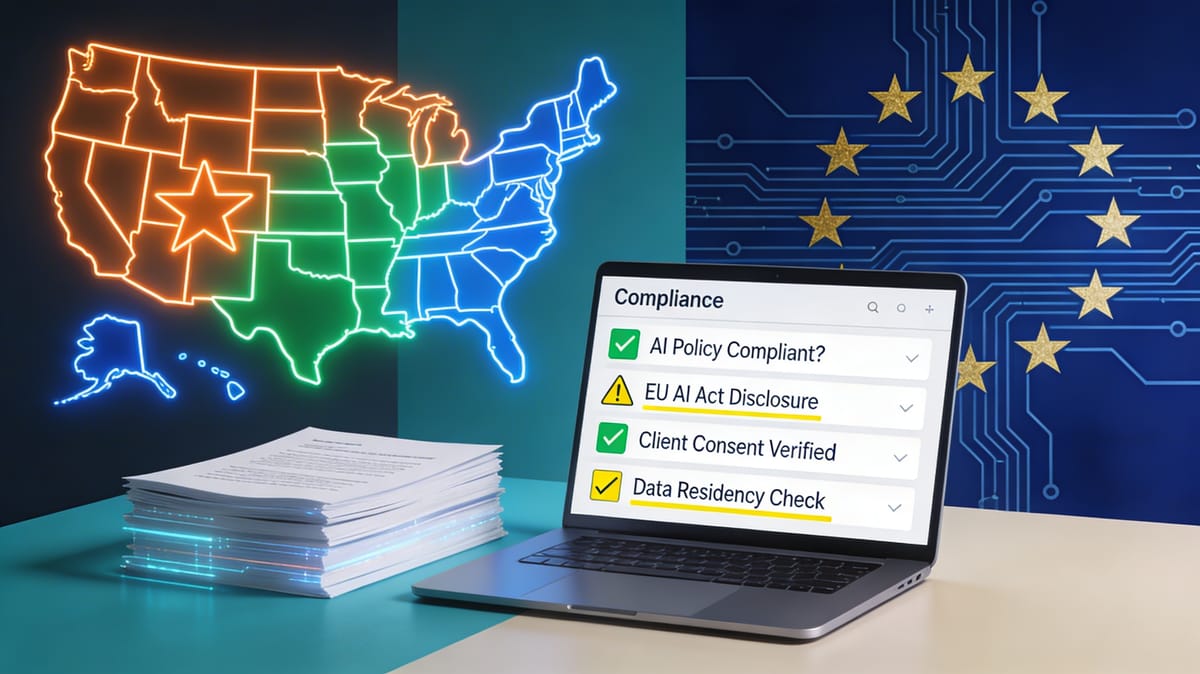
A 3-question checklist every business using AI for contracts needs to read right now.
The regulatory moment nobody saw coming — until it arrived all at once.
At the start of 2025, most small business owners I spoke to were asking: “Should we be using AI for our contracts?”
By the start of 2026, the question has changed. It’s now: “Are we using AI for our contracts in a way that could get us in trouble?”
That’s not a rhetorical shift. It’s a legal one.
In the span of fourteen months, five major AI compliance frameworks have either come into force or moved to within weeks of enforcement:
• Texas TRAIGA — effective January 1, 2026• California AB 2013 + SB 942 + SB 53 — effective January 1, 2026• Colorado CAIA (SB 24-205) — effective June 30, 2026• EU AI Act (high-risk provisions) — effective August 2, 2026• Quebec Law 25 — fully in force since September 2024
Jurisdiction | Key Law(s) | In Force | Penalty Ceiling |
Texas | TRAIGA (HB 149) | Jan 1, 2026 ✅ | $200K/violation |
Colorado | SB 24-205 (CAIA) | Jun 30, 2026 ⏳ | $20K/violation |
California | AB 2013 · SB 942 · SB 53 | Jan 1, 2026 ✅ | $1M/violation (SB 53) |
European Union | EU AI Act | Aug 2, 2026 ⏳ | €35M or 7% turnover |
Quebec, Canada | Law 25 | Sep 2024 ✅ | 4% global revenue |
If you use AI to help draft, review, or manage contracts — and you interact with customers, employees, or counterparties in any of these jurisdictions — you are within scope of at least one of these laws. Possibly several.
I’m a lawyer. I built EqualDocs because legal services were too slow and too expensive for the businesses that need them most. And I’ll be honest with you: the new AI regulations are not simple. Some of them are genuinely hard to parse. Much of the implementation guidance hasn’t been published yet.
But across all five frameworks, there are three foundational questions that cut through the complexity. If you can answer yes to all three, you’re building on solid ground. If you can’t, you’ve found your compliance gap.
Three questions. Every business using AI for legal documents needs clear answers to all of them.
1 | Can you produce a complete audit trail for every AI-assisted document decision? |
Why this question matters
The Colorado AI Act (effective June 30, 2026) requires deployers of high-risk AI systems to maintain detailed records of impact assessments, system usage logs, and any decisions made using AI — for a minimum of three years. The Colorado Attorney General can demand these records within 90 days of a request.
Texas TRAIGA (already in effect) provides affirmative defenses for businesses that can demonstrate adherence to recognized AI risk management frameworks like NIST — but only if they have the documentation to prove it.
The EU AI Act classifies AI used in legal services and administration of justice as high-risk, requiring technical documentation, usage logs, and conformity assessments. Penalties reach €15 million or 3% of global turnover. Extraterritorial reach applies: if any counterparty or customer is based in the EU, your system is in scope.
In practice, this means: if an AI tool helped generate a contract clause that later becomes the subject of a dispute or regulatory inquiry, you need to be able to show exactly what system was used, what version it was, and what decisions it made or suggested. “I used ChatGPT” is not a compliance record.
Ask yourself: When your AI generates or suggests contract language, does the tool log: • Which AI model or version was used? • What input you provided? • What output it generated? • Who reviewed and accepted or modified the output? • When each of these events happened?
If the answer is no — or "I don't know" — that’s a compliance gap. |
What EqualDocs does: Every contract created or reviewed in EqualDocs carries a complete version history and activity log — who drafted it, what the AI suggested, what was changed, who reviewed, who signed, and when. Your documents are stored in your account, not scattered across chat threads. If a regulator or a counterparty ever asks for a record, it exists.
2 | Is a human genuinely in the loop — or just technically available? |
Why this question matters
Every major AI law passed in 2025–2026 includes some form of human oversight requirement. But the language matters.
Colorado’s AI Act requires that consumers be given the right to appeal consequential decisions and request human review. The EU AI Act mandates “meaningful human oversight” for high-risk AI systems — specifically stating that humans must be able to intervene, correct, and override AI outputs. Quebec’s Law 25 requires notice when automated decisions are made about individuals, and gives individuals the right to request human review.
California’s new automated decision-making rules (ADMT) give California residents the right to opt out of automated processing in certain contexts and to request a human review of any significant decisions. Texas TRAIGA places specific obligations on deployers to prevent reliance on AI systems for decisions that harm consumers.
The practical problem is that most AI tools technically allow human involvement, but the workflow doesn’t actually require it. A user pastes AI-generated contract text directly into an email, hits send, and never looks at what the AI wrote. That is not human oversight. That is a human pressing enter.
"Human in the loop" isn’t a checkbox. It’s a workflow design question.
There’s also a subtler issue. Anthropic’s own documentation for the Claude legal plugin includes a clear disclaimer: all AI-generated output must be reviewed by a licensed attorney before being relied upon. That’s the right and responsible position. But it also means that for businesses without in-house legal counsel — the vast majority of small businesses — generic AI legal plugins create a compliance dependency they may not be equipped to fulfill.
Ask yourself: In your current AI legal document workflow: • Is a human required to review AI-generated language before it’s sent to a counterparty? • Can a counterparty or affected party request human review? • Is there a record of what was reviewed versus what was accepted automatically? • If you operate in Colorado or the EU: can individuals appeal or contest AI-assisted decisions?
If your answer is “we trust our team to read what they copy,” that’s not a compliance program. |
What EqualDocs does: EqualDocs is built as a two-party platform — both sides of a contract are actively engaged, reviewing, commenting, and negotiating. The design makes human involvement structural, not optional. Review steps are visible in the audit trail. Ningsi’s background as a practicing lawyer informs which AI suggestions require careful human attention and which are routine. The platform is built to empower people to make their own decisions, not to automate past them.
3 | Do you actually know where your contract data goes — and who can use it? |
Why this question matters
This is the question most businesses haven’t asked yet. And it’s the one that may carry the highest risk.
Quebec’s Law 25 — fully in force since September 2024 — requires organizations to conduct Privacy Impact Assessments (PIAs) before launching technology projects that process personal information. It requires explicit consent for sensitive data and gives individuals rights over automated decisions that affect them. If your AI contract tool processes any personal information about Quebec residents — including the names and details of parties to a contract — you are within scope.
California’s AB 2013, in force since January 1, 2026, requires AI developers to disclose detailed information about training data — including whether it includes personal information, whether it was licensed, and whether synthetic data was used. This matters for users because it tells you whether the AI tool you’re trusting with your contracts was trained on data that may have included confidential documents.
The EU AI Act requires deployers of high-risk AI to implement data governance measures and verify that training data practices comply with applicable law. It has the same extraterritorial reach as the GDPR: if any party to your contract is in the EU, you’re in scope.
And here’s the uncomfortable truth about many general-purpose AI tools: their default terms of service permit the use of user inputs to improve future models. Your contract draft — the one with the confidentiality clause, the pricing terms, the compensation structure — may be training the next version of the model. That’s a data privacy issue. In Quebec and under the EU AI Act, it’s potentially a legal one.
Ask yourself: For the AI tools you use for contracts: • Do you know where your document data is stored? (Country / data center region?) • Are your documents being used to train or improve any AI models? • Has the tool provider disclosed what training data their AI was built on? • If you have Quebec or EU counterparties: have you conducted a Privacy Impact Assessment? • Can you request deletion of your data, and is there a documented process for doing so?
If you can’t answer these from memory, you probably haven’t read the terms of service. |
What EqualDocs does: EqualDocs does not use your contract data to train AI models. Your documents are your documents. For organizations with strict data sovereignty requirements, EqualDocs has already validated a local-first deployment architecture on NVIDIA DGX Spark — meaning the entire stack can run in your own environment, with zero data leaving your infrastructure. And for Quebec users specifically, our data practices are designed to be consistent with Law 25 requirements.
So what should you actually do right now?
Here’s the honest version: you don’t need to panic, and you don’t need to hire a compliance team. But you do need to be intentional about which AI tools you trust with your legal documents.
If you’re a small business, a startup, or a freelancer — the regulation is designed primarily to govern the AI system providers, not to punish you personally for using a chat tool that doesn’t keep logs. But the downstream risk is real: if a contract dispute arises, or a counterparty raises a data protection complaint, you want to be on the side of “we used a purpose-built, accountable platform” — not “we used a general AI assistant and hoped for the best.”
A few concrete steps you can take today:
• Audit which AI tools are currently touching your contract workflow and review their data terms• Check whether any of your counterparties, employees, or customers are based in Texas, Colorado, California, the EU, or Quebec — if yes, you have jurisdictional exposure now• Make sure your AI contract tool creates logs and version history you can access and export• Ask your AI vendor directly: do you use my documents to train your models? What data residency options do you offer?• If you’re in Quebec: review whether a Privacy Impact Assessment is required for your use of AI in contract management
The bottom line
I built EqualDocs because I watched small businesses sign agreements they didn’t understand, using tools that weren’t built for them.
The new wave of AI laws is, at its core, about accountability. Who is responsible for what an AI system does? Who keeps the records? Who ensures a human is actually thinking, not just clicking?
Those aren’t just regulatory questions. They’re good business questions. And they’re the questions EqualDocs was designed to answer — for every user, in every contract, at every stage.
The compliance window is open right now. You have time to do this properly. The question is whether you choose a tool that helps you get there, or one that quietly creates the liability you’re trying to avoid.
Try EqualDocs free — no credit card required. equaldocs.com
Sources & Further Reading
Colorado AI Act (SB 24-205) — Colorado General Assembly
Colorado AI Act Compliance Guide 2026 — TrustArc
Texas RAIGA (HB 149) Compliance Overview — King & Spalding
California AB 2013 — Generative AI Training Data Transparency — Crowell & Moring
California SB 53 — Transparency in Frontier AI Act — Pillsbury Law
EU AI Act 2026 — Compliance Requirements and Business Risks — LegalNodes
EU AI Act: 6 Steps to Take Before August 2, 2026 — Orrick
EU AI Act Article 16 — Obligations of Providers of High-Risk AI Systems
Canada Bill C-27 / AIDA — Current Status — ISED Canada
Quebec Law 25 — AI & Automated Decision-Making — Field Law
2026 AI Regulatory Preview — Wilson Sonsini
© EqualDocs 2026


