Shifting Compliance Timelines & The Rise of Fiduciary-Grade AI Agents

June 25, 2026
The gap between having access to AI and generating tangible business value is one of the biggest challenges facing modern organizations. Today’s legal tech and compliance developments highlight how the industry is moving from simple text generation to secure, domain-specific, and agentic solutions that handle complex workflows. For small and medium-sized enterprises (SMEs), these changes offer opportunities to reduce costs and manage risk, provided they implement the right strategic guardrails.
The AI “Value Gap” and the Next Generation of Legal Assistants
Thomson Reuters released its 2026 Future of Professionals Report alongside early access to the next generation of CoCounsel Legal. The survey, covering over 1,800 professionals across 62 countries, reveals a critical gap: while 74% of professionals use AI tools weekly, 91% believe their organizations have yet to realize their full value.
This mismatch creates real operational risks. Without a clear corporate policy, one-third of employees rely on unapproved “shadow AI.” This exposes businesses to security vulnerabilities, potential loss of talent (one in four professionals are considering leaving companies that lag in tech adoption), and client revenue risks. However, organizations with a structured AI strategy are three times more likely to meet or exceed their expectations than those without one.
To address this, the new version of CoCounsel represents a shift from task-based prompt interfaces to a fiduciary-grade agentic platform. Users can describe a legal matter in plain language, and the assistant autonomously drafts a project plan, retrieves authoritative materials from Westlaw and Practical Law, analyzes the legal issues, and outputs structured results with verifiable citations. This transition to grounded, audited agentic workflows sets a new standard for using AI in high-stakes professional work.
Secure Portfolio Management for Fractional General Counsel
As companies increasingly outsource their legal departments, Sapphire Legal has launched a dedicated “Legal Operating System” designed for the fractional General Counsel (GC) market. Developed by a fractional CTO and Chief AI Officer, the platform addresses the operational challenge of managing multiple client portfolios simultaneously without data leakage.
Key features include:
- Private Legal Intelligence: Isolated, private-tenant large language models (LLMs) prevent confidential client data from being used to train public models or bleeding into other clients’ folders.
- Portfolio Command Center: A unified dashboard to organize tasks, track deadlines, and manage client communications, eliminating the friction of using fragmented tools.
- Per-Client Memory: The AI learns the writing voice, preferences, and key priorities of each client organization.
- Automated Client Portals: White-labeled portals provide small business clients with an easy way to upload documents and track legal tasks.
The system is priced at a base rate of $499 per month plus $999 per client firm, a cost that fractional GCs typically pass through to their clients. This structured approach allows freelance legal professionals to scale their capacity while ensuring institutional privacy for the organizations they support.
From Alerts to Action: Automating Legislative Tracking
AI startup Abstract has introduced Abstract Workers, a service that moves beyond simple regulatory monitoring to agentic workflow automation. While the company’s core platform helps government affairs and legal teams findlegislative changes, “Abstract Workers” is designed to help them act on them.
Instead of introducing another dashboard, the service deploys customized AI agents that connect with existing productivity tools like Slack, SharePoint, and Microsoft 365. When a regulatory change is detected, these agents autonomously perform follow-up tasks:
- Analyzing and prioritizing alerts.
- Updating internal compliance trackers.
- Drafting stakeholder newsletters and briefing reports.
- Coordinating next steps across departments.
By managing the setup, testing, and optimization of these agents, the service allows policy and legal teams to automate administrative tasks without needing to write custom code or manage complex AI pipelines.
Shifting Timelines: The EU AI Act Compliance Schedule
On the regulatory front, the European Parliament approved the Digital Omnibus on AI, introducing amendments that delay the enforcement of high-risk obligations under the EU AI Act. This change gives organizations more time to align their systems with European standards.
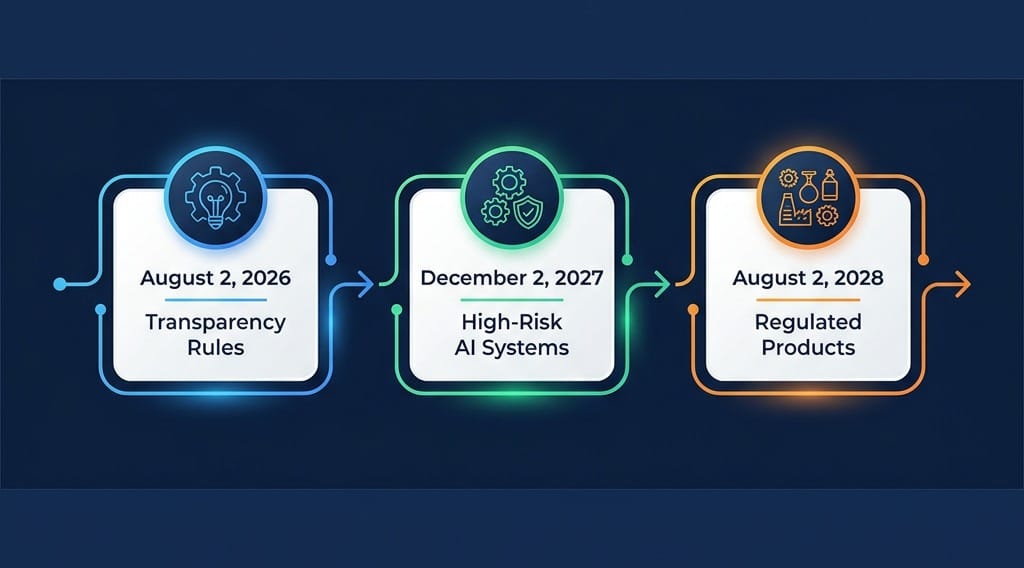
Under the updated schedule, the compliance deadlines are:
- December 2, 2027: For stand-alone high-risk AI systems (Annex III), such as those used in recruitment, credit scoring, or critical infrastructure.
- August 2, 2028: For high-risk AI systems embedded as safety components in regulated products (Annex I).
However, not all requirements are delayed. Article 50 transparency obligations—such as labeling AI-generated content and notifying users when interacting with AI systems—remain active for August 2, 2026. Additionally, the European Commission’s consultation on high-risk classification guidelines has been extended to July 23, 2026, with final guidelines expected by the end of the year.
Key Takeaways for Businesses
- Address Shadow AI: Establish clear internal guidelines on which AI tools are approved for business use and how data must be handled to protect trade secrets and client confidentiality.
- Review Compliance Roadmaps: If your software or systems interact with the European market, ensure your team is ready for the August 2, 2026 transparency mandates, even as high-risk classification audits are deferred.
- Explore Agentic Workflows: Move beyond simple text generation tools. Evaluate agentic software that connects directly with your data sources and automates end-to-end tasks like contract updates or compliance tracking.
For more information on managing your digital general counsel operations and global compliance, visit equaldocs.com.