Common Legal Pitfalls for Startups: Data/Privacy and Commercial Terms — ToS, Privacy Policy, DPAs, GDPR/CCPA Exposure

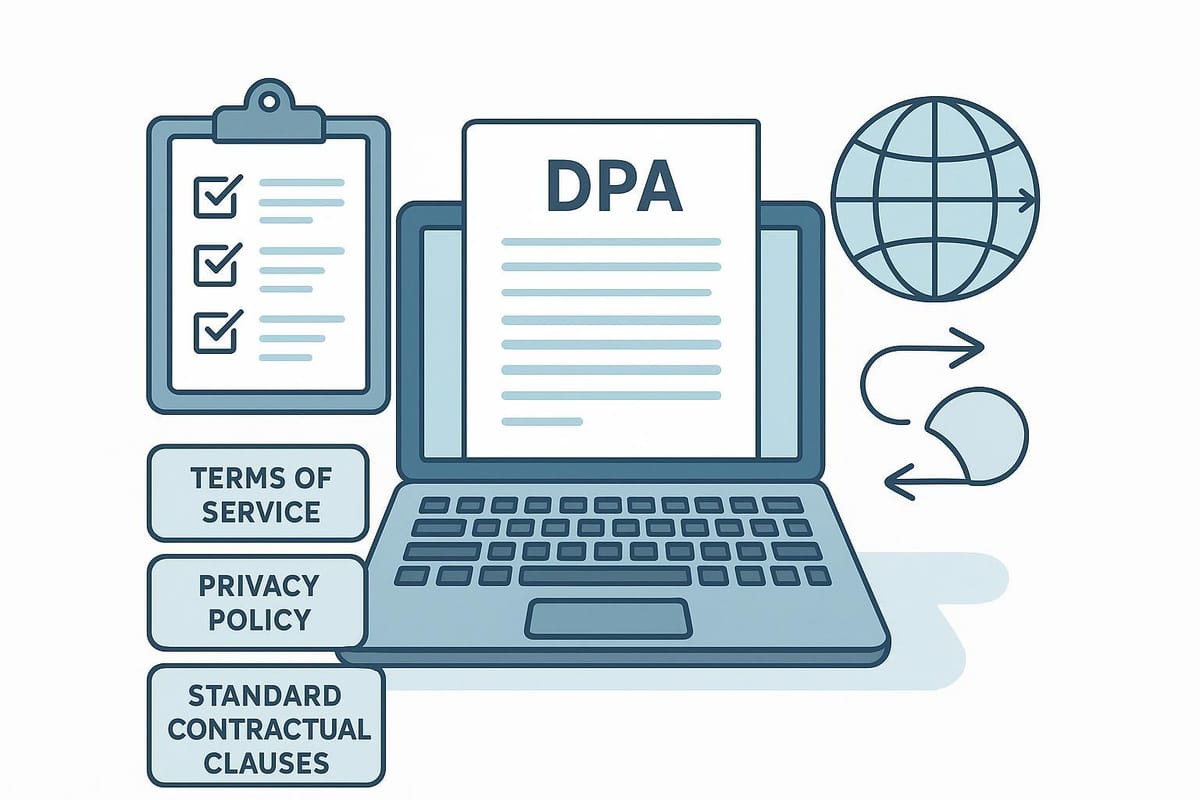
If you’re the first legal hire or solo GC at a growing startup, you’ve got to ship product and sign deals without tripping over privacy landmines. This fast checklist focuses on the highest‑impact data privacy pitfalls startups face in ToS, Privacy Policies, DPAs, and cross‑border transfers—plus quick fixes and where an AI legal assistant can speed the work.
Rapid checklist to avoid data privacy pitfalls startups
- Data inventory and RoPA basics: Confirm systems, data categories, purposes, recipients, and transfer destinations are documented and kept current. Align notices to reality. For transparency elements to cover, see the ICO’s plain‑language guidance on lawfulness, fairness and transparency, which outlines the disclosure building blocks (controller, purposes, lawful bases, recipients, transfers, retention, rights). Refer to the ICO’s page titled A guide to the data protection principles — lawfulness, fairness and transparency and the ICO’s privacy notice generator for practical examples: ICO guidance on transparency and ICO privacy notice generator.
- Red flag: Teams ship features that collect new data types but notices never change.
- AI tie‑in: Use an assistant to summarize systems from contracts/policies and surface missing disclosures for quick edits.
- Legal basis and consent flows: Map each processing purpose to a lawful basis; document legitimate‑interest assessments; confirm consent UI avoids dark patterns. For response timelines and rights handling under GDPR (e.g., DSARs within one month, extendable for complexity), the EDPB explains what “without undue delay” means and how to calculate deadlines: see the EDPB SME FAQ on access request timelines.
- Red flag: “Legitimate interest” is used everywhere with no balancing test.
- AI tie‑in: Generate a one‑page purpose‑to‑basis matrix and LI test prompts to guide stakeholders.
- Cross‑border transfers: Identify EU/UK data recipients outside the EEA/UK. Choose the right Standard Contractual Clauses (SCCs) module and maintain a Transfer Impact Assessment with any supplementary measures. The European Commission’s Implementing Decision (EU) 2021/914 sets the SCC modules and when to use each: EC Implementing Decision on SCCs (2021/914). For transfers to certified U.S. companies, you can also rely on the EU‑US DPF adequacy decision reviewed in 2024: European Commission adequacy decisions hub.
- Red flag: EU personal data flows to a U.S. vendor with no SCCs/DPF coverage or TIA.
- AI tie‑in: Create a TIA checklist and draft follow‑up questions for vendors.
- Vendor DPAs and subprocessor control: Ensure your processors sign DPAs meeting GDPR Article 28(3) duties: documented instructions, confidentiality, security, subprocessor approval/notice, assistance with rights, DPIAs and breaches, deletion/return, and audits. See the ICO contracts/accountability toolkit summary and EDPB Opinion 22/2024 on reliance on processors/sub‑processors.
- Red flag: Vendor can add subprocessors at will and never notify you.
- AI tie‑in: Auto‑scan uploaded DPAs to flag missing Art. 28(3) clauses and propose edits.
- CPRA service provider/contractor terms: For California personal information, ensure contracts restrict use to specified purposes, require equivalent protections, provide rights‑assistance, and permit audits/cooperation. The California Privacy Protection Agency posts the effective statutory text and regulations, including service provider/contractor contract requirements: CCPA/CPRA statute (effective 2026) on the CPPA site and the California Attorney General’s CCPA overview.
- Red flag: A “service provider” may reuse data for unrelated analytics or ads.
- AI tie‑in: Draft a redline converting a generic “vendor” to CPRA‑compliant service provider language.
- Privacy notices and user choices: Use layered, plain‑English notices and reflect international transfers, retention, and rights. The ICO tools show how to present clear disclosures and route users to exercise rights: ICO guidance on transparency.
- Red flag: Opaque “improvement” or “training” rights that contradict public promises.
- AI tie‑in: Compare ToS/Privacy Policy commitments to contract clauses to catch inconsistencies.
- Security, breaches, and timelines: Confirm incident playbooks meet EU/UK and U.S. state expectations. Under GDPR, notify the authority within 72 hours where risk to individuals is likely; document decisions. See the EDPB SME guidance on data breaches and the ICO breach reporting guide.
- Red flag: No 72‑hour triage path; vendors notify late or not at all.
- AI tie‑in: Pre‑draft regulator/customer notices from a structured incident template.
- AI/ML data use: Honor your commitments on training/improvement; don’t quietly expand purposes. The U.S. FTC has warned companies not to make deceptive AI claims and to respect stated retention/minimization policies; see FTC technology policy resources and the FTC press release on deceptive AI claims crackdown (2024).
- Red flag: Retroactive ToS updates that broaden data use without clear notice/choice.
- AI tie‑in: Generate a concise disclosure block and change‑log entry for policy updates.
Mini scenarios Solo GCs face
- A sales‑pushed DPA arrives “as‑is.” Red flags: no subprocessor notice or audit rights; breach notice only “without undue delay.” Next steps: request prior authorization + 30‑day change notice; set a 24–48‑hour breach SLA to avoid classic data privacy pitfalls startups encounter in vendor management.
- EU telemetry goes to a U.S. analytics tool. Red flags: no SCCs or DPF certification; no TIA on file. Next steps: add SCCs (right module) or confirm DPF; run and file a TIA with any supplementary controls.
- Privacy Policy promises “no training on customer content,” but ToS reserves broad “improvement” rights. Red flags: mismatch invites deception risk; no opt‑out path. Next steps: align commitments; add a clear training disclosure and choice consistent with stated policy.
- DSAR volume spikes after launch. Red flags: unclear verification steps; missed one‑month GDPR deadline or CPRA 45‑day window. Next steps: publish a simple request flow; template replies; log extensions with reasons.
Copy‑paste micro‑templates
- DPA purpose/scope: “Processor shall process Personal Data only on documented instructions from Controller, for the purpose of [purpose], for the duration of [term], regarding [data categories] and [data subjects].”
- Subprocessor notice: “Processor shall not appoint a Subprocessor without prior written authorization and shall notify Controller at least [X] days before any change, providing an opportunity to object.”
- Breach notice: “Processor shall notify Controller without undue delay and no later than [24/48] hours after becoming aware of a Personal Data Breach, including details sufficient for Article 33 assessments.”
- Data return/deletion: “Upon termination, Processor shall, at Controller’s choice, return all Personal Data or securely delete it, unless retention is required by law, and shall certify deletion.”
- CPRA SP/Contractor: “Service Provider shall not retain, use, or disclose Personal Information for any purpose other than the limited and specified purposes in this Agreement and shall assist Business in responding to verifiable consumer requests.”
- AI training disclosure (Privacy Policy): “We do not use customer‑uploaded content to train generalized AI models. If we use anonymized data to improve functionality, we describe those uses and your choices in this section.”
Practical example using an AI legal assistant
Here’s how a neutral workflow with an AI legal assistant can help you move faster without skipping steps. You upload a vendor’s DPA and related order form. The assistant parses roles and data flows, then highlights missing GDPR Article 28(3) elements: no subprocessor authorization or notice window, ambiguous deletion/return duties, and a breach notice timing that lacks a concrete SLA. It also spots a cross‑border transfer with no SCCs referenced. From these findings, it drafts short remediation language aligned to the risk: a prior‑authorization clause with 30‑day change notice, a 24‑hour breach notice commitment plus content requirements, and a termination‑return/delete clause with certification. It suggests adding the correct SCC module with a prompt to initiate a TIA and log the decision. You review, edit, and send a focused redline to the vendor. Once terms are resolved, you finalize with e‑signature. Tools like EqualDocs can streamline this specific flow by automating clause detection and proposing neutral, review‑ready snippets you can negotiate—helping avoid recurring data privacy pitfalls startups face in DPA reviews.
When to call counsel
Escalate if a regulator contacts you or requests information about transfers, notices, or incidents.
Escalate if a vendor refuses Article 28(3) essentials (subprocessor approval, audits, deletion/return) or CPRA service‑provider terms.
Escalate if cross‑border flows are high‑risk or involve sensitive data and supplementary measures are unclear.
Escalate if a material incident occurs and you’re unsure whether 72‑hour notification or consumer notice is triggered.
—
One last nudge: If this checklist surfaced gaps, pick one system today and close the loop on its notice, DPA, and transfer file—then rinse and repeat.