Claude’s New Legal AI Plugins Tank Legal Software Stocks

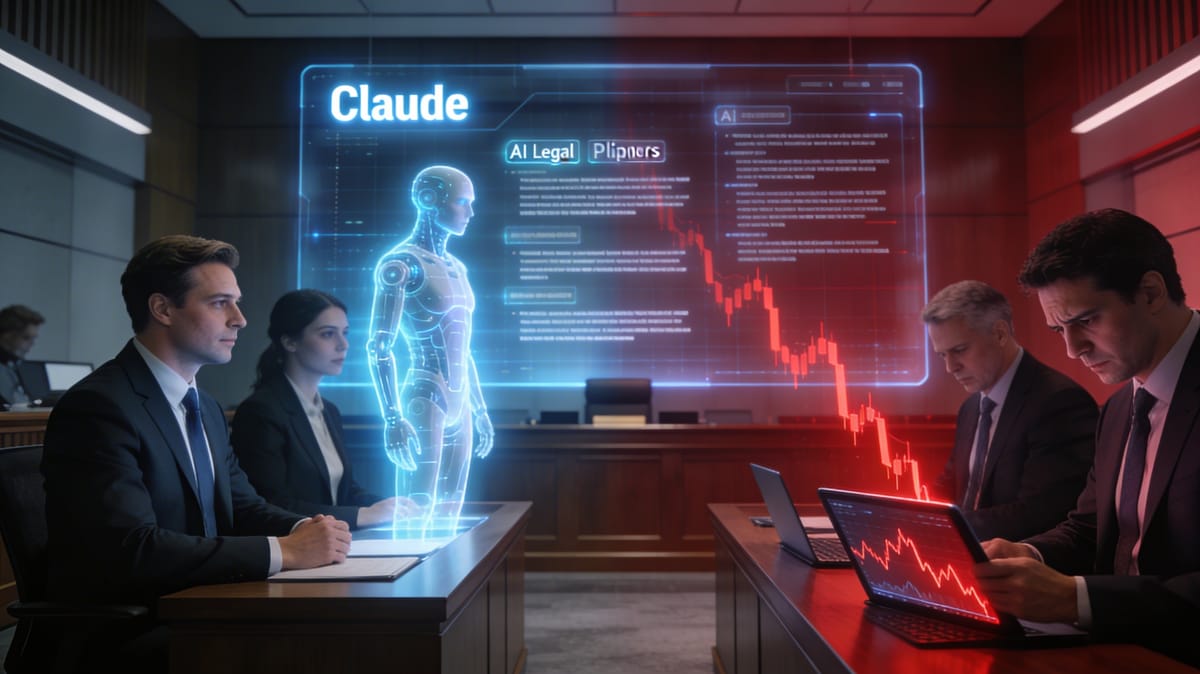
On February 3rd, the legal tech world had a bad day.
On February 3, 2026, Anthropic released a legal plugin for Claude Cowork — the company’s no-code agentic AI platform. The plugin targets tasks like contract review, NDA triage, risk flagging, compliance tracking, and templated legal responses.
The market reaction was immediate and brutal. Thomson Reuters fell 15.83% — its biggest single-day drop on record. RELX posted its steepest fall since 1988, down 14%. Wolters Kluwer dropped 13%. LegalZoom sank nearly 20%. Jefferies Group coined a phrase for it: the “SaaSpocalypse.”
More than $50 billion in market value was wiped from legal tech stocks in 48 hours.
If you’re an EqualDocs user, you probably saw the headlines. You might have wondered: should I be worried about this?
Short answer: no. Long answer: this is actually good news for you.
3-Let me explain what really happened — and why the story the stock market is telling is not the story that matters for your business.
What did Anthropic actually build?
The Claude legal plugin is one of eleven vertical-specific plugins Anthropic released alongside Cowork. In practical terms, it’s a structured layer of workflow maps and system prompts built on top of Claude’s existing language model — not a new AI model, and not a new legal research database.
It can help legal teams:
• Triage and summarize NDAs• Flag risk clauses in contracts• Draft templated legal responses• Track compliance obligations• Produce legal briefings from uploaded documents
It is explicitly open source. Anthropic’s own documentation states that the tool assists with legal workflows but does not provide legal advice — and that all AI-generated output must be reviewed by a licensed attorney before being relied upon.
That last line matters more than people are giving it credit for.
Who actually panicked, and why?
The companies whose stocks crashed are not companies you’ve ever used, unless you work at a law firm or a large enterprise legal department.
Thomson Reuters sells Westlaw — a legal research database used by lawyers at major law firms, priced at thousands of dollars per user per year. RELX owns LexisNexis, same story. Wolters Kluwer sells compliance and regulatory software to banks, insurance companies, and large enterprises. These are the “content moats” of legacy legal tech: decades of curated legal data, maintained by teams of attorney editors, sold to institutional buyers.
Anthropic’s legal plugin does none of what Westlaw or LexisNexis does. It does not provide authoritative legal research. It cannot cite case law. It has no access to proprietary legal databases. Analysts at William Blair called the selloff “overdone,” noting that the plugin has nothing to do with legal research, which is the core value of TR’s and RELX’s businesses.
Thomson Reuters CEO Steve Hasker agreed: the plunge “represents anxiety, not fundamentals.”
The companies that dropped are enterprise legal data providers. EqualDocs never competed with them in the first place.
So why did the stocks fall so hard? Because investors are pattern-matching to a broader fear: that general-purpose AI will commoditize every specialized software category. That fear may be directionally correct over a very long time horizon. But it misreads who is actually at risk right now, and who isn’t.
The gap in the narrative: enterprise legal teams vs. everyone else
Here is the question the market forgot to ask: who is the Claude legal plugin actually built for?
The answer is in the features. NDA triage. Risk flagging for compliance teams. Integration with Slack, Box, Jira, and Microsoft 365. An enterprise AI deployment model where everything runs through Anthropic’s cloud — or for sensitive organizations, through a local-first architecture.
This is a tool designed for in-house legal teams at large corporations. Fortune 500 companies with dedicated general counsels. Mid-size enterprises that already have legal staff but want to move faster. Organizations large enough to care about Anthropic’s MCP (Model Context Protocol) infrastructure integrations.
Now think about the EqualDocs user.
You’re a founder in Montreal running a 12-person startup. You need an NDA before tomorrow’s partner meeting. You’re a landlord with three properties and you need a lease renewal drafted tonight. You’re an HR manager at a growing company and your top candidate just got a competing offer — you need a compliant offer letter in the next hour. You’re a freelancer closing your first commercial contract and you have no idea what clauses to watch out for.
You don’t have an in-house legal team. You don’t have a Westlaw subscription. You have never heard of Thomson Reuters.
EqualDocs was built specifically for you.
Why this changes nothing for EqualDocs users
Let me be concrete about the five reasons the Anthropic legal plugin is not a threat to your EqualDocs experience:
1. It still requires a lawyer.
Every Anthropic document about the legal plugin includes this disclaimer: AI-generated output must be reviewed by a licensed attorney before being relied upon. That’s the right and responsible thing to say. But it means the plugin is best suited for organizations that already have legal counsel on staff. EqualDocs is designed to help SMEs handle everyday contracts — offer letters, leases, service agreements, NDAs — without needing a lawyer for every document. You remain in control. The AI helps you draft and review clearly, and Ningsi’s background as a practicing lawyer is baked into the product logic.
2. A plugin is not a platform.
The Claude legal plugin is a workflow layer on top of a general AI model. EqualDocs is a complete contract lifecycle platform: draft, review, negotiate, e-sign, and archive — all in one place, with both parties in the loop. When your counterparty needs to sign, comment, or negotiate, they can do it directly in EqualDocs. A plugin on a user’s AI assistant doesn’t solve the collaboration problem. Your contract still needs a home.
3. Multilingual support isn’t optional here.
EqualDocs serves English, French, and Chinese-speaking communities in Canada and beyond. The Claude legal plugin is a generalist English-language tool. If you’re drafting a lease in Québec, or negotiating a commercial agreement with a Mandarin-speaking partner, you need a tool that understands that context. EqualDocs does.
4. Data privacy matters more as AI goes mainstream.
As AI handles more sensitive documents, the question of where your data goes becomes more urgent, not less. EqualDocs has already validated a local-first deployment architecture on NVIDIA DGX Spark, meaning enterprise and privacy-sensitive customers can run the entire EqualDocs stack without data ever leaving their own environment. The Anthropic cloud plugin doesn’t offer that.
5. The SME market just got less crowded at the top.
As Anthropic, Thomson Reuters, LexisNexis, and Harvey fight over enterprise legal teams, the SME segment — which was already underserved — becomes even less of a priority for them. That’s not a problem for EqualDocs users. That’s an opportunity.
What this actually means for the industry
I’ve been a lawyer for over ten years. I’ve watched the legal tech industry make the same mistake repeatedly: build for law firms, ignore everyone else.
Anthropic’s move into legal AI does something important: it validates the thesis that AI-native legal tooling is not a niche, not a gimmick, and not the future — it’s the present. When one of the most respected AI companies in the world ships a vertical-specific legal plugin, the conversation about “can AI really do legal work?” is over.
That’s good for everyone who builds in this space. Including us.
What’s interesting is where the real disruption is happening. Harvey — the legal AI startup valued at $8 billion — is now squeezed on two sides: legacy incumbents with proprietary content moats, and Anthropic with a free, open-source plugin that does what Harvey charges for. Harvey’s response has been to partner with LexisNexis, adding authoritative content to its stack — an acknowledgement that foundation model capability alone isn’t a moat.
Meanwhile, nobody is building for the founder who needs an NDA today. Nobody is building for the landlord in Laval who wants to send a lease without paying $500 in legal fees. Nobody is building for the freelancer who doesn’t know what “indemnification” means but knows they don’t want to be liable for it.
The market is consolidating at the enterprise tier. The SME market is wide open. That’s exactly where EqualDocs is.
The bottom line
When I started EqualDocs, I didn’t set out to compete with Westlaw or Harvey. I set out to solve a problem I saw as a lawyer every day: small businesses signing agreements they didn’t fully understand, or skipping agreements altogether because legal help was too slow or too expensive.
That problem hasn’t changed. If anything, it’s more visible now that AI has made everyone acutely aware of what’s possible.
The companies that dropped on February 3 are the ones that built expensive, gated systems for powerful institutions. The stocks that dropped are the ones that are most exposed to a world where AI commoditizes legal workflows.
EqualDocs was never that. We built for the people those institutions ignored.
If you’re an EqualDocs user, the Anthropic news is a signal that the direction we’re all moving in — AI-powered legal tools for everyday use — is right. The question is just who is building it for you, specifically.
We are.
Try EqualDocs free at equaldocs.com. No credit card required.
Sources
Anthropic Moves Into Legal Tech — Artificial Lawyer
Anthropic Releases Legal Plugin for Claude Cowork — Law.com
Anthropic’s Legal Plugin Triggers ‘SaaSpocalypse’ — LawFuel
Thomson Reuters CEO Says Plunge Driven by Anxiety, Not Fundamentals — Globe and Mail
Anthropic’s New AI Tool Sends Shudders Through Software Stocks — CNN Business
Thomson Reuters, RELX, Wolters Stocks Crushed — Morningstar
LexisNexis Embraces Anthropic Claude Cowork Legal Plugin — Artificial Lawyer
Claude Cowork Legal Plugin: One Month On — Legal.io
AI Fears Pummel Software Stocks: Is It Panic or a SaaS Apocalypse? — CNBC
The Legal AI Split That Will Reshape Every Law Firm’s Tech Stack — LawFuel
© EqualDocs 2026